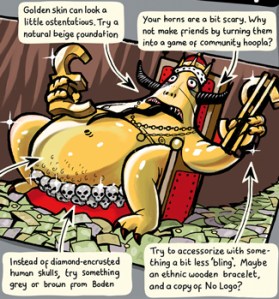
It’s characteristic of modern and post- modern societies to have sympathy for the Devil. There’s no evidence for such a thing in medieval society, where the power and destructiveness of the Prince of evil is off-limits, except to the damned. In the early modern era Christopher Marlowe created a sympathetic but terrible Mephistopheles in his Faustus, as Goethe also did,albeit in a different way, in his  Faust 200 years later. In my own time sympathy for the Devil and for his followers is common. Although the span of my life has contained numerous appalling examples of the power of evil, from Hitler to ISIL, our culture has moved away from any serious philosophy of good and evil towards a view that these absolute categories are not very helpful in preventing evil actions. Something less ambitious, capable of seeing some wrongness in even the best people and some good even in the worst, with a corresponding lack of conviction about the value of punishment, has been more common

Mephistopheles by Mark Antokolski

In this culture the idea of a punishing God makes no sense. If there is a God, which many doubt, then surely he/she is responsible for everything including the evil and has no right to punish. God’s love is emphasised by theologians at the expense of his judgement. Punishment of evil however was one of the ways in which people imagined God taking responsibility for his flawed creation. Modern theologies often seem to present a well-meaning God who wrings his ineffectual hands while evil continues.

Jesus was quite aware that human beings create their Gods; he himself imagined a Heavenly Father who loved his creation, yet punished those who worked against his wish to perfect it. Jesus’ teaching about punishment is probably the most direct and extreme in the bible. Again and again he sets out his view of God’s rescuing justice, and goes on to imagine his punishment of those who oppose it. God’s commandment is clear and strict; those who have disobeyed it can find forgiveness and turn their lives around but those who never turn are warned they are heading  for hell. Fire, darkness and separation from all good are included in Jesus’ imagining of God’s judgement. Death is the cut-off point. The rich man who ignores the poor man at his gate gets off with it in life but in death he is punished apparently without mercy. Those who have done nothing for the least important of their brothers and sisters, are permitted not to do so in this present age, but in the time of the great judgement they are cast into outer darkness, apparently without promise of parole.

Jesus never luxuriates in this sort of scenario, but simply mentions it as if were a thing that all should know. Of course he is talking in picture language about God, but the picture itself is clear: believing in the God of Jesus means believing in clear commandments, with rewards for obedience and penalties for disobedience. This may seem extreme to people who want to be more forgiving towards human evil than Jesus was.

The rich man in hell, Lazarus with Abraham

I happen to imagine, that the purpose of God’s punishments is restoration. They are designed to burn out the evil from human souls, as they are in Dante’s Purgatory. Like Dante however I also believe that there are those who will continue to refuse all goodness and may be headed for what the book of Revelation calls the second death, that is utter extinction.

But about Jesus saving us? I’m sure he wants to rescue us from evil and that God’s love in him can enable us to turn our lives around. But I don’t think he rescues us from the consequences of our wrongness, either in this world or the next, and there’s no evidence that Jesus thought differently.

I see our beloved PM has been preaching again about opposing extremism and strengthening British values. In particular he seems agitated about “extremist narratives” by which he means any historical narrative about the UK which doesn’t sound like one of Uncle David’s bedtime stories, in which the UK is always Mr. Wonderful, bringing peace and sanity to a troubled world.

Pontius Pilatus
Pontius Pilatus

My guess is that almost all imperial powers have told this story about themselves, including the Romans, which has led me to the discovery of an alternative  and more accurate account of Jesus’ conversation with Pilate.

Pilate: You can leave us, soldier, I don’t think the Son of God will attack me.

Soldier: Sir!

Pilate: You may be seated.

Jesus: Thank you.

Pilate. Of course we know a deal about you from our spies, but Jesus of…Nazareth? Where is it exactly? I don’t think I’ve had the pleasure of passing through it

J: It’s in Galilee, near the Lake, not far from Capernaum. My family has a builder’s business there. For most of my life I worked in it.

P: Before your eh, radicalisation?

J: I learned a great deal from the Prophet John, called the Dipper.

P: A good and harmless man put to death by your corrupt King.

J: Just so.

P: Perhaps your dislike of Herod sparked your ambition to be a king?

J: I’ve been advocating God’s Rule which doesn’t depend on worldly power.

P: The sort of power on which Rome depends, you mean?

J: Yes.

P: And that’s what leads you to hold secret gatherings of vast crowds in desert places, many of whom think you are the anointed one, the true king of Israel as opposed to filthy Gentiles like us?

J: I have never encouraged that sort of talk…

P: But clearly you haven’t discouraged it much, as we got it from several of your followers…one of whom,a certain Shimon, we know as a member of the so-called Zealots….

J: Ex- member.

P: Of course you would say that. We don’t object to religion however daft it may be, but when religion gets mixed up with anti- Roman propaganda and a doubtful narrative which depicts the Jews as victims and the Romans as oppressors, we know we’re half – way to another Messianic rebellion!

J: Violent words and actions are foreign to God’s way.,

David Cameron
David Cameron

P : Yet one of our men heard you say that you had not come to bring peace, but a sword!

J: I was using a metaphor to  describe the effect of God’s rule on family life.

P: But you did say it knowing that your words would be reported….and how people might understand them. Come on Jesus, you have become a powerful man, with influence over the lives of many people. And you have no respect for Roman values.

Jesus: I haven’t come across any Roman values, but I’m sure if I did I would give them the respect they’re due…

P: It’s that kind of disrespect which has landed you here in my power.

J: I recognise your office, Pontius, but I am not in your power. Do tell me about these Roman values.

P: Your use of my name is impertinent. I am due your respect as the representative of the Roman values of order, law, peace, communication, commerce, art  and philosophy. In our short rule of your country we have improved the whole level of civilisation, especially the infrastructure, like roads. Many of them are now safe for all travellers. We have helped people live a more rational life.

J: As long as they agree that you should be in charge. Don’t you see how this contributes to the common story in these parts that you are a young arrogant power incapable of recognising any civilisation except your own?

P: That’s just the sort of extreme narrative we have to defeat, because angry young men are radicalised by it and turned into the sort of extremist thugs that have made suicidal attacks on our off- duty soldiers. I’m sure you don’t approve of that any more than I do, and I hope that you’ll denounce it along with me.

J: You denounce the petty violence of local people, while you ignore the seven hills of violence on which Rome is built. I, on the other hand have denounced all forms of violence…..

P: How I wish I was back home on one of these hills rather than stuck here dealing with irrational assasins and sons of God!

J: This son of God wishes you well, Pontius, but can’t you see that every time you execute a Zealot or even a son of God, you add another chapter to the story of Rome as an empire of blood?

P: But will you still wish me well, Jesus of Nazareth, when I put you on one of our stakes,as you know I must, for the price of order is unflinching severity.

J: Yes, even then, for the price of justice is unflinching love.

P: Maybe you are more dangerous to Rome than the most violent assasins. I can imagine how your followers will tell your story…..and mine.

J: It’s not fixed in advance, Pontius, you get to write your own part.

P: But I must hold to my duty and my Roman values. Farewell, son of God. Guards!

I’ m sure readers will have views on the question above, but I want to start with another question:

Why did Jesus give so much of his reaching in the form of commands? Of course people who grew up with Bible stories are used to the idea of commandments, but most people associate commands with being children who need told what to do because they can’t yet be trusted to know what is best. In adult day to day life, most people  are rarely issued with a command, unless they are in the armed forces or some other work where lives may be at risk.

Jesus seems to have been in favour of lifting people up rather than bringing them down, so why did he give so many commands. Certainly he grew up in a religious culture which gave a prominent place to the “commands of God” which had been entrusted by God to Moses and the prophets. But lawgivers and prophets always prefaced commandments with ‘This is God’s word’ whereas Jesus simply gave commands on his own authority – ” in the old times they said …..but now I tell you.” His attention was more on the content of the command that on its supposed origin. “This way is good …..follow it!”

SNP CONFERENCE THIS WEEK

This means that when Jesus commands “Love your enemies” he is not giving wise advice about the best life – style. He is speaking as the channel of a long tradition, allowing its collective insight to speak through him, so that he puts his whole being behind its truth and expresses its urgent relevance to his own time. Although he loves his disciples he believes they need the creative pressure of his commandment to keep them on the right track. Jesus knew the capacity of human beings for good and evil. We are not naturally good and therefore need a degree of discipline to keep us decent far less good. Commandments are an instrument of beneficial discipline. We are not to question, but to obey, which of course we will only do if we trust the one who is issuing the command.

I listened to the only question to the triumphant SNP worth asking this week. “When as promised you get responsibility for benefits and income tax in Scotland, will you reverse the Government’s benefit cuts which you are presently denouncing?” Answer? “Well no, not really, because we won’t have control of the whole economy.” Mmmnnn…. …I think I just heard the sound of hypocrisy. Because of course, increasing income tax to increase benefits would be very unpopular even with the SNP’s own supporters. That’s because years of undisputed capitalist propaganda have dinned it into people that they as individuals should be the sole arbiters of what is done with “their own money.” If we as individuals want to help the poor, we can do so, but no government should make us do it by increasing our taxes.

Well I can remember when conservative philosophers accused socialism of believing in the perfectibility of human beings! Now conservatives believe so much in the goodness of human beings that they will leave whole areas of social justice to the whim of individuals. In this matter, I think, knowing myself, that Jesus was right. Left to myself, I may feel I want to increase social justice by my own charitable actions, but probably, because I am a sinful, selfish person I will not do so with sufficient regularity to make any difference to the lives of the poor. I need discipline, and I can find it by voting for a party that will, if elected give me no choice. it will tax me justly to create more justice in society. In matters of social,justice, taxation can take the place of a commandment.

Sure, this would only be acceptable if a) I supported the social programme of that party and b) trusted it to use taxes honestly and effectively. But if I trusted the SNP in those respects, I would vote for a programme that increased my taxes. I am not a rich person, My annual income is not more than £30,000 all told, although I have full ownership,of my own house and car. I am semi- retired and lucky enough to need no medical or social care. There are many people in my position. £5 buys a cheap bottle of wine. Would it really give me pain to miss one bottle of wine a week, if I could be sure that the extra £5 of tax would allow the poorest of my fellow citizens some dignity?

One less cow pie per week?

So, here is my xtremejesus challenge to the SNP or any political party. “Tell me what you could do with that extra £5 per week tax, and I might well campaign for that increase. Jesus has commanded me to give to the needy without expecting a return, and to worship God not Wealth. You could help me obey.”

It’s time we were adult about this issue rather than resting on the childish and destructive nonsense peddled by selfish people who cannot see that all wealth is communally earned. Who builds their roads, their houses, their cars, their airports? Who maintains emergency services and the rule of law? Who cleans their houses? Who looks after their frail elderly? The Thatcher doctrine that there’s no such thing as society is just an excuse for beggaring your neighbour. We are inevitably dependant on others. We can choose to make this relationship fruitful for all rather than some. And what’s more, as I probably drink too much wine, this tax would also be good for my health and save the NHS the expense of my liver transplant.

I’m just gearing myself up to deal with this question when my Aunt Ethel interrupts. She’s a staunch member of a  Baptist church in Wolverhampton.

Aunt Ethel: Now just hang on a minute before you start! Be careful what you’re saying. Your church and churches like it may be empty, but our church and churches like ours are well – attended and full of young people too.

Me:  Maybe so, Aunt Ethel,  but they are still a minority……

Sunday school Jesus
Sunday school Jesus

Aunt Ethel: Don’t patronise me with statistics young man! I’ll tell you why ours is full and yours is empty. It’s because you have abandoned the gospel! It’s because you have dishonoured the Word of God in the Bible by preaching all kinds of new- fangled things like being nice to Muslims and homosexuals. That’s why your church is empty……

Me: But these are important issues that have to be faced….

Aunt Ethel: Yes, but they have to be faced with the truth of God’s Word. People are not looking for some wispy-washy liberal stuff when they come to church. They want certainty.  A clear-cut Gospel with clear-cut standards. A teaching that leads society instead of following it. And I not just talking about older people, it’s young people too. They want certainty as well.

Me: You mean the sort of certainty the Muslims have?

Aunt Ethel: Exactly! You don’t find them apologising for Allah…….. Eh, well, of course I don’t mean what they believe of course, that’s all lies, but their assurance, their certainty….

Me: I don’t see how you can call it lies, Aunty-after all it’s all written down in a holy book that contains God’s truth. As you say, it gives them complete certainty – apart from the way one lot of them disagrees with the other. But yes, they all are certain. How can you say they are wrong?

Aunt Ethel: Because the Bible is God’s Word while their Qur’an is the words of human beings.

Me: While they would say that the Qur’an is God’s Word while the bible is the word of human beings. And they’re so certain that if you insult their holy book, they’ll stone you to death. All of that admirable certainty leads to killing.

Aunt Ethel: I’ve got confused in here. In the end of the day my church is not preaching the Bible it is preaching Jesus Christ as our saviour, who died for our sins and gains us salvation and a place in heaven! That’s the real certainty. The rest is important, but that’s the message. A lot of your churches don’t preach salvation any more.

Me: I grew up in a gospel church so there’s something there I agree with. But you know all I ever heard about Jesus as child and a young man was how he died on the cross for my salvation. He was supposed to be important but his life didn’t seem to matter. Yes, he was born of a virgin, did  some miracles, died and rose again…..

Jesus saviour of the world

Aunt Ethel: What could be more important than Jesus being my saviour?

Me: I don’t doubt your salvation Auntie, but I want to ask you a question: do you like Jesus ?

Aunt Ethel: What in earth do you mean? I love Jesus as my saviour!

Me: But do you like him? I mean, for example, he associated with tax collectors and prostitutes.

Aunt Ethel: I don’t think the better of him for it, but I suppose he had to save them.

Me: And he attacked people who were sure of their salvation  and looked down on others…

Aunt Ethel: But it was just a Jewish salvation….

Me: And he criticised the holy scriptures….

Aunt Ethel: No he did not!

Me: He did you know. He said, the Law says this but I say that. He challenged the Scripture in God’s name.

Aunt Ethel: You’re right. I’m not sure if I like him. I prefer to love him as my saviour!

Me: My saviour too I hope. The saviour of the world. I like your enthusiasm for Jesus. I like your church’s determination to reach out with the gospel. We’ve a lot to learn from you. But we also have to know our saviour as a troubling difficult man who hated religious certainties but loved sinners and poor people. We have to reckon with the fact that maybe the clearer we are about his message, the less popular it will be.

Aunt Ethel: ( starts humming “O Happy Day”)

Me: (joins in)

Aunt Ethel: See, that’s the Gospel !

Me: But only if we remember the real Jesus. We’ll talk again Aunty.

A storm on the Mediterranean. An overcrowded motorboat is wallowing in the waves while another vessel pulls away.image

Voice 1: Hey, you can’t leave us here with no petrol……

Voice 2: Come back, there are kids here and a baby, come back, you promised to get us to Greece!!

Voice 3: We paid you well, a thousand a family, and now you ditched us. Bastards!

Voice 1: Well, they’re gone and won’t be back. We better do what we can.

Voice 3: Don’t be a fool! There’s nothing we can do. No gas, no engine, no oars, in the midst of a storm. We’re dead pal.

Voice 2: Don’t say that. We’ve got our kids here. We need to fight for them.

Voice 1: I’ve got an idea! Listen everybody!

Voice 3: Quit wailing would you and listen to the man. Quiet!

Voice 1: If we can’t keep the boat moving the storm will sink us. So, check your belongings for anything , shirts, dresses, coats, we could use as storm sails. And don’t hide anything in your bags. Better to reach land naked than die at sea! So now, look, everybody!

Voice 2: Well done, that’s got them.

Voice 3 : They’re all looking …

Voice 2: Except that man at the back there, he’s doing nothing at all….

Voice 1: It’s almost like he was sleeping…..Good God……or …maybe dead?

Voice 3: Hey at the back there! Yes, there. Check the bloke behind you. He’s not moving…..

Voice 4: Here’s a sheet, will that do?

Voice 5: I’ve got a linen cloak, how about that?

Voice 6: Hey! Up front! This guy is OK he was sleeping, but he’s a troublemaker!

http://www.pitts.emory.edu/dia/detail.cfm?ID=11426 Author: Herberger, Valerius, 1562-1627. Image Title: Jesus Sleeps in Boat Scripture Reference: Matthew 8 Description: Jesus sleeps in the boat during a storm. Click here for additional images available from this book.
http://www.pitts.emory.edu/dia/detail.cfm?ID=11426
Author: Herberger, Valerius, 1562-1627.
Image Title: Jesus Sleeps in Boat
Scripture Reference: Matthew 8

Voice 2: Just ignore him…… Look for sails…..

Voice 1: What sort of trouble?

Voice 6: Says he’s Jesus!

Voice 5: Leave him to me. He’s taking the piss because he knows we’re Christians.

Voice 4: Yeah, that’s what got us into this boat, he’s having a laugh….

Voice 5: Listen you, yeah you at the back, shut your face and look for sails like the rest of us. And no more about being Jesus or we’ll beat the shit outa you….

Jesus: But I am Jesus, I’m sorry I was sleeping while everyone was helping…..

Voice 6: Isn’t there a Bible story………….?

Voice 1: Never mind all that. give me a hand to fix this sheet to the mast to give the boat some movement…

Voice7: Yeah but wait a minute, maybe he is Jesus, and maybe he can save us just like on the Sea of Galilee,

Voice 5: He was sleeping on the boat and his disciples woke him up and he told the wind and the waves to cease and there was a great calm.

Several Voices: Jesus! Lord Jesus! Have mercy upon us. We’re all sinners, except these little children. Have mercy upon them. Speak to the wind and tell the waves to be still. Save us, Lord before we all die!

Jesus: I’m sorry, there’s nothing I can do more than you’re doing already.

Voice 6: Don’t give us that stuff. You’re the Son of God, of course you can do anything!

Jesus: That would be nice, but truly I can do no more than you…

Voice 1: Listen! Ignore him.He’s some kind of nutter. Leave him be. Concentrate on keeping calm, looking after the kids and helping me. She’s beginning to pull through the waves.

Voice 3: Yeah, listen to him. He’s more use than Jesus, poor daft bugger…..

Yesterday my wife have me the gift of a book by my favourite poet, Don Paterson, “40 Sonnets” published by Faber and Faber. He is a marvellous writer, strangely described on the book’s blurb by fellow poet Paul Muldoon as the ” most interesting mid-career poet working in the UK.” Wow! If my pitch to be the next Pope  ever gets off the ground, I’ll probably not ask Mr Muldoon to be my publicity manager.

In fact, that little story chimes with my theme in this blog which is the importance of words. I recognise that with the world-wide use of social media, there must be a greater volume of public words than ever before. Sure, most of them are very ephemeral, which is just as well seeing how ill-considered many of them are. But that raises the question of the place of well- considered words in such a world. In the welter of communications daily flooding the media, is there any longer a place for poetry, or good prose, or significant speech? Judge for yourself from this sonnet by Don Paterson on the mercy – killing of his dog.image

MERCY

She might have had months left of  her dog – years

but to be who? She’d grown light as a nest

and spent the whole day under her long ears

listening to the bad radio in her breast.

On a steel bench, knowing what was taking shape

she tried and tried to stand, as if to sign

that she was still of use, and should escape

our selection. So I turned her face to mine,

and seeing only love there – which, for all

the wolf in her, she knew as well as we did –

she lay back down and let the needle enter.

And love was surely what her eyes conceded

as her stare grew hard, and one bright aerial

quit making its report back to the centre.

The words are simple and none is out of place, but the poem is not simple as anyone who has tried to speak of their feelings at such a death will know; in fact, all of us who have had this experience will feel on reading the poem, that somehow Don Paterson has managed to speak from our hearts as well as his own, not because of the authenticity of his emotion, although I do not doubt it, but because of his disciplined skill with words. Just look at that last phrase, the one bright aerial that “quit making its report to the centre” is of course the dog’s eye in death that ceases to communicate with the brain, but it’s also somehow the whole living creature ceasing to communicate with the centre of life. What centre of life? Do I know, my words are merely floundering but there is a power in Paterson’s words, that links the death with something even more fundamental, probably love.

Good words open up a community in which even those whose words are clumsy can share a truth, that is, an understanding that is adequate to their experience, and cherish it, knowing that it enriches their lives.

This is also true of the stories of Jesus. We often forget that the words of these stories come from a communal experience of Jesus, told and re- told until the words are pruned of everything unnecessary, and then written down by masters of narrative. Even meretricious modern translations cannot wholly spoil them, but reasonably literal translations are to be preferred. Here for example is one story in the translation by John Darby, from Luke chapter 7, vv 36ff:

36 But one of the Pharisees begged him that he would eat with him. And entering into the house of the Pharisee he took his place at table; 37 and behold, a woman in the city, who was a sinner, and knew that he was sitting at meat in the house of the Pharisee, having taken an alabaster box of myrrh,
38 and standing at his feet behind him weeping, began to wash his feet with tears; and she wiped them with the hairs of her head, and kissed his feet, and anointed them with the myrrh.

Poussin
Poussin

39 And the Pharisee who had invited him, seeing it, spoke with himself saying, This person if he were a prophet would have known who and what the woman is who touches him, for she is a sinner.
40 And Jesus answering said to him, Simon, I have somewhat to say to you. And he says, Teacher, say.
41 There were two debtors of a certain creditor: one owed five hundred denarii and the other fifty;
42 but as they had nothing to pay, he forgave both of them their debt: say,which of them therefore will love him most?
43 And Simon answering said, I suppose he to whom he forgave the most. And he said to him, You have rightly judged.
44 And turning to the woman he said to Simon, Do you see this woman? I entered into your house; you gave me  me no water on my feet, but she has washed my feet with tears, and wiped them with her hair.
45 You gave me no kiss, but she from the time I came in has not ceased kissing my feet.
46 My head with oil you did not anoint, but she has anointed my feet with myrrh.
47 For which cause I say to you, Her many sins are forgiven; for she loved much; but he to whom little is forgiven loves little.
48 And he said to her, Your sins are forgiven.
49 And they that were with them at table began to say within themselves, Who is this who forgives also sins?
50 And he said to the woman, Your faith has saved you; go in peace.

If I were a Muslim or a Jew I would have been encouraged to memorise this story, so that it formed part of my store of wisdom. As it is, I have more or less done so after a lifetime of reading it. The words are precious, not just the incident they recount, for my retelling of the incident might be no more adequate than my retelling of Don Paterson’s poem.

Notice the storyteller’s skill:

The situation is briefly introduced, Jesus is eating with a Pharisee. Almost immediately the woman appears from nowhere and is described expressing her passionate thanks to Jesus. Here the details matter, she stands behind the reclining Jesus, she weeps, washes his feet with tears, dries them with her hair, kisses them and anoints them with myrrh. Even if we do not know Jewish table customs, we know all this is an embarrassing intrusion. The Pharisee thinks critically about Jesus and is caught doing so and made to answer a swift and brutal parable about debtors. Just how brutal is revealed when Jesus takes each courtesy lacking in the Pharisee’s welcome to dignify the loving courtesy of the woman he despises as sinful. The details of the Pharisee’s coldness have been held back from the reader until this moment so that we can experience the brutality of Jesus’ rebuke to the Pharisee and the delicacy of his honour to the woman, in a single moment of understanding. The woman is depicted as already trusting in Jesus’ forgiveness before he utters it, showing her gratitude in advance of his gift.

The story is a perfect representation of Jesus’ character: his brusque dismissal of religious status, self- righteous judgementalism and protocols, and his delight in those who have made their bare humanity into a gift. His counter- cultural conviction that men and women can inhabit a climate of generosity, shines from the narrative and makes a community of all who welcome its truth.

Did it happen exactly like this? We cannot know but we do know that small groups of Jewish and Gentile followers of Jesus, told it and re- told it, because it made a link between their mortal lives and something even more fundamental, probably love, which they could cherish and by which they were enriched.

Words can do this.

There’s an old joke about the minister who is part of a golfing four playing the Old Course at St. Andrew’s, a special privilege. He is the first to tee off, his shot is short but straight, and he watches his friends follow him with some dismay. The first one shanks his shot into the rough. “******* missed” he shouts and is rebuked by the minister. The second trundles his drive into a burn. “******** missed,” he cries, and the minister says, “now really, men, you have to respect my position and not embarrass me with swearing!”  The third takes his shot and fails to make contact with the ball altogether. “***********. missed” he howls. In a split second there is a terrifying flash as a thunderbolt shoots down and burns the minister to a crisp.

And then the three survivors  hear a voice from heaven, ” ***************** missed!” it says.

The idea that someone possessed of terrifying power might be as incompetent as a Saturday golfer is not actually amusing, especially in the light of the latest collateral damage done by US led forces in AfghanIstan, which destroyed a Medicins Sans Frontieres hospital, killing some staff and patients, while rendering it unusable. The US general admitted there may have been collateral damage, because he is unable to say the human sentence,” We have killed some people by mistake.”

Hospital staff in shock after attack

The folly of this sort of war is yet again illustrated. Sensible people have reacted to the war with courage, by putting their medical skills at the service of the wounded, while cowardly clowns bring incompetent violence to add to the human misery already present.

Jesus warned that those who use violence will die by violence.

Who is to say that the conviction of the USA that violence is always a good answer abroad,  has not fuelled the violence seen this week again in the slaughter of students in Oregon? Who is to say that the creepy UK involvement in the The Middle East and Afghanistan which adds its own pathetic underfunded violence to that of the USA, has not fuelled the violence of Jihadists in the UK?

And yet we have our idiot foreign secretary saying yesterday that aiding US bombing of ISIL will “make our streets safer”!

We have to get back to the resolute extremism of Jesus, who was not at all impressed with the vast violence of Rome nor with the small violence of Jewish Jihadists. He taught that his followers must be ready to break the cycle of violence. Clearly that’s not easy, especially in international conflict. But surely MSF have the right approach. If from the start we had refused to be partisan in such conflicts but had put all our resources into forms of humanitarian aid, such as MSF, Food Aid, Education, and safe havens for peaceful people, it seems certain to me, that we would have done more good than has been achieved by killing, including the killing of many of our own young men and women.

Hospital before attack

Of course, such an approach might not bring all conflict to an end, but where do we get the idea that we, especially we, with our dirty hands, could achieve such a thing? Our desire to fix the world according to our wishes comes from both the past and the future: we are reluctant to forego all the privileges of our imperial past, and terrified by a future in which nations may have to compete for short resources.

It has often been thought that Jesus’ teaching about violence was extreme and only for saints. It looks to me now like the merest common sense for nations as well as citizens.

Well, Jeremey Corbyn has said publicly he wouldn’t fire a nuclear weapon if he was PM! I mean, good grief what sort of idiot is he? When he could have a perfectly good way of wiping out millions of people, he would turn it down out of some bizarre ethic of peace!

What’s more he goes totally against the teaching of the Lord Jesus as followed by all right- thinking people.

I’m sure I need only give a few examples:

Jesus said, Blessed are the war- mongers for they shall be called children of Adolf, blessings upon him.

Jesus said, Blessed are the aggressors for they shall inherit the burnt out shell of the earth.

Jesus said, If some one smacks your right cheek, waste him with your AK 49 so that he knows not to do it again.

Jesus said, If some goddam Islamic terrorists cause you pain, take the bastards out with drones.

Peter asked Jesus, if my brother does me wrong how often do I have to forgive him, seven times? Jesus replied, Don’t be stupid, if you forgive him even once he’ll just do it again. But if you smack him in the mouth, he’ll maybe think twice next time.

And his disciples asked Jesus, how will we win their hearts and and minds? And Jesus answered saying, If you’ve got them by the balls the hearts and minds will follow.

Jesus said, they will reject me and try to put me on a cross, but they will not succeed. So if any man wants to be  my disciple let him take up his tactical nuclear weapon and follow me for sometimes you need to destroy people in order to save them.

Jesus said, Do not think I have come to bring peace. No, not peace but a Trident missile. So do not be dismayed if even your children and grandchildren are against you for you can blow them all to kingdom come if they get up your nose.

Jesus said, Never give in, while you can kill.

As you can see, Corbyn is seriously anti- Christian and a danger to the spiritual welfare of a Christian nation.

The main room of a modest house in Damascus around 70 CE. Marcos is standing at a writing desk, over which are spread many smaller and larger pieces of papyrus and vellum. In front of him is a sheet of vellum on which he is writing. He is a young, dark-haired man, vigorous and even impatient in his movements. His wife, Rachel, hovers in the background, trying to get his attention.

Marcos: Yes, what is it, Rachel?

Rachel: It’s the time for eating. I’ve cooked some beans, and there’s salad, and bread and fruit….

Marcos: But I’m just completing this section…it won’t take long…..

Rachel: The food’s ready, why not leave your story till after?

Marcos: You don’t get it, do you? With the help of God’s spirit I’m writing the good news of Jesus Messiah. I can’t just leave it for food….

Rachel: Even God knows that his prophets can’t work without food. Think of Elijah and the ravens!

Marcos: I’m just in the middle of a story about Jesus and a leper…image

Rachel: …..where the leper says to Jesus, “You can heal me if you want.”

Marcos: Who told you that?

Rachel: “And behold there came a leper to him and knelt before him, saying, If you want you can make me clean.” That’s it I think, that’s how it’s told in Damascus. I like it because it’s so true of lepers, they can’t believe anyone wants to help them

Marcos: My version doesn’t have these words, and it comes from people who were taught by Peter himself. What’s more I’ve written it already, I don’t want corrections, and anyway it would just hold me up…

Rachel: God has blessed you with food and a wife to cook it, so come now…

( she is interrupted by a knock at the door)

Rachel: (opening door) Hello, blessings, – it’s a stranger- welcome, sir, come in, we are just going to eat, beans and bread, there’s some wine too, please join us.

Jesus. You haven’t even asked who I am!

Rachel: I thought you’d tell us…

Jesus: I’m Jesus of Nazareth, thanks for your welcome.

Marcos: You should watch your mouth, stranger, you are not Jesus of Nazareth.

Jesus: How do you know?

Marcos: Because he’s….

Jesus: Were you going to say, dead, Marcos?

Marcos: No I wasn’t, I was going to say, with God.

Jesus: I am with God but God is here.

Rachel: Welcome Jesus, we both welcome you. Will you eat with us, over here on the cushions, you can recline there and Marcos will join you. He was just finishing part of your story.

Jesus: Yes, I know, that’s why I came. It’s very bold of him to write the story of the good news.

Marcos: So you know about my work!

Jesus. One day all the world will know it. Yes, I know all the questions you’ve asked, all the stories and sayings you’ve collected.

Marcos: But now you’ve come, you can tell me what to write.

Jesus: No, I’m happy with what the people remember…but I was going to ask….

Rachel: Jesus, there’s beans and salad, and here’s the wine skin….

Marcos: Blessed be God who gives us the fruits of the earth, blessed be my household and the stranger who is within our gates.

Jesus: Amen. Thank you, Rachel. Yes, Marcos, I was going to ask if you might slow the story a little…

Marcos: Slow it?

Jesus: Take the section you’re at today. What’s in it?

Marcos. Well, you go to the synagogue in Capernaum, where you heal a man with an unclean spirit, and you teach the people, then you go home and people bring you all the sick of the village and you cure them, then early in the morning you go out to pray, then a leper comes asking to be healed…

Jesus: Yes, that poor man who said, if you want to, you can make me clean.  Yes, and how many times have you used the word, immediately?

Marcos: Well, twice, no, three times I think,

Jesus: I know what you want to do, Marcos, you want to show the good news making a difference..

Marcos: I want to show you making a difference, battling against the evil…..

Jesus: Good, but if you don’t watch you’ll turn me into something inhuman….

Marcos: But you are…. What do you mean?

Jesus: Well I remember, that same day, when we came from synagogue, Peter invited us all to his house, and went there, Peter, Andrew, James, John and me. Five of us, and he hadn’t warned his wife, so you can imagine she was a bit put out, but she welcomed us, just like you did, Rachel, and put food in front of us.

Marcos: But I can’t put that in the story, I mean, nothing happened……

Jesus: That’s what I mean Marcos, it wasn’t dramatic, it was just people together in Capernaum. I wasn’t rushing on immediately….( he begins to chuckle)

Rachel: Why are you chuckling Jesus?image

Jesus: I just remembered. You see Peter’s wife’s father had died and so her mother had moved in with him and his family. Not easy, when the one who’s used to being head woman has to take second place to her daughter. Now when we arrived Peter’s wife Naomi apologised for her mother. She had a fever and was unable to join us. But I remembered her as the same age as my mother, and I thought she might need some attention. So when nobody was looking I sneaked behind the curtain and spoke to her. ” Ah, mother Rebecca, there you are, I had looked forward so much to seeing you again, you always looked so well and had such presence, more than the younger women we see now! And Zebedee’s boys, they said it would be a great feast if you were  in charge. So here I am to offer you my hand, to bring you to the table! ” “Jesus bar Joseph,” she said, “You were always a rogue with the gift of the gab!” And she rose and joined us. How about that for your story, Marcos? This is splendid food, my favourite beans, Rachel….

Rachel: Still the gift of the gab, Jesus! Have some more wine. I’m sure Marcos will use it.

Jesus: Blessings on your story, Marcos, however you tell it. It will last as long as the world lasts.

s

Today the tabloid newspapers are full of unsupported allegations by Lord Ashcroft that PM David Cameron, when a student at Oxford, took part in an initiation ceremony for a membership of a club, by placing his penis in the mouth of a dead pig. Clearly if Ashcroft had any real evidence for this story he would have gleefully published it, so we can assume he does not have any. It’s the kind of story beloved by journalists, revealing the fundamental decency and seriousness of their profession and giving us reason to rejoice in the freedom of the press.Or not.

Still it’s fun, isn’t it? Apart from the sexual humiliation involved in the alleged ceremony, there is a special frisson, because it involves a dead pig. It may have been part of a boorish initiation for toffs but it carries with it a whiff of something more ancient and darker. Indeed critics of Cameron should beware that far from reducing his appeal to the electorate the story may strengthen his macho image and the power of his more brutal policies.

But the pig is vital. Other animals, badgers, foxes, pheasant, grouse or salmon, while interesting, would not have had the same presence as the pig.

I have to declare that the pig is my favourite animal; my family buys me books about pigs; and I am always happy conversing with pigs wherever I find them. They’re more intelligent than most animals, and to me at least, more congenial. For this reason I have had to wean myself off bacon, ham and pork, which are of course, extremely delicious. I am not a convinced vegetarian but want to see all farm animals treated with respect and given a decent life before going to market. But there is a darker side to pigs, namely, wild boar, formerly found only outside the UK but now, due to escapes from farms, present in some numbers. The wild boar has a ferocious appearance and reputation, but is a shy animal that will try its very best to keep away from human beings. But of course it is hunted for sport and therefore has to be credited with the kind of viciousness with justifies and dignifies the hunter. I once was aware of wild boar near me when climbing in the Pyrenees, could hear them and smell them over a period of hours but did not once see them. pig

But isn’t this blog supposed to be about Jesus? So it is, and all of this is just an introduction to the Jesus pig -story. Here you are:

 Jesus and his disciples came to the other side of the lake, to the region of the Gerasenes. As soon as Jesus got out of the boat, a man possessed by an evil spirit came out of the tombs. This man lived among the tombs, and no one was ever strong enough to restrain him, even with a chain. He had been secured many times with leg irons and chains, but he broke the chains and smashed the leg irons. No one was tough enough to control him. Night and day in the tombs and the hills, he would howl and cut himself with stones. When he saw Jesus from far away, he ran and knelt before him, shouting, “What have you to do with me, Jesus, Son of the Most High God? Swear to God that you won’t torture me!”

He said this because Jesus had already commanded him, “Unclean spirit, come out of the man!”

Jesus asked him, “What is your name?”

He responded, “Legion is my name, because we are many.”

10 They pleaded with Jesus not to send them out of that region.

11 A large herd of pigs was feeding on the hillside. 12 “Send us into the pigs!” they begged. “Let us go into the pigs!” 13 Jesus gave them permission, so the unclean spirits left the man and went into the pigs. Then the herd of about two thousand pigs rushed down the cliff into the lake and drowned.

14 Those who tended the pigs ran away and told the story in the city and in the countryside. People came to see what had happened. 15 They came to Jesus and saw the man who used to be demon-possessed. They saw the very man who had been filled with many demons sitting there fully dressed and completely sane, and they were filled with awe. 16 Those who had actually seen what had happened to the demon-possessed man told the others about the pigs. 17 Then they pleaded with Jesus to leave their region.

18 While he was climbing into the boat, the one who had been demon-possessed pleaded with Jesus to let him come along as one of his disciples. 19 But Jesus wouldn’t allow it. “Go home to your own people,” Jesus said, “and tell them what the Lord has done for you and how he has shown you mercy.” 20 The man went away and began to proclaim in the Ten Cities all that Jesus had done for him, and everyone was amazed.

Legion 20's symbiol
Legion 20’s symbiol

The story will be familiar to all who ever attended a Sunday School. It’s popular with children because it has demons and tombs and suicidal pigs. The key to the story however is something that most commentators ignore, the demons’ name. The man says his name is “Legion, for the are many of us.” Most commentators find no interest in the name, as if it simply meant, “many”. But of course it means a detachment of the Roman Army, which in the time of the author had just finished destroying Jerusalem and its temple, and was an occupying force in the time of Jesus. Nobody could use the word “Legion” and ignore its primary reference. If we take it that the man in effect says, “I’m the Roman army” then we may attribute his possession to the trauma of violent invasion and control by one or more Legions. In modern psychobabble he has introjected the violence of the invader and now directs it at himself, while choosing to inhabit a place of death. For all these reasons he would be considered “unclean” in Jesus’ society and perhaps even in the Decapolis, the “gentile” part of Palestine.

Unlike others, Jesus can see through the demon possession to the human being, and by encouraging the man to name his illness, is able to cure it. The atmosphere of the story is wild, the graveyard, the howling and cutting, the screaming, it is taboo land, but Jesus remains cool. But now comes the pig-moment. How can Jesus make these pigs suffer and die in this way? The traditional answer is that Jesus, like all Jews, considered them as unclean and foreign, and so didn’t much care what happened  to them.

But there’s another possibility, and that’s to ask what sort of story this is. The obvious answer is that it’s another of these miracle healings that Mark likes so much. Certainly it is part of a series of stories in Mark which show Jesus breaking through the barriers of social and religious taboo, to liberate their victims and restore them to community life. But maybe this one has darker undertones, which may come from Mark or from his source. It deals with a victim of Roman occupation, who calls himself Legion. There were at least three Roman Legions who used a boar as their symbol. It is very likely that these symbols would have been known to Jesus and his contemporaries. If Romans were happy to see themselves as boars, maybe some Galileans were happy to think of them as pigs: unclean, foreign and disgusting. So the story may have been told originally from the point of view of patriotic Jews who saw some humour in the picture of Jesus sending the unclean demons where they belonged: into unclean animals, in which case we may think that their descent into the lake was meant to be more like a cartoon film sequence in which nobody is really hurt.

Jesus casts out the Legion

I’m aware that this interpretation is speculative, and requires a lot more evidence to be convincing. If for example I could prove that one of the “boar legions” had been stationed in the Decapolis, it would have more likelihood.

For Jesus, David Cameron’s student antics with a pig would be much less important than his government’s use of social violence (impoverishment) against the poor,  and military violence in Syria, both of which are known to leave their victims open to self-destructive illness.