imageI want to preface this blog by dealing with a fundamental objection levelled by a number of readers at my first principle of theology, that all gods are invented by human beings.
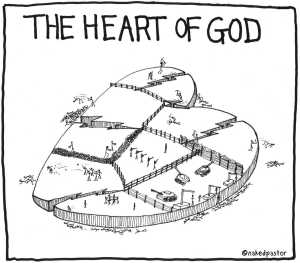
The critics point out that from the perspective of the Judaeo- Christian tradition, I’ve simply got it all the wrong way round, as all human beings are invented by God, and all knowledge of God is revealed by God to human minds.

Yes, yes, I agree that’s the God and the humanity portrayed in the Bible; and that the faith that we are the creation of God from whom all life flows, is a true faith. But who made the Bible portrait of God and who created the concept of life as received from God’s hand?

People did, people like you and me, leaving the marks of their time, place, culture and above all of their human imaginations,  all over their image of the creator God. I am not suggesting that the creator god does not exist, or that he/she does not reveal his/her self to humanity, but I am pointing out that human knowledge of God comes from the exploratory fictions of human experience and imagination and is mediated by human worship, storytelling and writing, in the context of human community.

I don’t think this issue is merely an intellectual game. It is a matter of human survival in the face of religious fundamentalisms that pretend  believers have no choice but to obey their crazed deities who tell them to assault abortion doctors or to cut the heads off infidels. These are all people who have invented gods that suit their own bloodthirsty hatreds but are prevented by bad faith from admitting it. This bad faith however exists in all forms of religion that deny responsibility for their gods. The God who can be truly worshipped is one towards whom our inventions point, but who is always beyond all inventions. Worshipping this one, trusting this one, will from time to time lead to new inventions or modifications of what has been invented in the past. If religion is not to be the death of humanity we have to take full responsibility for what we believe and challenge adherents of other religions to do the same.

I can easily move from that argument to writing about Jesus, because of course, the thing about him that most horrified the religious leaders of his time, was that he went about re-inventing God. For them God had revealed himself in the Torah and the Writings and the Prophets, and the essence of true faith was to learn this revelation and to obey its prescriptions for holy living. All the true stories of God had been told; all the genuine commandments of God had been given; all the permitted means of worship had been prescribed. There was room for interpretation but not for invention because none of their tradition had been invented; it had been given, revealed, signed, sealed and delivered by God and therefore could be altered in any way; nothing could be taken away, nothing added.image

You can almost sympathise with these leaders when they were confronted by a man who not only disobeyed the cherished commandments and rejected hallowed custom, but also was constantly telling new and blasphemous stories about God. Even worse he cheerfully accepted personal responsibility for his innovations, claiming that as God’s child he had authority to act on behalf of God. Where would this end, they must have asked, for if everyone began to take responsibility for their God, there wouldn’t be much point in religious leaders.

I am not exaggerating. Because of our own tradition of faith, which emphasises the authoritative revelation we have received, we fail to notice the revolutionary creativity of Jesus in his words and actions.

Take his impatience with the traditional concept of sin, which was fundamental to the power of the Temple and its priests. People would offend the holy God by their ritual impurities and moral failings, and would find forgiveness through the sacrificial rites of the Day of Atonement. Sin was serious business that required the skilled intervention of the priesthood. Jesus on the other hand saw sin and its attendant rituals as a prison in which people were locked or locked themselves, cutting them off from God and their neighbour. He used forgiveness as a key to this door, so that sinners could come out and get on with what God wanted them to do. The forgiveness is not an end in itself, but a means of getting people out of jail to start living. This involved inventing a God who was less concerned with transgression than with the welfare of his human children.

Or take his parables which constantly overturn the traditional pieties about God. I’ve have already written in this series of blogs about parable of the parable of the so-called prodigal son, which really ought to be called the parable of the foolish father or daft dad, in which God is offensively portrayed as fond, permissive and unable to control his own emotions for the sake of both of his sons. Then there’s the story of the great feast which features a rich man who plans a great banquet to which he invites all his rich friends,  and is so miffed when they find other things to do, that he  fills his house with the poor, the blind the crippled and the lame. How can this be the anything to do with God’s victory banquet to which the faithful expected to be invited? And how can this grumpy and impulsive host be a decent image of God?

imageJesus, and the faith – community that followed him, were continually inventing and re-inventing God in ways which did justice to their experience of the world and of the one who is beyond all worlds.


It was only when the Jesus communities became an established religion, that invention became suspect and indeed evil, because of course the power of a priesthood always rests on its possession of divine truth.  A tradition which has been received from God and is therefore unalterable, puts God in the pocket of its main keepers, who will use it to justify their cruelties.

A recovery of the Jesus who reconstructed God and God’s House, Jesus the Builder, you might say, would be a benefit to Christian believers, to believers of other faith traditions and to a world in which religious certainty has become lethal.


i started off this series of blogs by proposing a fairly scandalous statement as the first  principle of all theology, namely:

ALL GODS ARE INVENTED BY HUMAN BEINGS

But I went on to argue that a human invention should not necessarily be thought of as unreal. Scientists have invented our modern picture of the universe, but we think of the picture as ‘real’ or at any rate as pointing towards reality. My knowledge of history tends to suggest that the present day scientific picture will look fairly primitive in a thousand years time, but I am happy to see it as a reasonable approximation, which is at least pointing in the right direction.

Stephen Hawking
A beautiful mind

Then I asked what evidence existed to back up the human invention of a creator God. In my last blog I took the human mind with its extraordinary capacities as an indication that the evolutionary process that produced it flows from a source which is itself intelligent.

My second piece of evidence is human goodness. Simone Weil pointed to the almost ineradicable human conviction that we ought to be treated well. We may forget that our neighbours should be treated well, but even hard-hearted people are often convinced that they should be treated well. This faith in goodness, she says, is our link with God. The source of goodness is God, and the link with that source constitutes humanity. If we lose that link because of our own brutality or the brutality of others, we are no longer human.

I was reminded of this last week when I listened a report on radio of what had happened in the city of Leeds during the recent floods, when many families were made homeless. People of all races and religions came together to resource a communal kitchen which provided hot meals for all affected by the floods, while also being an unofficial centre for other forms of help. The woman in charge of the kitchen told reporters that she had been in tears much of the time, not out of grief, but out of astonishment at the communal outpouring of love. Where had it all come from, she wondered.

image
Outpouring of love

it is often the case, that when human hearts are opened to the need of other human beings, or of our planet and its creatures, the goodness done is felt to have been a gift received as much as an ideal achieved. People speak of being a channel for a goodness which has come from beyond themselves.

Of course this is not any sort of proof of God, but it is evidence that goodness is not fully understood in terms of evolutionary biology, and that belief in God as a source of goodness is not wholly without a basis. It may be that when we are open to goodness, we are linked with the relentless persuasion of God who wants our help in perfecting his creation. Only when that has happened will God be able to look at his creation and see, in the words of Genesis, “that it is very good.”

I want to emphasise that my arguments from the existence of the human mind and from human goodness are not to be taken as ‘proofs of God’s existence’ but rather as evidence that when I believe in God I am not doing something completely irrational, as Richard Dawkins has argued. Of course my way of thinking about faith has implications for the way I think about Jesus, which will be the subject of my next blog on this site.

I’ve just been having fun on the Hubble webimagesite, which allowed me to journey to a black hole in the Andromeda Galaxy and even to fall into it. As I understand it, black holes are  objects of such great density that their own gravity makes it impossible for anything, including light to escape from them. This means that unless they have captured some light emitting body, they  cannot be seen on the visible spectrum although they show up on the X-ray and radio spectrums. Many astronomers think that there is a massive black hole at the centre of all galaxies.
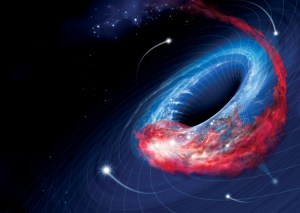
Out sciences have obviously not fully understood these objects as yet, but they have made observations, invented the concept of a black hole and will continue to investigate, and perhaps improve, or even radically change their concept, as time goes on. That’s the way science works.

It is also the way my sort of religion works. I do not live in a different world from scientists; I live in the same world, with the same information about it as scientists. Indeed I am reasonably diligent in keeping up to date with the tiny proportion of scientific discovery that can be understood by the non- specialist. It’s just that I am part of a tradition that has invented different concepts from those of the scientists, but which is as prepared to have them tested out as they are.

The first set of facts to which this tradition attends, is the set of facts about human life. While accepting the basic story of evolutionary process described by Darwin and his successors, my tradition of thought is not wholly satisfied with this theory, because it does not give sufficient attention to the emergent phenomenon of human intelligence. While accepting that all life has some sort of intelligence, the creative capacity of human intelligence seems to me and my tradition to be discontinuous with even the greatest animal intelligences, and its effect on the earth and even the galaxy to be different in kind as well as quantity. The terrifying potential of such an intelligent creature for the preservation or destruction of life and its environment suggests that its existence should be the subject of deeper reflection than has been given by the sciences. One of the foundational theories of my tradition, the book of Genesis,  suggests that the extraordinary qualities of the human animal, are due to its being “created” in his/her image by a source of life and intelligence who is also the source of the universe. The need for the creator of humanity to be also the creator of the universe, is that it’s clear from all the sciences that the process by which human beings are created is the natural history of the universe and of our planet. We are made of star stuff and our DNA is fairly similar to that of the fruit flies. image

No, I am not suggesting that a creator interfered with the evolutionary process to make it do what he wanted. Indeed all the evidence suggests that the elements of the universe resist control, that the smallest particles of matter are are fundamentally unpredictable. I am suggesting that it is precisely the unpredictable and indeterminate nature of evolution which has produced human intelligence, and that it is precisely the creator’s absence of control and his/her involvement in the pain, loss, and extinctions in the universe, that constitute his/ her deity. God is not effortless power, but an unrelenting drive for perfection which has to work from the inside of matter, life, history and understanding rather than from outside. As these cannot be controlled, they must be persuaded to move towards perfection, which requires God to share the agonies of the process.

This is not my individual theory. This is what the foundational story in the book called Genesis, says.

From the start God “lets be”, allowing some order to come out of chaos, but including elements of chaos, the waters and the darkness, to be part of what is created. Certainly human beings are “let be” in the image of the creator, but this proves to be more of a problem than a success, as the unruly humans cannot be controlled by commands, threats, or punishments and God has to follow the logic of creation by getting down and dirty on the earth, to persuade even one human family to follow his way to perfection.

This story is almost as scandalous a representation of God as that of Jesus of Nazareth who characterised God as a crazy parent so soft on his kids that he gives them the means to waste and destroy his good gifts in riotous living; and when they come whingeing home meets them with soft-hearted indulgence. Would God put up with such humiliations if not because he/she wants to persuade his creatures towards perfection.

imageSo that’s the God invented by the Judaeo- Christian tradition, as a response to living in the same world as scientists. Scientists have some evidence that their inventions, their descriptions and laws correspond to reality. Is there any evidence that the invention of this very strange God corresponds to reality?

Well, as I suggested above, I think that the emergence of the human mind from the process of evolution is possible because the divine mind is embedded in the countless complexities of that process. So there you have it, my first piece of evidence that my tradition’s theory of God points to reality is, the human mind!

But it’s by no means my only evidence, so tune in  for another great instalment in two days time, when I move from black holes to warm hearts.


In my last blog I declared that the first principle of all theology must be:

ALL GODS ARE THE CREATION OF HUMAN BEINGSimage

But I went on to claim that true theologians trust that their inadequate creations capture enough of the truth to point towards one who is beyond all worlds, who can’t be grasped by human thought.

Let me expand a little on that argument. I grew up in a Christian household and church community, through which I was given access to a tradition that included ancient stories, moral prescriptions, prayers and evangelical discourses, including the stories of the life, death and resurrection of Jesus. These were transmitted to me by people who had adopted this tradition as their own and who tried to live according to its vision of life, through worship, prayer, bible study and practical goodness. Like all the generations of believers before them, they had adopted the creative imagination of the first believers, while adding their own creative interpretations of it, out of their own lived experience. They found it intellectually, aesthetically and morally satisfying to imagine God in this way, trusting that in ways beyond their understanding the goodness of the one beyond all worlds became a resource for their own living. They may or may not have believed in what are popularly called miracles, but this fundamental miracle, whereby the eternal goodness was transmitted through their human lives, without any supernatural magic, was central to their faith.

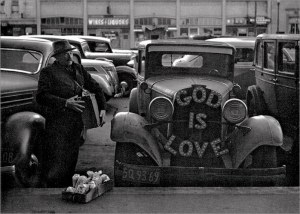
imageKeen eyed readers will have noticed that there is a lack of definition in my use of the word “goodness.” The Christian tradition defines goodness by identifying it with the character of God, which is revealed through a long process of development, culminating in one sentence in a letter of the first century CE, “God is love.” ( First Letter of John, chapter 4). Of course that ultimate simplicity contains many varied commands, illustrative stories and wise sayings, but all of these are to be interpreted in the light of the one simple truth of God’s love.

The fact that interpretation is required and that it involves the human experience of love, gives scope for the creative development of the tradition over time. My own conviction about the moral equality of heterosexual and homosexual relationships, which dates from long before this was the dominant view in society, was due to my own experience of love and my own understanding of homosexual love in people who were my friends. From that time I mentally excised from the tradition the ancient injunctions that told me otherwise.

But isn’t that a process of picking and choosing? Yes, it is. That’s what adults do. They don’t simply accept everything they are told, even by holy traditions they otherwise revere. But if the traditions need changing, why accept them in the first place? Because they are vast depositories of human wisdom, built up over time, that give access to a goodness which is beyond them. The very fact that they can and should be re-interpreted, as Christians say, ‘in the light of God’s spirit’ is evidence that they do give that access.image

All of this means that as a believer  I am an active participant in the tradition to which I have chosen to belong. I must use all my intellect, imagination, and moral conscience in understanding, interpreting, criticising and altering this tradition. I cannot avoid my moral responsibility by saying, with Martin Luther, that my conscience is in chains to the word of God, for it is through my conscience that I first of all recognise any word as a word of God. If it is not a word of love it is not a word of my God. Can I justify that fundamental principle? No, I cannot. It grasps me by its majesty and rigor, and I wholeheartedly believe it to be true, but I know that it cannot be sustained by argument. It is the wisdom that I have chosen because somehow it first of all chose me and has been creating me.

There, I have used the word which represents my understanding of my own and other religious traditions: they are collections of human wisdom, which point beyond themselves. I can understand why sensible people might dismiss the claim that they point beyond themselves, or deny that there is anything to point to, but I cannot see why any agnosticism or atheism should mean that people neglect such vast stores of human imagination, moral perception and wisdom.

Does all this leave me, as fundamentalist believers might ask, unsure of my own salvation? Well, yes, in a sense it does. If there is no God or God is not love, I will not be saved. But if there is, perhaps I shall. Somehow, all my life I have found people who were sure of their own salvation, whether Jesus – lovers or Jihadis, profoundly unattractive.


Yesterday I came across a blogger whose work gained my respect as I read his stuff. He is Kenan Malik, who blogs at Pandaemonium kenanmalik@wordpress.com. covering philisophocsal, moral, political and cultural topics with an easy elegance and impressive knowledge. He calls himself an atheist and is apparently used as a devil’s advocate by a theological training college to sharpen up its students for the warfare ahead.

blakeI also listened to a video in which he described his atheism as “having found no necessity to believe in God,” especially in view of the comic jumble of absoluely certain descriptions of God’s character offered by the religions of the world, and sometimes by different groups within the one religion. Obviously, for example,there is considerable distance between the God of the Archbishop of Canterbury, who, wincing a little, can accept homosexual people as believers, and the God of many African bishops, for whom they are an abomination. Kenan Malik rightly observes that in spite of all the talk about unchanging truth and divine revelation, the views of Christian churches do change according to place, time and social mores. For Malik this is desirable because he sees the creativity of individuals and societies as the true driving force of humanity’s bumpy journey towards a better world.

I am happy to accept most of what he says. The history of Christian morality in the UK in the last hundred years, indeed even within my own lifetime, is evidence of both change and creativity. The Christian culture in which I grew up, while distinguishing itself from the puritanism of some Scottish churches, was quite clear that heterosexual intercourse outside marriage was a grave sin and that homosexual behaviour was deviant and frequently degenerate. God had created us male and female so that we could get married and have children and any departure from this plan was an offence to the creator. Sixty years on, not only my views but the views of many non-fundamentalist believers like me, have changed, in that we expect our grandchildren to have a number of sexual partners before they marry; and we welcome homosexual people as worthy members of our churches.

What has happened here? Fundamentalist believers will say that we have abandoned the clear witness of holy scripture to the will of God. They will argue that God’s will has obviously not changed, but that I and people like me, have changed and not for the better, since we have lapsed from true faith and perverted the truth of God.It is easy enough to make fun of the contradictions involved in fundamentalist belief (why do they not obey the clear commandment to stone adulterers to death?) but less easy to justify our view that holy scripture is normative for our living … but…er…only the bits of it we like.

The root of the problem lies in the bad faith of religions of revelation in refusing to admit the human creativity which has produced their sacred traditions. The creation story in the book of Genesis Chapter 1 has at least one human author, who chose to represent the faith of his/her community in these words. She was aware that her story was different from the various stories told about the creation of the world in the surrounding  Canaanite, Babylonian and Egyptian cultures. Although the corpus of writings which contain her story, the Torah, claims divine authority via Moshe, the author of the creation narrative simply tells her story, without attributing it to divine revelation. If we read it sympathetically, we become aware that sentence by sentence, she is inventing God. I don’t mean that she was the first person to think of God this way; clearly she was representing a tradition of belief. But those traditional beliefs themsleves  are a human creation, bearing the marks of their place and time of origin. The author of the Genesis creation story is a creative artist who in all probability, was the first to synchronise the stages of creation with the days of the week, including the splendid idea of God resting from his labours on Shabbat.

This all too brief analysis reveals what ought to be the first statement of all theology:

blake 3
God creating Adam

ALL GODS ARE CREATED BY HUMAN BEINGS

All systems of theology that do not admit this are in denial. They give the game away by decribing other religions as human creations, while maintaining that their own is guaranteed by  holy books whose every word is inspired or written by God. But the obvious truth is that their books bear just the same marks of human genius, human lies and human brutality as the books of their opponents.

Am I suggesting that there is no God or that God does not communicate with human beings?

No, I am suggesting that the best and most honest human users of word God are aware that they want it to point beyond their best inventions to the one who is beyond all worlds and yet accessible within all worlds to those who listen creatively. Even the grandest theologies should put the word “God” in commas, to show that is not a name or definition, but rather a pointer towards a truth that cannot be fully defined. I don’t mean that theology should be vague in its descriptions, just that it should admit that these descriptions are its own creation, just as the description by contemporary scientists of the origin of the universe is their creation, and like them, subject to criticism and development.

For example the story of Genesis chapters 1-12 is of a creator God who fashions a good world, but makes the strategic error of creating a being in his own likeness, with the power to choose, who predictably chooses not to obey God and disrupts his plans. So from the 3rd chapter onwards “God” becomes a comic figure, always being outmanoevred by his best creation, continually trying to get a grip on a deteriorating situation, who ends up almost wiping out his entire creation in a flood in a pathetic attempt to gain the upper hand.  I say “attempt” because no sooner has the flood finished and the rainbow taken its place in the sky than Noah and his family are back into the old routine, drunknness, sexual scandal and lack of concern for their creator’s wishes. Finally, this “God” realises that he can’t control humanity from a distance by threats and punishments, and that he must therefore persuade (!) them to live in his way; and to that end he chooses to begin again with one family, that of Abraham. If you think I’m exaggerating, read these chapters without prejudice. No unbeliever has ever painted a less flattering picture of deity.

blake 2
God judging Adam

The Genesis writers, as subtle storytellers, are perfectly aware of what they are doing. Even within their story they offer alterntive versions, such as the two stories of the creation of humanity, because they know that they are creating God and that their creation will, at its best, only point in the direction of a truth that cannot be grasped by human beings but which may grasp them. They tell the story because they think that, inadequate as it is, it contains profound wisdom for living.

Believers should not be dismayed by the notion that they help create their God. Human inventions can be both useful and true. E= MC2 is a human invention which is both useful and  true, while also being subject to criticism and development.

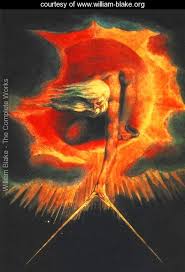
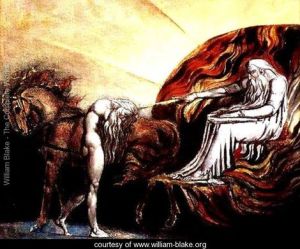
That’s already too much for one day. I’ll continue tomorrow. All the images are by William Blake, who invented new stories about God.


For some time I have looked at the pop up advert on my Windows 7 PC that advises me to upgrade to Windows 10. As I have been reasonably content with my present operating system, I resisted its blandishments, until today, when emboldened by my wife’s decision to use Windows 10, I clicked the button to get the upgrade, expecting that it would all happen in a flash, or at least, rapidly. As those who have already made this transition will know, that was a mistaken assumption,  as the various downloads and alterations are annoyingly slow. As I have absolutely no idea exactly what processes are involved it’s entirely possible that in fact the upgrade is lightning  fast, given all the tasks it has to perform.w10

I!m told that if you decide to clean the old system out first of all, the installation of the new one is much quicker, as it doesn’t have to cope with the idiosyncratic collection of programmes which you’ve added over time.

I want to compare this upgrade with the event that Christian believers call conversion,  meaning the fundamental change brought about by trusting Jesus and his way. Christian theology has seen this a a complete turn – around of your life, which in the New Testament is the Greek word metanoia, sometimes mistranslated as repentance. It does mean a change of mind and heart.

As a teenager I became for a while enthusiastic about an evangelical form of Christianity that expected true conversion to be a rapid event. Maybe not quite overnight, but certainly not protracted. It involved a true recognition of your sins and a passionate desire to turn away from them towards the mercy of God offered in the life, death and resurrection of Jesus. If you completed this process of conversion, you were “saved”, you were given “salvation” which was a sure possession even if it required to be “worked out in fear and trembling.”

Ach, dearie dear, if only it had been as simple as that!

update
spectacular conversion

In fact, this promised upgrade, the replacement of my malfunctioning operating system with the mind of Christ, has taken most of a lifetime already and is far from complete even now. As I write I notice that my computer is telling me that the Windows Uphrade is 9% complete. Is my Jesus upgrade any more complete? I doubt it. Looking back on past evils and follies that I have recognised I am emboldened to think that some progress has been made, but when I recollect that at the time I deceived myself into thinking they were acceptable, I’m not so sure. Perhaps, no, almost certainly, there are similar faults in my present living about which I am again deceived.


If I were to give any details about these faults, my readers would feel they were getting too much information. It’s like other peoples’ sex lives which are always either disgusting or ridiculous. Perhaps it’s enough to say that (unfortunately?) my sins have not been great, scarlet, swashbuckling sins, but small, grey and cowardly, about which I could never boast even in bad company.

On the other hand, there have been times when I’ve realised much to my surprise that I have downloaded some of Jesus’ operating system and am capable of some goodness which was beyond me in the past. Along with Simone Weil, who wrote some daft things, but also expressed some fundamental truths with unmatched clarity, I believe that our connection with the goodness that is God, that is not of this world, is what keeps us human. In its absence, we become demonic, but even a small amount of it makes all the difference.

The difficulty of conversion is that the new programme has to overwrite previous programmes, some of which, however warped, show surprising resilience. In the case of the most stubborn, there may need to be complete removal. My computer said, ” in order for the upgrade to continue the following programmes must be completely removed. Do you want to continue?” So when I refused to change a particularly cherished fault, it didn’t merely leave one thing uncorrected, it stopped the entire process of conversion. There are no 98% converted people who just happen to be racists; rather, their racism has prevented the transformation of their lives by God.

update 2
slow, incremental changes


So that’s why a man in his 74th year on this planet can compare his conversion to a computer upgrade which is taking an inordinately long time. It would certainly be no surprise if God, like me, has at times been tempted to cancel the process, as I presume that like me, God keeps an eye on what’s happening and looks forward to the finished conversion, when the thing will be more effective for his/her work and less liable to foul-ups and crashes. So it wouldn’t surprise me if God were to say,”Oh for goodness sake, life’s too short for this nonsense. I’ll put that one to the tip and get a new model!”

But the gospel tells me that fortunately I live in the time of God’s patience,  so this slow turning of mine can continue, if I am willing to keep learning.

“Lord, for your tender mercies sake, lay not our sin to our charge; but forgive what is past and give us grace to amend our sinful lives. To decline from sin and incline to virtue, that we may walk with a perfect heart before you now and evermore.” ( Cranmer)

Coincidentally, my computer now says, “Welcome to Windows 10!”


chuchuk
Chuchuk

In my newspaper this morning I read the sad story of the Scot working in Kyrgyzstan who made an online joke comparing the national delicacy chuchuk ( a kind of sausage) to a horse’s penis. This so annoyed his fellow workers that there was a strike leading to his arrest on grounds of racial hatred. It is unclear what will happen to him. I can imagine what the man is feeling. He put his joke online in good will towards all, in the sure conviction that all humanity finds horse penises as funny as Scots do. Yes, I am claiming that the scatological humour of Scots thinks a horse willy is usually good for a laugh and that there’s nothing offensive about it.


Unfortunately, in Kyrgyzstan………

Good grief what’s wrong with these people? Have they no sense of humour?

This incident is another indication of the danger of jokes, particularly in multi-racial or multi-religious contexts. Something that simply sounds funny to one group of people may sound like hate-speech to another. This is notoriously true of religious jokes. It would appear that many people are quickly outraged by jokes about what they consider to be holy. You would need to be very stupid as well as insensitive to make a joke about the Prophet Mohammed in Mecca at Hajj time. The argument put forward by the writers at Charlie Hebdo is that religious believers like all other people have to endure jokes at the expense of their profoundest beliefs.

I can see problems with this argument. What about the brutal humour of the Nazi press towards the Jews in the 1930’s? Or the sarcasm of the Red Guards’ media towards “bourgeois intellectuals” in Mao’s cultural revolution? There is clearly a tricky job for legislators in distinguishing humour from hate-speech. But as far as my own religious tradition is concerned, I hope that Christian believers can remain cheerful or at any rate patient, when faced with jokes about our what we think is holy. Sometimes we may be able  to learn something useful even from an offensive joke.

For example:

“Jesus is dying on the cross. Indeed some of his followers even think he’s dead. But then he opens his eyes and gasps a word which is unrecognisable. When he receives no response, he tries again, but again no one can make out what he is saying. Finally with a supreme effort he cries out, “Peter!” Immediately Peter runs to the cross and looking up with reverence and pity, says, “Yes, Lord?” And Jesus replies, “Peter…. I … can……see your house….from up here.”

bright side
Always look on the bright side..


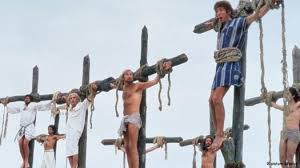
The first time I heard this I found it offensive. Yes, I recognised the contrast between the horror of the situation and Jesus’ banal observation, but I didn’t find it funny. I was offended because the joke seemed to make light not just of Jesus’ pain but of all human pain; that is, I though it a brutal and stupid joke. Later I realised that there might be a spark of genuine humour in the perception that being elevated on a cross let you see some familiar landmarks. Years later, I was reminded of this joke when I watched “The Life of Brian” by the Pythons, in which a vast gathering of people on crosses sings “Always look on the bright side of life”, causing offence to many Christian believers. I thought it shed an interesting light on some kinds of Christian piety which have turned a Roman atrocity into a routine image of salvation.

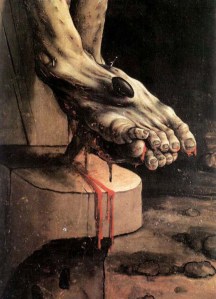
Coming back to the joke now, because, curiously, I found it the other day in an online collection of “Clean Religious Jokes”, I can see more clearly that it asks questions about the Gospel stories, all of which feature some utterance of Jesus from the cross. Believers who are familiar with the narratives have come to accept their truthfulness in spite of their inherent improbability. I doubt if most crucified people said much. In Jesus’ case, the narrative has already told us that the disciples, including Peter had deserted him. Perhaps some female disciples were present but maybe not that close. So who could hear what Jesus said, if he said anything? Perhaps the gospel writers’ piety – I exclude Mark who only records Jesus shouting in despair- the way they set up the cross as a kind of pulpit for Jesus’ last teachings, is itself offensive, especially to those whose lives have ended under similar torture and mockery. In the Gospels, the pain and degradation, the dust, the flies, the blood and piss of the crucifixion have been elided in favour of its theological significance. On the other hand, Mel Gibson’s “The Passion of the Christ” convinced me that a fascination with brutality and pain produced a narrative that was finally stultifying.

Grunewald2
Matthias Grunewald

My own conclusion is that there is a real issue about how Christian believers tell the story of the crucifixion. We should probably avoid the hyper – realism of Mel Gibson, but we should not forget that we are dealing with an imperial execution, a “cruel and unusual punishment,” an injury to the body, mind  and spirit of a man, and not simply an incident in the history of salvation.


I owe this process of thinking to an offensive joke.

According to the Gospels Jesus, like many other Jewish people, used “shalom” meaning peace, goodness, good day, as his greeting. It can be used simply as a conventional hello, or with more profound meaning. In John’s gospel, when Jesus says to his disciples that he gives and leaves them his peace, he notes that his gift is not to be mistaken for something worldly, as if it was mere good fortune. John places these words in the context of Jesus’ imminent suffering and death. Clearly most human beings would welcome a peace which has been tested but not destroyed by suffering.image

Jesus’suffering was not simply the expectation of death. I don’t fancy death too much but I have known some splendid human beings, some of them quite irreligious who faced their dying with courage, indeed, even with humour. But Jesus was tortured and deliberately degraded. Could his kind of peace cope even with that? This year I have often mentioned David Haines, the refugee camp volunteer tortured and killed by Daesh. He managed to retain his dignity. Perhaps part of the peace shown by Jesus and by David Haines, came from knowing that the ending of their lives was in tune with their sacrificial living.

But it’s possible that Jesus came to doubt his life’ s commitment to God’s justice. Maybe his questioning howl on the cross  expressed the feeling that it had all been for nothing.

That’s a true killer. When you are forced to ask if your main reason for living has not fallen to bits;  that something you have worked for, loved, lived with, grieved over, may be null and void. My sense is that Jesus experienced this and overcame it. The writer of the book of Revelation, conscious of the persecution which might afflict his flock, used the word overcome, or conquer, to characterise the strenuous shalom that would see them through such suffering.

“Split all ends up, they shan’t crack/ and death shall have no dominion.” (Dylan Thomas)

“In the teeth of life we seem to die; but God says no. In the teeth of death we live!” ( Martin Luther)

If there  is such a peace, then we should not imagine it as a feeling, not even as an inner conviction that cannot be extinguished. No, it is the capacity to endure the unendurable, annihilating nothingness, as if it were the love of God.  I do not mean that God wills the suffering or excuses the evil that causes it, but rather that God’s love respects the autonomy of his creatures as long as they live on earth, and does not intervene, no, not by force or miraculous messages in the mind. But when God receives his creatures in death, then he wipes away all tears and welcomes them into a peace that is beyond their understanding.

So of course, the words spoken by Jesus in the gospels are always the words of the Risen Lord. The peace which Jesus promises comes from beyond all worlds. But I can only receive it as I walk with Him in this world, where even the greatest trust is far from certainty.

image
Bognor

In imagine all this sounds a bit somber; far from the cheery sign off message appropriate to the last day of 2015. In fact, I’m not gloomy, I am speaking of a fighting faith. God’s peace to all my readers! Confusion to your enemies!  And bugger Bognor! (The reply of George V on his death bed to someone who tried to avoid the issue by hoping that soon he might be well enough to holiday in Bognor. It is also my reply to all pious attempts to make life seem easier that it is.)


The writer Brian Aldiss either invented or quoted from somewhere the adage that “civilisation is the distance between Man and his own shit,” which he thought mistaken and proceeded to construct a novel that illustrated a radically different possibility. I am reminded of this argument every time I see a report on my local beach at Monifieth, where the water is frequently “polluted with faecal material” in spite of the recently installed Great Outflow which is intended to take it all elsewhere, possibly Germany. image

My excuse for this unsavoury opening paragraph is the increasing evidence that humanity has a maybe fatal difficulty with the waste products of all its activities, especially those which create carbon dioxide of course, but also with nuclear and chemical waste from agriculture, not to mention the plastic particles which already clog most of our oceans. A measure of how serious the difficulty is can be seen in the self-congratulatory tone of the decisions of the recent Paris Conference which agreed more stringent hopes for limiting poisonous wastes without agreeing a single binding commitment.

In spite of the romantic view that all this is due to modern civilisation which has destroyed the wisdom of our more remote forebears,  I guess that from the start Homo Sapiens has been a tad careless about the natural world. The greatest destruction of the Caledonian forest we are now told, took place in prehistoric times, when it was cleared to create land for farming. There’s no doubt however, that the ruthless consumption of natural resources and deposition of waste products in earth and air and water, by private and state- owned industries in the last 100 years, is of a different order from anything that went before. Currently the most profitable and polluting industries try to persuade us that the environmental crisis is not as bad as some fear, and that as long as they can continue to pollute, they will try to provide a fix.

image
Polluted burn on beach

In truth I am not competent to write about these issues, and certainly do not have clean hands: I still drive a car powered by a pollutant (diesel) and would still consider using a plane to get to Europe.

The thing is I understand the human impulse to forget the mess we leave behind us, only too well. I can remember as a young man hiding the vast collection of glass milk bottles I had accumulated in the attic of my flat, only to be found out by a colleague who had taken over the flat and found my bottles when he tried to use the attic to hide something else. It may be the memory of such acts of shame that has turned me into a furious recycler, ever ready to remove rubbish from my house to the council tip.

More seriously I know that I have sometimes moved  jobs when the problems I’d created seemed beyond me and could be safely abandoned for someone else to sort out. I know people  who do the same thing with relationships. The attraction of being clean, of being able to make a new start, is very powerful when we begin to smell the mess we’ve made. Perhaps that’s why we have invented the phrases, “clean sheet, clean start.” The impulse to move on quickly may owe something to an animal fear of being tracked down by our spoor, but its human form is nearly always irresponsible. We hope something can be abandoned while knowing that nothing disappears, and that all actions have consequences.

But doesn’t the Christian Gospel, with its offer of forgiveness through Jesus, encourage just this mindset, that we can leave the mess behind us and be saved? Well, yes, sometimes it may have been misunderstood to mean just that; but in fact the forgiveness that Jesus offered released people from social condemnation and self- loathing to deal with what they had been, while reaching towards what they could be. The story of the corrupt collaborator and tax collector Zacchaeus, is of a man who is freed by Jesus’ advance of trust (forgiveness) to restore the money he has extorted from his victims. (Luke 19). In fact Jesus was always dealing with the mess that others had left behind. The diseased outcasts, for example who had been judged as suffering for their sins by the rigidly righteous; or the prostitutes, whom men had used and forgotten.

I like the gospel word “redemption” which originally referred to the buying back of captives or of slaves. It is used as a metaphor for the liberation Jesus brings. It is not a matter of “at one bound he was free”; there is a price to be paid. People who are in a mess have to be empowered to tidy it up or make reparation to others. Often they have been unable to do so, but somehow Jesus helps them do so by transferring some of his credit to them. Jesus loses some of his public honour  in order to give honour to Zacchaeus, who in turn deals with the mess he’s made. image

Indeed we could say, that in Jesus, God takes responsibilty for the mess he’s made by inventing human beings and permitting their evils. In Jesus, God shows that he will avoid no suffering to clean things up, that he tolerates no pollution at all, but fights it to his last breath, and invites human beings to share his passion.

So, yes, the ending of a year brings time for urgent reflection on the messes I make, so that I can help to clean them up. And , oh yes, which Council department do I contact about the state of my local sea water?


It’s a phrase from the Christmas story in Luke chapter 2, which tells of the coming of the Angel to the shepherds, and the chorus of angels singing glory to God. Then it says that when the Angels were gone away from them into heaven, the shepherds decided to obey instructions and go to Bethlehem to see the child. There is a vision, then the everyday world returns, in which there are no angels, and still these remarkable shepherds decide to stick with the vision.

When the angels have gone away into heaven, is when Christmas lives or dies. For if it is a brief moment of pretence, the families who rarely come to church these days, all present and smiling for our Christmas Eve services, and the old stories generating a glow of magic and goodwill that lasts till they get home, but not much longer, then not much has happened.

image
Dundee, a good place to be

if I, after becoming utterly absorbed in the worship and the worshiping people, return to face my own accusing memories of countless follies in the past with no confidence that my future will be different; if I am no more equipped to cope with the terrible suffering of one of my family than I was before; if the fact of the plain stupidity of human beings including myself suggests just as messy future for the planet and its creatures as it did last week; yes, if the Angels have gone away into heaven, leaving no addresses, what benefit can there be in this festival?

Luke, the storyteller would not be impressed with this ineptitude. He knew that when the Angels went away, everything depended on the shepherds’ readiness to meet the new reality, just as it had all depended on Mary when the Angel went away, that there would be any new reality for them to meet. Of course Luke is writing magical realism rather than history, but every single detail is important. This one suggests that I have to get off my ass, and find the reality in which God is with us.

image
The earth and its creatures

Did I say, “in which”? Of course, it should be “in whom.” That is, it will be present in human beings and in the creatures of the earth. If the word, the wisdom of God was indeed made flesh through all the processes of evolution, then I should  be able to trust that it has not gone back into heaven but continues to be flesh here and now. This presence of God however is not some mystic thing that that exists in and under everything, it is goodness: the goodness God saw in his creation; the goodness of Jesus Christ in every person who shares his ministry to other human beings and his sufferings at their hands; the goodness of the Holy Spirit, who shows me that I am not on my own, but that I inter- exist with all other existences, including God’s.

Ths link to goodness is all that matters, as it tells me that hurt, oppression, violence, selfishness, greed, addiction, lust and self- righteousness, as well as all disease and suffering,  are damaging and wrong and must in God’s name be opposed, healed, perhaps transformed.image.jpeg

I can sit on my butt complaining that angels have never had to deal with sheep tics, or I can make my way to Bethlehem and find a family treasuring their newborn, as families do. Treasuring the good God has given me, is where I must start again, and where I can learn again to treasure all the good God gives, when the Angels are gone away into heaven.