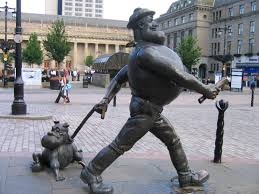
 AT the end of last season Celtic Football Club sacked its manager, Ronny Deila, for not delivering the kind of results the Board expected, and with a flourish of trumpets unveiled their new manager, Brendan Rodger, who had been sacked by Liberpool FC for not delivering the kind of results their Board expected. Since then the Parkhead publicity machine has not ceased to provide tasty sound bites about how the great days of Celtic as an all-conquering European football force are just about to return. All eyes therefore were on Celtic’s qualifying match yesterday with the minnows of European football, The Red Imps of Gibraltar. Naturally Celtic were thrashed 1-nil, and were lucky to escape greater humiliation. Seasoned observers of Scottish football would of course have predicted that if there was a way of wresting disaster from the jaws of victory, a Scortish team would find it; but shrewd pundits might anyway have spotted this was a classic David and Goliath set-up.
The D v G scenario of course features the small weak force against the gigantic strong force, and includes the pre- match boasting of the latter; but it also includes the fact that this is a David home game, in which the small one knows what works and what doesn’t. David, the wide boy from Bethlehem, may never have seen a fully-equipped Philistine warrior before, but he knew instinctively that this unwieldy over- armoured monster was a sitting duck. If my shrewd pundit had been reviewing the contest for Chosen People TV and noted David’s body language and the gleam in his eye, he would have advised the Philistines to have the extra large coffin waiting in the wings. Unfortunately for him the hard- of-thinking thug didn’t see what was coming, and in no time at all his supporters were on the way home complaining, “The boy done terrible; he lost the heid.”
In the case of the Red Imps of Gibraltar, they must have guessed that the combination of an Astro Turf pitch, southern European temperature and a modest competence with a football would see Celtic off. I wish I’d placed a bet on it.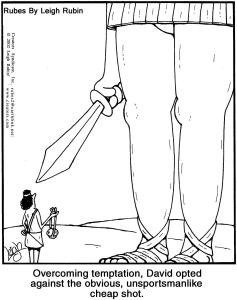
The Bible interprets such events as revealing the invisible arm of God who secures victory for his minnows even against overwhelming odds. A more profound and counter-intuitive version of this is found in Isaiah chapter 52:14 – 53:12, the song of God’s servant, which speaks of how the arm of God has been revealed in one who was a man of sorrows and acquainted with grief, suffering injustice, humiliation, torture and death; but becomes the instrument of God’s forgiveness and healing for many nations.
In the religious tradition of Israel, this strange prophecy was taken as an image of Israel herself, suffering many defeats from the big boy nations, so that God’s blessing might come to the whole world. Doubtless Jesus of Nazareth grew up with that prophecy amongst others, and may have seen it as a guide to his own destiny. Certainly his first followers took it as a prophecy of his rejection, execution and resurrection, of the one faithful in weakness against overwhelming odds, bringing God’s goodness to the world. Even his apparent defeat was a victory in their eyes. This very radical and almost contradictory version of the David and Goliath theme is a central motif in the Gospels, the Letters of Paul and the book of The Revelation. In the latter the David/ Jesus figure is called the Lamb, while Goliath is transformed into Babylon, the Beast from the Sea, the Great Dragon and The Satan, the enemy of God. All the apparent defeats of the sacrificial Lamb and his followers by the powers of evil are seen as simultaneously victories of God’s goodness in those who are faithful to it. From a worldly point of view they are terrible defeats but from the point of view of the Spirit they are victories, because the victims’ trust in God’s goodness is unconquered, and they share the glory of the Lamb in the world to come.
As a rather reluctant and fearful follower of the Lamb, can I share this faith? On the whole I would very much prefer not to be beaten up by the Goliaths of this world -one or two tastes of what they can dish out left me grateful not to have had more- but I have also seen the suffering courageously endured by my heroes great and small. I can easily affirm that their resistance to evil and commitment to goodness is a splendour of the human spirit, but do I really believe that it is a victory, not a loss of life but precisely a fulfilment of it? Can it be true in something more than a poetic sense, that their battle has mysteriously taken place on home ground, and that the well-aimed stone of their courage has dented the forehead of the devil? Are they in fact now enjoying the life of God? 
Well, yes, that’s my faith. Whether I can live by it is another question, but I do believe it, I believe in the victory won by all the small people like Dietrich Bonhoeffer, Chico Mendes, Rosa Parks, Mahatma Gandhi, Helder Camara, Alice Scrimigeour, David Haines, the medical staff of MSF killed in Syria, and thousands of others, who looked Goliath in the face and knew they had the beating of him. I will certainly not have earned it as they have, but Lord, I want to be in that number.


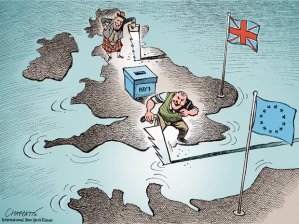
 His radical breadth of sympathy comes to mind now when the alternative to a various forms of toxic English nationalism appears to be some kind of Scottish nationalism. If I want to live and work in a society which is more free, equal and fraternal than that of the present UK, my best option is support for the SNP, at least until another referendum has established Scotland as an independent nation. I am heartened that there has been an increased support for this in the wake of The Brexit vote, because it indicates that our nationalism is outward looking, especially towards Europe.


 The nifty bit of abuse in my title comes from a Christmas song by Sydney Carter who imagines Mary and Joseph “knocking on the window on a Christmas Day” and getting the answer:





 xtremejesus