imageAs I lumber round my favourite running route, through the Angus farmland, I recognise groups of Yellowhammers exploding from hedgerows to play hide and seek with me, disappearing and reappearing up ahead. They do so because they know I’m an animal and will inevitably stir up insects for them to eat. Their yellow heads and necks glitter in the sunlight.

How could there not be yellowhammers in heaven? Could I learn to love angels as much as I love these birds? I doubt it.

Why is it important to ask the question about animals and heaven?

It matters firstly because it serves to expose inherent difficulties about this Christian doctrine. I realise why it was important to John Calvin to minimise the number of people who might make it there. Our imagination of heaven works much more easily if we think of it as a reasonably private club; for as soon as we extend its membership to Tom Dick and Harry, the staggering numbers involved make it seem less desirable and more ridiculous. If we were also to open membership to Rover, Puss and Pretty Boy, the sense of potential overcrowding becomes undeniable, and we begin to appreciate the value of death as an elegant way of limiting the sheer numbers of creatures.image

At this point it is useful to pay attention to the teaching of Jesus, that heaven is not a continuation of earth; its inhabitants neither”marry nor are given in marriage, but are as the angels”, that is, they share the life of God,  in whom worldly maths and marriage no longer count. This is not the most popular of Jesus’ teachings, as many hope they will be re-united with their loved ones, but it is a useful corrective to sentimentality.

” But surely your idea of animals in heaven is gross sentimentality!” some reader will protest. That objection brings me to the second reason why this issue strikes me as important. It affects the Christian doctrine of the image of God, which is granted to men and women but not to animals. This doctrine suits the common sense view of animals in the developed world. It also rests on a pre- Darwinian understanding of the creation of human beings by God as the instant making of beings which were like himself and not like the animals. As soon as I begin to put together what I believe about God and what I know of evolutionary science, it becomes much harder to apply this doctrine. If indeed what we call human beings evolved over millions of years from unicellular animals, at what point in this process did they receive the likeness of God? As hominids, as Neanderthals, as Homo Erectus, as Homo Sapiens, and if the last, does that mean that evolution has ceased? The questioning exposes the fact that although our science still sees different species, it also draws attention to the ecosystems in which these are embedded, and without which they cannot survive. The separateness of Homo sapiens may have been greatly exaggerated: we cannot survive without the bacteria in our guts or the oxygen we get from the trees.image

With this in mind, we might look for a more comprehensive and cooperative doctrine of the image of God, which views it as an emergent quality of the universal ecosystem rather than of a single species. I say universal in the expectation that we will discover life elsewhere in the universe. I cannot pretend that this would not be a major change in theology, nor that I can even begin to sketch an ecological doctrine of the image of God, but I am fully convinced that such a change is required by mere fidelity to facts. As it happens, I also find it congenial to my own experience of the world, which tells me that contrary to the teaching of Jesus, I am not “more valuable than many birds”. I am more intelligent, more complex, more dangerous, but not more valuable.

In crude terms, the biblical heaven is a temporary residence until the day when God will make “new heavens and a new earth.” The book of Revelation tells us there will be water and trees (albeit no seas!) in that new earth. Perhaps this is the Bible’s own hint that the final expression of God’s goodness will include all his creatures.


My family deplores my habit of talking to pigs, partly because it involves rubbing noses with them, thereby polluting my person and maybe theirs’ with all manner of bacteria, and partly because it’s embarrassing to explain to strangers what I’m doing. Of course the pigs may imagine that they are going to obtain some food from this conversation, but they often give every evidence of enjoying it long beyond the discovery that I have nothing for them. I, on the other hand, enjoy their extraordinary vocal repertoire  of grunts, gurgles and squeals, their robust slyness, their curiosity, their good humour. I have never known any particular pig for any length of time, but I imagine that it would be a fulfilling relationship. They are said to be one of the most intelligent animals, ranking above dogs, if below great apes.image

I was thinking of pigs as I read a splendid book by Esther Woolfson, called Corvus, an account of her relationships with several members of the Crow family whom she kept in her house over years. She is unsentimental about them but attributes to them an affection for her which matches hers for them. She muses on what this means, concluding that “we are something of the same.” Perhaps humanity could be divided into those who think animals and human animals are something of the same and those who Insist on the differences. When I say animals, I am not referring primarily to pets, to whom many owners grant quasi human status, but rather to wild animals and especially those that live amongst us.

Humans and animals are creatures of the one ecological network, in which the former because of their superior intelligence have responsibility for the latter. Burns’ mock-heroic humour expresses this in relation to a mouse:

‘I’m truly sorry man’s dominion,
Has broken nature’s social union,
An’ justifies that ill opinion,
Which makes thee startle
At me, thy poor, earth-born companion,
An’ fellow-mortal!’

He recognises the ‘dominion’, which the book of Genesis attributes to divine command, but also ‘nature’s social union’ which is an extension  of Jean Jaques Rousseau’s ‘contrat social’,  and holds them in regretful balance. He doesn’t deny the dominion, but hints that the social union is more important. Just as ‘A man’s man for a’ that’ rubbishes the importance of rank, so here he refuses any interpretation of ‘dominion’ that emphasises status to the exclusion of partnership.image

I find myself drawn to this balance. Animal advocates who deny the ‘superiority’ of human beings often pay silent tribute to it when they protest the huge and destructive effect of humanity on the natural world. The intellectual capacity of human beings demands recognition if only so that it can be controlled. The Bible recognises it by commanding a ‘dominion’ which includes responsibility for all other creatures, although it also tells them to fill the earth and subdue it. In the biblical God’s original plan however, animals were not food for human beings, but humans and animals were to feed on plants. The bible account as a whole is ironical because it depicts human arrogance over status as the origin of evil.(‘you shall be like Gods..’.)

About the fellowship of all mortal creatures the Bible has nothing to say. Its main texts were written in a an era of extraordinary human development  of technologies which allowed the growth of urban centres and the creation of a leisure class. Human wonder at its own achievements blinded its thinkers to all that humanity shared with animals. The 18th century in Europe began to challenge humanism from the standpoint of nature, providing the Romantic movement with some of its most important materials. The contemporary world is rich in radical thinking about ecological matters, and especially about the rights of animals. (At the same time, nevertheless, agribusiness on a huge scale continues to torture animals daily so that people can have cheap food.) I am not sure if the language of rights is helpful, except as a counterweight to abuse, but I want to promote nature’s social union through education, good farming practice, and knowledgeable appreciation of wild animals, while using man’s dominion to protect the web of life.

The Christian tradition can help construct this social union by discovering its own areas of blindness to other creatures as well as its areas of insight. (e.g. The Sabbath is for animals as well as humans.) One of the areas of blindness is the question of whether animals have ‘souls’ and can go to heaven. The traditional answer is that they don’t and can’t, an answer based partly on the bible and partly on cultural prejudice. It’s true that the Bible does not envisage animals having a share in eternal life. Indeed its authors viewed the Egyptian custom of providing the dead with animals to accompany their life after death as heathen superstition.

In fact, the bible tradition does not speak of humans “having souls” they are souls and bodies and minds and spirits. Hebrew culture certainly thought that animals were souls, in the sense of ‘centres of active life’. They forbad the consumption of an animal’s blood, because the ‘blood is the soul'( Hebrew:nephesh). Animals are not described as spirits. God is known through his spirit and he is also a body and a mind but is never described as a soul. How these different dimensions of life relate is not explicitly described in the Bible,but it seems clear that spirit is the dimension in which we are able to step outside of ourselves to affirm meaning, place trust and offer love.image

So my question to the Bible is: on what grounds do you deny that animals are spirits? Do they not find meaning, place trust and offer love? For if indeed they step out from themselves towards other beings, surely they are as much spirit as me. I think that there are very few people who have had a serious relationship with an animal and would deny its spiritual capacity. Probably this what Esther Woolfson meant by “something of the same.” And if we share this relationship with animals, how can they be excluded from sharing the eternal life which we are promised?

Yes, it’s taken me all this time to get back to my title. If, by grace, I end up in heaven, I’ll be very disappointed if there no pigs.

There’s more to be said on this topic, but I’ll keep it for my next blog on this site.


“Until now philosophers have only interpreted the world; the point is, to change it.”

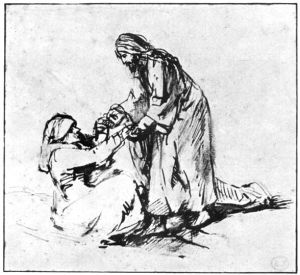
I think Jesus might have agreed with this remark of Karl Marx. After all, his main interest was what he called the “rule of God” which the gospel writer Matthew interpreted as, ” your will being done on earth as it is in heaven”. Jesus’ public ministry of healing the sick and restoring the outcast, was his demonstration of the change required by God. There is almost nothing in the teaching of Jesus which provides an interpretation of the world or encourages followers to imagine that such a thing is important; nor does he construct a religious system whose rituals offer a way of living with the holiness of God. In fact, it’s difficult to find anything in the practice of Jesus or of the first churches that justifies the creation of Christianity as a religion. Jesus wanted his followers to cooperate with God in chanelling his/her goodness into the world.image

Karl Marx provided an analysis of capitalist injustice so that his followers would know what sort of revolution was required. For Jesus, that work had already been done by the lawgivers and prophets of Israel. Their intuitions of the goodness of God and the evils of humanity gave him a vision of what God’s rule could be. Other groups in his society were inspired by the same tradition but had different views about how they should use it. Pharisees believed that a meticulous communal adherence to the laws of God would be Israel’s salvation. The Priestly cast believed that the temple  cult with its rituals offered the people an accommodation with God’s holiness. The Zealot party believed that God’s Rule should be established by holy war against the infidel Romans, and by strict rejection of the liberal customs of Greek society.

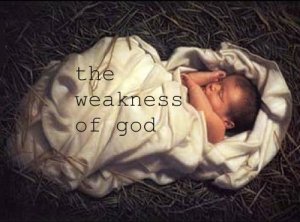
It’s interesting, however, that none of these groups believed that God would impose his rule by supernatural force. Some of them doubtless shared the hope of apocalyptic writers that, in the end time, God would impose his justice, rewarding the faithful and punishing the infidel. Many of them probably shared the hope that God would provide an anointed leader, the Messiah, who would establish his rule on earth. But all of them believed firmly that there were human actions that would assist God’s Rule. This reluctance to expect too much of God is typical of the Jewish tradition of belief. Yes, God is the only God, the creator of the universe, before whom other Gods are mere human constructs, but no, he will not bring his goodness to the world without the help of his human people, his Israel. What St Paul calls the weakness and foolishness of God had already been glimpsed by the realism of the Jewish tradition that nurtured him. But who wants a God who needs human help?image

Jesus accepted that God needed human help, but he differed from his contemporaries in believing that God was all goodness, wholly committed to his creatures, and that all of this goodness was available to human beings to import into their lives and into the world. God would do nothing without human beings but he would enable human beings to do all goodness now. God was not so concerned about human sin that he wanted an elaborate religion of forgiveness; he was ready to forgive all sins for the sake of the goodness that might be enjoyed and communicated by one person who had turned towards God. God’s law was good if it introduced people to the goodness of God but bad if it became a substitute or God. The vigorous struggle against worldly powers in the name of God’s Rule was good if it was done in God’s character, but bad if it imagined that God did not love his enemies.

For Jesus, God is, one the one hand, everything: God is all goodness. On the other hand, God is nothing: God will do nothing without human help. Overflowing generosity on the one hand; utter refusal to intervene, on the other. I think it’s reasonable to claim that the urgency of Jesus’ announcement and demonstration of God’s Rule expresses this double conviction. From the outset Jesus knew that God had ‘abandoned’ the world by refusing to interfere other than through the offer of his usable goodness. Therefore he, Jesus, had to use it, here, now, for all, and teach others to do the same.

imageI was writing earlier in the week about God’s “abandonment” of my youngest brother, still dangerously ill in hospital, but having been to visit him in the liver transplant unit of the Royal Edinburgh Hospital, I have seen those to whom God has abandoned him, namely the wonderfully kind and skilled medical teams there. Our medicine has grown on the basis that God will not heal people on his/her own, but has made available the spiritual, material and intellectual resources for human beings to discover and use. Although science often imagines itself in opposition to faith,  I think it’s no accident that it was born in parts of the world influenced by the tradition of Jesus.

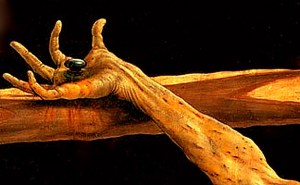
Dietrich Bonhoeffer, killed by the Nazis, wrote,  “The God who abandons us is the God who is always with us.” He was not playing with words. He meant that the God who refuses to intervene by supernatural means, is the God whose goodness we experience in all human goodness, including our own, and whose suffering we experience in all human pain, including our own.

This is an irreligious faith that changes the world for the better.


This ancient Scottish explanation of anything from a broken window to a broken neck came to mind when I was reading about Blaise Pascal, 17th century French philosopher who proposed the idea of a ‘deus absconditus’. Most translators render this as ‘a God who withdraws or hides’ but the book I was reading suggested ‘a God who absconds’; specifically, a God who commits creation then runs off, taking with him the secret that may make sense of it.

Annie Dillard, the author of “Abundance”, a series of essays that reflect on the beauty and terror of creation, makes this suggestion after describing how a giant water bug first paralyses a frog then sucks it to death. We don’t have many texts that meditate on this face of creation. Even the book of Job, which is about as daring as our Bible gets, refers only to the mystery of human suffering, while giving vivid examples of the inexplicable order of the natural world. I have written before on this site about the need for Christian theology to reckon with the facts of the natural world and with the theory of evolution.image

What was Jesus doing when he prayed to the ‘father’?

Was he asking, as we are tempted to do, for special treatment for himself and his concerns? And if he wasn’t, (as pious people say) because he was only concerned with what God wanted, is he really any use to people like us?

Or maybe he had a genuine understanding of the God who permits frogs to be sucked to death, citizens of Nagasaki to be vapourised, and Judaean prophets to be crucified. Perhaps he knew that the father had not absconded, that he had not done a terrible thing and run away, but was hidden in the suffering of his creatures.

Matthew in his Gospel gives a hint of this when he uses a phrase from Isaiah 53 to describe Jesus’ healing, “he has taken upon himself our diseases.” Matthew thought that Jesus healed others by a process of suffering. Mark always presents Jesus as the crucified and risen Lord even before he is crucified. The last book of the  bible may be profoundly right in identifying the suffering Jesus with God, in the phrase, “the lamb who is in the heart of the throne.”

The secret may be that there is no way for a creator to fashion a universe that is good, other than by suffering along with it the consequences of its own freedom.  There is a persistent witness in all art that there is no true creativity without suffering. If Jesus understood that necessity and shared the Creator’s commitment to his/her plan, then we could imagine his prayers being very different from ours, without ceasing to be human. “Father, let this cup pass from me” that’s human, that’s my sort of prayer; “Neverthess, not what I want, but what you want” – that’s alien, that expresses Jesus’ partnership with the will to suffer. In his humanity Jesus identifies with me; in his readiness to suffer he identifies with God.image

The fruit of his prayers will have been his sense of God’s presence, especially in the suffering of the creatures. “Not one sparrow falls to the ground without your father; the very hairs of your head are numbered.” I hope this is true even if I can’t really understand it.

My youngest brother is in the high dependency unit in hospital. I am praying for him to this strange God:

May it be true, God, that not one man or woman is taken into the HDU without the father

I noticed as if for the first time that his hair is quite grey.

May the hairs of his head be counted by you

May the hairs of his head be counted by you

May the hairs of his head be counted by you

Let this cup pass him by

image

Nevertheless..

Nevertheless…

No, bugger nevertheless,

Let this cup pass him by.


Some content on this page was disabled on August 15, 2016 as a result of a DMCA takedown notice from Michael Benard. You can learn more about the DMCA here:

https://wordpress.com/support/copyright-and-the-dmca/

Me: Yes, who is it?

He: I have been sent to speak with you. I am Mohammed, the Prophet. Peace be upon you.

Me: Upon you peace! But surely there’s some mistake – I’m not a Muslim…

He: No mistake. I have been sent because you keep denigrating those whom you call fundamentalists, in which you seem to include my followers if not myself.

Me: Well, of course my real quarrel is with fundamentalist Christians….

He: You seem to use the word as a useful term of abuse which you don’t need to define.

Me: I’m sorry if I’ve offended you or your followers, but I understood that you regarded every single word of the noble Qur’an as the word of Allah, which is identical with the way Christian fundamentalists regard the Bible.

He: A scholar like yourself should be more precise. “Fundamentalism” is an invention of 19th century Americans, and includes doctrines such as the so-called Substitutionary Atonement. Most fundamentalists have read only a tiny proportion of the Bible and have in fact very little reverence for it other than the passages which support their peculiar doctrines. Faithful Muslims on the other hand have not only read the whole Qur’an but have memorised many of its passages. No Muslim will gain the reputation of a scholar without studying Qur’an and much more in its original language, whereas many Christian fundamentalists think the Bible was written in Elizabethan English.

Me: You’re right of course. Please accept my apologies for being so careless. From now on I will distinguish between fundamentalists and those who believe their scriptures are the very word of GOD.

He: But you think that such a belief is a bad thing?

Me: I have said that it seems to me to create an idol alongside the one God, namely a divine book.

He: Christians are on pretty shaky ground when they talk about idols alongside the one Allah- what about the Son of God and the Holy Spirit, aren’t these idols?

Me: Our theologians have explained that God is One and Three…

He: Clever words which have never convinced me. But let’s leave that old quarrel. In our faith the Qur’an is noble because it is from Allah and commands human belief and action, but it is not divine. Allah is great and One! And who would dare to distinguish between one teaching or command and another? If Allah reveals himself in words, that is, in the words he gave to me, how can one word be more important than another?

Me: You want me to see you as a passive channel for God’s word, which I refuse to do. The very fact that God is said to speak in your language means that your culture and experience of language are part of the revelation, as is your own faith.

He: If Allah wants to talk to an Arab why would he not speak in Arabic?

Me: I’ve always wanted to ask you if you received the whole Qur’an in your visions, or if maybe some of it existed before you?

He: A Muslim might be in danger of his life for asking that question!

Me: But you’re not answering it. Neither will your followers permit a genuine historical investigation of the origins of your faith, whereas Christians have opened up their traditions to close examination by scholars of history. We know that our Gospels for example, do not always give us the precise words of Jesus, but we also have a good idea of who wrote them and when.

He: But when you interpret the scriptures you use the text of your bible and nothing else. However the text was formed, it’s what you’ve got. And even you, with all your reservations, use the bible day by day in your blog. Doubtless there are many interpretations, but they all arise from the one text. So maybe you are just as dependent on an authoritative writing as I am. Only I admit my dependence on Allah’s word, whereas you advertise your right to reject or accept your scriptures as binding.

Me: Yes, there’s grandeur to your unquestioning obedience, but I don’t want it. For I know that I’ve chosen my scripture, because I think it points to God and my salvation. Of course that means I engage with all of it, I cannot simply ignore what it says, I must let God speak to me through it, but if it tells me something I regard as untrue, or tells me to do what I think is wrong, I cannot excuse myself from rebellion against it, because I chose it in the first place.

He: So let me check this out: you hold your scripture in honour as containing the revelation of God, but you reserve the right to stand as judge upon it?

Me: I think that’s what Jesus did.

He: I hear  you. But is it any surprise that Islam in your country has many young followers, while you have few? People looking for a guide to living will be attracted to a faith that offers certainty rather than  one that admits doubts. And the noble Qur’an is  strong and beautiful in the midst of so much ugliness in your society.

Me: I love my Bible but not as I love God or Jesus or the Spirit or my neighbour. If God is love then God trusts me to be more than obedient, however hard that may be.

He: What can be more than obedience to Allah?

Me: Peace be upon you!

He: Upon you, peace!


Eliza Manningham -Buller, a former chief of MI5, delivered a measured but deadly analysis yesterday of what she called the “blame culture” in UK society. She was giving an essay on Radio 4 in which she interviewed witnesses from the security service, social work, nursing, football management and private enterprise to make the simple point that the allocation of blame for problems or disasters had become more important than the establishment of facts. It interesting that she aired these views within a few days of the enquiry into the Hillsborough disaster exonerating the Liverpool fans whom Police and the Sun newspaper had been swift to blame without any evidence at all. Perhaps she would have found the immediate media response of blaming the disaster itself solely on the Police another proof of her argument.

'As you both know, here at Frump, Cuttle and Howsen, failure is not an option, so that only leaves blame.'
‘As you both know, here at Frump, Cuttle and Howsen, failure is not an option, so that only leaves blame.’

She questioned whether any human enterprise, and especially those that have to make quick decisions on partial evidence, can ever be free of mistakes. Although many citizens, consumers, users of services and even football fans are convinced that what is provided for them ought to be perfect, all the evidence suggests that this cannot be the case, any more than in any sphere of human action. We are not always at our best, and even when we are, the world may be resistant. I remembered, listening to her, how she had given evidence to the Chilcot enquiry into the Iraq war, that Tony Blair, for reasons best known to himself, had decided to go to war on evidence which she had warned was inadequate.

She noted that there were occasions where evidence would reveal that someone had failed to prevent or even had contributed to a disaster, in a blameworthy manner. She was not suggesting that there should never be blame but rather that an unexamined belief in perfectability was justifying a culture of blame from which only lawyers and insurance companies benfitted.

She was more concerned to define this disabling culture than to ask why it has arisen. Without doubt, the need of news providers to sell their wares in a society where the morning´s news is dead by the evening, means that the arousal of public hysteria by providing scapegoats, is a successful strategy for making money. The notion of the scapegoat however, suggests that readiness to blame may have deeper social roots than Eliza Manningham-Buller mentioned.

The French philosopher/theologian Rene Girard, has argued that the religious and secular rulers of societies have always used the menchanism of scapegoating, that is, the shifting of blame for societal disasters on to a useful victim, through whose punishment/ death the social order might be preserved. Although in some societies this mechanism has been ascribed to God or Gods and honoured with appropriate ritual, Girard sees it as a means of maintaining power. Blame-Cartoon

In the Gospels, the story of Jesus can be interpreted in a Giradian way as a challenge to a culture of scapegoating. Power was legitimated in Jesus’ society by scapegoating the sick, the poor, the Torah breakers and the foreigners.The fragile rule of Pharisees, High Priests and the House of Herod was held together by categorising others as “sinners” and using holy violence against Jesus for siding with them. Jesus announces the rule of a God who desires no victims and allows no violence; nevertheless he ends up as the scapegoated victim of his society’s rulers.

Jesus, then, can be seen as a challenger to a “culture of blame” by his teaching and healing, and ultimately as a victim who forgave, and thereby overcame, the victimisers. The teacher who wrote in the dust as holy men blamed an adultress, advising that the man with no sin should throw the first stone, would understand Eliza Manningham-Buller’s essay and encourage her concern.


X: I’ve been looking at your blogs recently…

Me: Yeah, I mean wow! An actual reader! How nice to meet you….

X: I said I’d been reading them,s not that I liked them…

Me: Oh well, I might have guessed. Not even a little?

X: Well, yes, a little……sometimes…..

Me: What is it you don’t like then?

X: Well, they’re a bit samey……..

M: I thought they were remarkably varied in form and content.

X: In fact, the form is a dead give away that points to a fault in the content….

M: I’m sure you’re going to tell me what it is…

X: The usual format is that you start off with some current situation, moral or political, from the news or some other source and you explore it a bit, to define some issue of concern. You’re quite good at that…

M: Some praise anyway….

X: But then when it comes to the crux of the matter you mention some action or teaching of Jesus, which turns out to be decisive.

M: I don’t see what’s wrong with that…

X: Don’t you see, the questions may change from blog to blog but the answer’s always Jesus.

M: I mean, I am a believer you know, I suppose it shows …

X: It’s like a story I heard about a minister. He’s talking to children and he asks them, “What is grows on a tree, is round like a ball, and is coloured orange?” There’s a dead silence. No child has an answer. The minister tries again. Again he gets no answer. FInally he pleads, “Come on chIldren, grows on a tree, round, coloured orange, of course you know what it is!” At last a small boy speaks up, “Sorry, I think it’s an orange, but I know the right answer is Jesus.”

M: Yes, yes, very funny, but hardly a description of my blogs…

X: No? Maybe you should read them more often. You often use the language of good and bad. Indeed goodness is one of your central ideas. You want to define what is good in particular situations and to explore how it might work. The thing I like is that you want to be practical..

M:  I certainly try to be….

X: But then you spoil it all by going preachy and telling us that goodness is what Jesus did or said.

M: What’s wrong with that ? After all, even an atheist or agnostic, as I suppose you to be, must recognise the importance of Jesus’ life and teaching as a historical influence on the whole world; and especially his emphasis on practice rather than theory.

X: Quite so. I wasn’t criticising you from a general perspective, as you seem to think, but from Jesus’ point of view……

Me: From Jesus’ point of view!

X: Yes. Jesus never said that he had some special access to goodness. A lot of what he said is taken from his own Jewish tradition. He expected his hearers to know something about goodness- his stories and witty sayings relied on people to make their own judgements. When he asked who was neighbour to the man who fell among thieves, he knew he’d get the right reply. He recognised that the good way might have got perverted by religious experts, so he worked hard to expose their nonsense, and get back to what people knew in their hearts; for example, that it was right to heal on the Sabbath. But he certainly didn’t put himself forward as the only revelation of God’s goodness.

Me: But a revelation none the less!

X: As one revelation in a world of revelations, in which the birds of the air and the flowers of the field could be witnesses to God’s care. Jesus lived in a democracy of revelation, telling them that the goodness of God was amongst them. That’s why religious power brokers killed him. So when someone with your views called him “Good Master” he gave a curt reply, ” Why do you call me good? No-one is good except God alone!”

Me: Still, the Christian tradition, which may come from Jesus himself, calls him the Son of God!

X: He thought of himself as God’s child because he knew that all people could be the same. He wasn’t there to stand between people and God, but rather to deny that anything or anybody should stand between God and people. God was making his goodness available to people, so what need was there for any intermediary? That’s the way he lived.

Me: And died. And rose again. And sends the spirit that enables people to be children of God. He cannot be separated from his teaching, nor can he be separated from the God he called father.

X: But it’s only the spirit he sent if it leads you into truths he never spoke; and he’s only the Son if he introduces you to the father….

Me: So he is a sort of intermediary….

X: But once he introduces you there’s no more need for him to hold your hand, or for you to clutch his. You have to get on with it, in the democracy of revelation, knowing that your neighbour, or even yourself, may be able to do greater things than Jesus, as I think he said….

Me: These are provocative thoughts, I’ll need to think about them. Perhaps we can talk again, Mr. eh  Mr….?

?


Readers of UK news will know that in the last 24 hours the Labout Party has run into a predictable storm of criticism over the way it has mishandled anti- Semitic remarks made by one of its MP’s and by the chair of its National Executive. In fact, both of these offenders were suspended speedily, but its leader seemed reluctant to admit that these remarks were evidence of a crisis in the party.

The mass media, ever -ready to talk up a crisis because they need to create interest in their reporting, have not helped the public to understand the issue, as they probably do not understand it themselves.

image
Ken Livingstone, stupid prejudice

People of so-called left wing views tend to be critical of Israel, because of its despicable treatment of Palestinians both inside of Israel and outside it. They point to the quasi -apartheid by which Palestinians in Israel are second class citizens and to their brutal expulsion from areas of the occupied territories that Israel wants to settle. Patient accumulators of evidence like Noam Chomsky have shown how in partnership with the USA, Israel has become one of the most efficient security states in the world, with a deadly secret service, a brutal state apparatus for border control, and an army ready to kill anyone who dares to oppose it.

Honest Israelis admit the facts to which people like Chomsky point, but provide the sad justification that Israel is the only state in the world which has faced continual threats to its existence since it was founded. While such citizens mourn the excesses of their own forces, they point out that their cause is constantly undermined by the refusal of Palestinian organisations to affirm its right to to exist, by frequent acts of terrorism, and by the self-serving plots of the big Islamic states, like Iran and Saudi Arabia, not to mention the growing threat from Jihadis like Daesh.

This defence is not entirely convincing but it does suggest that violence by or on behalf of Palestinians against Israel has had little success other than to provide a justification for Israeli violence against them. At the same time it is evident that the basic USA-Israeli opposition to Palestinians and their allies has fuelled and continues to fuel very dangerous conflicts whose effects are felt far beyond the Middle East. Chomsky thinks that the USA – Israel alliance is the most dangerous in the world.

image
West Bank Wall

Not everyone accepts the above analysis, but perhaps all can agree that nothing is helped by those on both sides of the argument who fail to distinguish Israel’s citizens from its Government, and Jewish people from both.

As always, however, the sceptical observer has to ask of the present media storm, “Cui Bono? For whom is it good?”

Clearly it is good for the Israeli Government, its agents, and its supporters.

After all, if anyone is to blame for the confusion between Israel and Jews, it is those who have repeatedly justified Israel’s  brutal actions by talking about the holocaust. When it helps its propaganda, Israel is only too ready to identify itself with Jewish people in history and throughout the world; to publicise itself as a refuge for Jewish people; and to seek the support of Jewish people everywhere. (This stance is often called “Zionism ” by its opponents, but I would prefer to keep that word for a specific religious/ political movement with a specific history.)

A UK “crisis” which suggests that critics of Israel are all anti-Semites, must be relished by the Israeli Government and its supporters and may have been encouraged by them. That possibility does not excuse the stupid prejudices of the Labour MP and Senior Official who have been disciplined, but it does justify some caution when listening to those who tell us that anti-semitism is “endemic in the hard left.”

The continued life of the phrase “anti- Semitic” is also assisted by those who support the Israeli government. The term “Semite” has been abandoned by ethnographers as misleading, because it originated in 19th century German linguistic scholarship to describe a group of ancient middle eastern and North African languages, one of which is Hebrew and another ancient Arabic. The Qur’an is written in a Semitic language; indeed if  Mohammed is taken literally y, God spoke in a Semitic language. Ancient Chaldeans, Syrians, Phoenicians and Ethiopians spoke Semitic languages as their descendants do today. Genetic research however does not show an identity amongst these peoples. The clumsy categories of 19th century scholarship which assisted damaging stereotypes of “races” have been exposed and ditched by modern investigators.image

The racist term “Semite” was used first in Germany, and then elsewhere, to stigmatise Jewish citizens, which gives some justification to its modern use by defenders of Israel. But if it means anything, it refers to people who speak one of the Semitic group of languages, such as Arabs and some North Africans, as well as Israelis.

It isn’t hard to guess what the man killed by the Romans as ‘king of the Jews’ would make of all this. He was proud of the history and tradition of his people, but refused allegiance to jihadis who advocated holy war against the Roman invader. If once he denigrated a woman as non- Jewish, he learned from her to abandon that prejudice.He was a passionate advocate of non-violent speech and action, and suffered rather than depart from them. In today’s  wars of propaganda he urges his followers to be “wise as serpents and harmless as doves.”

“If the puppets are misbehaving, always ask who’s pulling the strings.” (Hasidic Proverb)


In 1773 the French philosopher Diderot wrote of how, during a dinner at the house of Joseph Neckar, the influential statesman, his views were sharply criticised and he found himself unable to think of a smart reply until he was on his way out of the house, at the “foot of the staircase.” This confession must have touched a cord with others because there soon developed a French expression, “l’esprit d’escalier” or “staircase wit” which referred to the smart replies we can all invent when it’s too late.  Genuine wits are always relaxed enough to provide an immediate response. Charged with having failed to attend the funeral of a man he disliked, Mark Twain replied, “I didn’t attend the funeral but I sent a nice letter saying I approved of it.”image

Our chagrin at not being ready with a smart reply is linked to a much more serious  regret: at being unready to respond as we would have wished to an important test of our humanity. I wanted to speak up for the victim of abuse, but I didn’t want to be unpopular…….I meant to offer significant help to a friend in trouble, but we were about to go on holiday……..I knew what was happening in our workplace was wrong but I didn’t blow the whistle because after all my job supported my family………… I wanted to stand up for someone who had been disgraced but then I wondered if they’d expose my secrets as well…….

This kind of unreadiness is serious because often the chance to do the right thing passes and all I can hope is that I’ve learned from my failure. But then the next test attacks a different weakness and once more I’m  left telling myself afterwards, at the foot of the stairs, what I ought to have done. That’s why I have such an admiration for those who live boldly and are ready for the tests when they come.

I realised recently that Jesus was like that. It’s not a theme much examined by bible scholars or theologians, but Jesus as a man subject to frequent tests which he was always ready to meet, is a theme of the Gospels, and of the Letter to Hebrews. Matthew, Mark and Luke present Jesus as being put to the test by the Adversary, the Power of the world’s wrongness, at the outset of his ministry (with temptations) and subsequently by his opponents, ( with trick questions) by needy people, (with demands to become a village healer) and even by his disciples ( when he had to rebuke Peter as a Satanic voice). These are integral to Jesus’ battle against the evils that afflicted people, including the evils they brought on themselves and others.

image
Jesus rebukes his sleeping disciples

In one way or another, almost all the encounters of Jesus’ ministry are presented as tests. Can he heal this person? Should he heal her? Will he condemn this one or forgive that one? Can he expose covert opposition and how can he withstand it when it becomes overt? How can he trust disciples who have so little trust in him? When the time comes, how will he face torture and death?

The gospels record a Jesus who is always adequate, always fully present, always ready with a sharp reply, an appropriate story, a shrewd question, an utterly compassionate response to need and an iron opposition to bullies. And none of this is credited to some supernatural inspiration. Jesus, the man, is grounded, unafraid, balanced, humourous, with a terrible desire to do what good he can, even to his opponents. For him this is the meaning of God: to be present in the world. This is the meaning of eternity: to be ready in time.

There were occasions when Jesus was not ready. The Gospels hint as much in the story of his struggle in the garden of Gethsemane, where in the course of rediscovering his own readiness, he warns his disciples that they have to find theirs. “Watch and pray” is an injunction which comes from someone who knew the importance and the difficulty of being ready. Doubtless he also failed sometimes, as for example in the way he dealt with a Canaanite woman whom he initially dismissed as a Gentile dog. He was able to learn from her witty willingness to be a dog, how wrong he was, and to make her readiness his own.

The book of Hebrews depicts Jesus as a high priest for all humanity who has offered his life to God as a sacrifice for human sin. The author asserts that it was essential that such a person understood human weakness. “The high priest we have is not incapable of sympathy for our weakness, for he has been put to the test in the same way as ourselves, apart from sin.” (Hebrews 4:15). Here the benefit of the testing is said to be that Jesus can understand his fellow human beings. Another benefit is that his fellow human beings can trust him.

image
Jesus and the Canaanite woman

Jesus’ readiness is an essential part of his offering to God. He does not hide his life or protect it but readily pours it out to meet the test. I am given the opportunity to learn from him how to stop ducking and diving and to face the tests of my life honestly. I can do this because I sense that his offering of life is for me and not against me, to enable me, rather than to condemn. And if I still fail, as of course I shall, then God says to my self-condemnation, “Don’t be so egotistical. I no longer see you as a separate life but only in company with my son Jesus.” I hope I can be ready for that test.

As part of my attempt to learn enough Spanish to get by on holiday, I often read the excellent Spanish newspaper El País online. On Saturdays it sends me its special supplement “Materia” on subjects of scientific interest. Today, for example it reports on world – wide investigation into using viruses as agents of destruction against cancer cells. It notes that this works on the same principle as vaccination, invented by Edward Jenner, whereby a micro-organism that causes disease can be re-designed for therapeutic purposes.image

A Spanish network of scientists are working on the Adenovirus family of viruses, which can be programmed to attack tumour cells. There is already anecdotal evidence that this approach may be successful.

When I consider all the kinds of scientific study which over centuries have created the possibility of this research – anatomical, genetical, chemical, biological, nano-technological to name but a few- I am moved to an awed respect for the patience and power of the scientific method. The capacity to frame ever- new hypotheses about the world and to test them rigorously has immeasurably enriched human knowledge and enhanced human lives.

This respect has driven me over years to be impatient with all sorts of religion that are careless with facts. From the sloppy emotionalism of evangelical ecstasy, through the ritual perfection of upper class Anglicanism to the bullying certainties of Free Kirk morality, there are many examples of a distaste for letting facts getting the way of faith, and of a pulpit rhetoric that remains six feet above contradiction.

Others, looking at the disjunction between religion and science have argued that there is no contradiction between them, because science establishes facts while religion announces their meaning. That seems dubious to me. The scientific theory of evolution, which has been for more than a century the most fruitful hypothesis about the development of life on earth, is not simply a collection about facts, but a narrative about the meaning of those facts. Christian opposition to the Theory began by denying the facts of the fossil record, (the missing link) then  attacking the narrative (how could humans be descended from apes?), then by dismissing the entire Theory as an atheist or communist plot. The truth is that Christian theologians saw correctly that both the Theory and the facts that supported it denied aspects of the biblical account of creation, and questioned many of the church’s doctrines. There is no way any philosophy or religion can dispute the meaning of the facts that underpin the Theory, without accepting and understanding them and the meanings that scientists have given them. A theology of creation might be more than the theories of science but it cannot be less. Any attempt to by-pass the facts is a denial of the creator. The facts are holy; God is in the facts.

The reluctance of churches and theologians to reckon with scientific method and its results has left a huge backlog of work to be done by those who refuse to accept a dichotomy between faith and knowledge. There is as yet no foundational theological work on creation that deals comprehensively with the theory of evolution, or with the discoveries of particle physics, or with the models of cosmologists or investigators of the human brain. Instead there are a plethora of re-runs of ancient controversies or eager engagement with fashionable issues.image

i have just re-read a book* about the theory of information by James Gleik which I do not fully understand but which introduced me to the many sciences of information and their related technologies, helping me to understand just a little about the IPad on which I am typing this blog. Computers have already transformed the world in which I live but most churches have used them as I do, to communicate their beliefs, rather to investigate these beliefs in the light of the computer revolution.

I was moved recently to read Dante’s Divine Comedy in a new translation by Clive James. It is the story of the journey of a pilgrim through hell and purgatory to heaven and to the final vision of the “love that moves the sun and the other stars.” It is  of course a great exposition of ChristIan faith, but is also a work of science fiction using the best science available to the author, so that faith, poetry and science form a single story of overwhelming beauty.

image

Yes, the explosion of knowledge in our time means that Dante’s grasp of all relevant science would be impossible for any one person today, but his book is a better model for theology than anything I know except the Bible. If we believe in the victory of God’s love in the world, we should be  eager to welcome all new knowledge of the world into our understanding and practice of faith, for if we reject it we may be rejecting  a revelation of God’s love.

The facts are holy; God is in the facts.

  • The Information, by James Gleik. Fourth Estate