I might have given as a subtitle for this piece, “The Insufficiency of Revelation” which would have seemed almost blasphemous to some and heretical to many. The “Word of God contained in the scriptures of the Old and New Testaments” – how could it ever be insufficient? But not only do I think that it is, I also think that the scripture itself admits that it is.

A series of utterances of Jesus about the coming of the spirit in John 14-16 constitutes this admission:

John 14: 12,13: Jesus says that those who believe in him will do even greater deeds than him because he is going to the father.

John 14: 16,17: Jesus promises that he will ask the father to send another advocate, the spirit of truth

John 14: 26: Jesus says that the spirit advocate will teach the disciples everything

John 15: 26: Jesus affirms that the Spirit of truth issues from the father and witnesses to him.

John 16: 7- 15: Jesus says that if he does not go to the father (via the cross) the advocate will not come. When he comes he will guide the disciples into all truth. The spirit will speak on behalf of God, bringing knowledge of the future by taking what belongs to Jesus and making it known in a new way.

The sum of these passages is that the spirit does not simply replace Jesus’ presence with his disciples but leads them into new understandings of Him. All future disciples who have not known Jesus in the flesh will know him through the spirit making use of what belongs to Jesus, that is, his story and teachings. Great deeds and new truths will be enabled. What has been revealed will always be insufficient (hallelujah!) because the spirit offers truth in the present tense.

An example may help. There’s not a lot in the Bible about ecological concern, except the command of God in Genesis that humanity should fill the earth and subdue it, exercising dominion over its creatures. Well, that hasn’t worked out wonderfully. The reason for this absence is that the biblical writings belong a) to an era of humanistic pride in mediterranean cultures, in which the capabilities of human beings were evident in a new urban civilisation fed by a new agriculture; and b) to the pantheon of masculine sky-gods and their consorts who had overruled the older, often feminine gods of the earth and the underworld. Beliefs and taboos that belonged to an earlier civilisation more embedded in nature were forgotten.

So we’re left with the fact that the saviour of the world has less to say about caring for the planet than Boris Johnson.

Now, of course, the ecological crisis has spawned an awesome number of theological writings asserting that “God is green,” few of which admit that classic Christian doctrine with its anthropocentric bias is partly responsible for the mess that the green God is now trying to clear up. The rush for relevance has in many cases outstripped the desire for truth. In the case of ecological issues Christian thinkers, in my opinion, are not dealing with a classic theme that requires updating, but with a set of assumptions that requires correction.

Is it possible that the spirit of truth can take from what belongs to Jesus an understanding that God’s interpretation of his life is different from ours, and from that of mainstream theology, and perhaps from his own?

When feminist believers asked that question with regard to patriarchal interpretations of Jesus they began to see hints in the scripture of what had been hidden by that bias. I have read a number of green makeovers of Jesus which have left me unconvinced, since they have demonstrated so little in the New Testament that even hints towards ecological truth. In effect they have simply incorporated Jesus’ goodwill in their own mix of ecological teaching.

John’s gospel famously characterises Jesus as the demonstration of God’s love for the WORLD, which is a very strong hint that Jesus was not here with love for human beings only. Is it possible to construct an interpretation of Jesus which sees him in the light of God’s love for the universe? Process theologians, using the insights of Alfred North Whitehead, have developed creation-centred theologies which deal fully with ecological issues, but so far at any rate, the weakest aspect of their work has been their interpretation of Jesus.

It’s possible that when the spirit goes to take ecological truth out of “what belongs to Jesus” it comes back with nothing more specific than an unbounded love of God and God’s rule, meaning God’s making of a perfect universe. But from that point of view, Jesus’ utter opposition to violence and greed, his advocacy of modest living and his trust in the creator might, with the inspiration of the spirit, and the wisdom of the Hebrew Bible, become the centre of a distinctively Christian ecology.

None of this can happen unless we celebrate the insufficiency of revelation, which in some cases amounts to the wrongness of revelation, and open ourselves to the other advocate, the spirit of truth.

Some doubtless may prefer to continue with their view of a fixed revelation, along with their motor cars and beef steaks, trusting that when the world gets fried, theirs will be the only asses that are unscorched. Well, good luck with that, is what I say.
Our daughter Eleanor died on the 21st April this year.

Eleanor:

“Civilisation is the distance of humanity from its own shit.”

I don’t know who said that, but I do know that I disagree with it.

Yes, yes, like others I was grateful for the WC and the sewers.

-In Rome as well as to bits of history like the Pope, they run tours

To the Cloaca Maxima, the big drain that fed by small ones took the poop

Out of the eternal city. We want rid of it but don’t ask where the gloop

Goes after. We feel the same about all our waste whether

It’s plastic bags or oil rigs, which adds up all together

To using the planet as a rubbish tip. But it’s the excrement I

Want to write about. Anyone who’s cared for a baby has plenty

Evidence of the connection between shit and love. We are disgusted

But also tender as we clean the child no matter how lavishly it’s crusted

With the stuff, and I also know from working in care homes, where wiping

Bums is as routine as giving pills, that in spite of our professional griping

We knew that God was with us: “ubi caritas et amor deus ibi est,”

Where there are care and love, God is present. Maybe that was the best

Work I ever did, in that part of God’s kingdom which is shared

By people who are not scared of shit, whom no government has ever cared

To pay correctly for the most important task in the world. I’m still

Part of that communion of saints, savage warm and humble

People who get no medals or applause, but God approves them.

The civilisation of heaven is not far from shit because it loves them.

Eleanor our daughter died on 21st April this year.

Me: I just had to tell you. It arrived with the post today, a glossy advertising leaflet, headed, A place for you at South Grange Residential Care Home. With nice pics! I know you’d have laughed, and wondered, aloud, how they knew me so well.

Eleanor: Yeah, it’s about time you got some professional care, not to mention appropriate discipline to keep you out of trouble….

M: I thought you’d like it. And then there’s the other aspect, which it’s maybe indelicate to mention, but how come they are advertising vacancies? In the wake of coronavirus? I was checking to see if there was a bit that said, “Don’t worry about the expense because you probably won’t be here long.”

E: Of course I’d visit you every week with a bunch of word games simple enough for your diminishing brain……if I was still on earth.

M: I wish you were…..but you came to me in my sleep last night, and you brought an old friend I scarcely recognised.

E: Lilian from Dumbarton. We met because she knows how you feel about me….

M: Ach aye. Her son drowned in a boating accident…. I spoke at his funeral, not understanding the peculiar pain of burying your child.

E: Is it a terrible pain?

M: Yes, it is, at least in comparison with the death of my best friend or my brother, although they are sorrows still.

E: Why is that?

M: Because although they are dear to me, you are younger and dearer…

E: As you and mum are to me. And I can share your pain, but Lilian knows it more than me. And we feel it as part of the burden of pain that heaven bears for the earth.

M: Lilian was a good pal who knew you as a baby.

E: What was I like as a baby and a toddler? I have only a few memories…

M: Your mum made you a happy baby, and you were a lovely toddler, full of fun and curiosity.

E: You were thinking of me yesterday, so I was thinking of you.

M: I was walking in the hills, imagining what you would have been saying…

E: I picked up your pleasure in the hillscape, in particular your smelling the bell heather, a quick intoxicating sweetness; and your looking west towards the great bulk of Lochnagar on the horizon. My memories mixed with yours. In my case I remember sitting beside its remote lochan, seeing in its clear depths a dumped coke can and a condom.

M: I felt you near when seated on the first of yesterday’s summits I heard a bird cry with a single note, and saw it standing nearby on a rock. I might have said, Dotterel? And you would have asked, But where’s the brown belly? And I would have suggested, Plover, Golden Plover? But the cry, a held note descending a half tone, laid on the air as if in knowledge of pleasure and pain, is one of the notes of life.

E: Lilian says that’s right.

Eleanor our daughter died on 21st April of this year

E:

“There’s something about him, the smart boy certainty, the wee

boy lies, the impertinent refusal to face facts, the confusion of free-

-dom with freedom to make money, the meanness of his unconcern

For human lives, that makes him easily hated by people who yearn

For simple decency. Trump. They long to rat-a -tat-tat their best punches

On his sneering face. And even Jesus, who was happy to have lunches

With prostitutes and collaborators, drew the line at those who blackguarded

The power of love and healing. He called their sin eternal. He’d have red-carded

Donald before now. Yet heaven sees beyond the sinner and the sin, resists

An easy condemnation, wants to know of evil acts the twists

And turns through which they came about. We see here a boy

Whose father made him feel unloved, told him wealth was his to enjoy

Only if he earned it by hard-heartedness and guile. He learned that calling

Yourself successful often meant your failures were ignored, falling

Would be seen as clever climbing, debts as profits, error

Hailed as strategy, yet nothing served to soothe the terror

That he’d be found out and punished, so if he suspected opposition

He got his retaliation in first. But what a sly trick of the Evil One

To get him stand for president and become the instant hero

Of millions whose desperation for success and fear of

Truth, matched his. And if at times he doubted, they knew a killer

When they saw one and lifted him to power to fulfil their

base desires, which he has done. In heaven we weep

To see the bodies and souls of the sick he wants to sweep

Out of sight so he can claim another victory. We use the word evil

Of him but also know all those whose lust to be deceived will

Permit the evil to take place. Evil is a communal disease;

Goodness is communal health. Understand this wisdom, please:

Through lack of love and self-respect the human soul is sickened

And only through being given these can its new life be quickened.”

Here Rembrandt takes the famous incident where Jesus visits Martha and her sister Mary, who adopts the posture of a disciple, while Martha prepares a meal. When in exasperation Martha asks Jesus to tell Mary to help her, Jesus says Mary has chosen the better thing and it will not be taken from her. The story is told with no comment, but it clearly shows Jesus accepting a woman as a disciple.

Rembrandt has spent some time on this drawing, witness the detail of the clothes, and the impression of a kitchen. His representation of Martha is masterly; she is not doing anything out of the ordinary. She is preparing a meal and gesturing towards her seated sister, expecting Jesus to close the conversation by sending her to help. She is not vehement; she is reminding Jesus of a woman’s role

But her pointing hand is matched by Jesus’ open hand asserting that Mary is doing the right thing. He is also calm, as if indicating what is to be the new normal for women. He makes no fuss but simply approves Mary’s daring. The important thing about this guest is that he comes to feed as well as to be fed.

Mary’s face, seen full on, returns her sister’s gaze without apology or rancor: she has made her choice. Rembrandt’s Reformed Church offered women no ordained ministry, like most mainstream churches until the 20th century, but I think he saw and understood the radical truth of this incident.

Our daughter Eleanor died on 21st April of this year.

E:

You asked about my relationship with God

now, and since it is a present fact, you’ll find it odd

I can’t answer you directly, but it should not surprise you

since even Jesus chose to use parables as a device to

communicate the indefinable. And I found a narrative

In yesterday’s BBC news, which seems to me to give

an image of my history with the One I still call Father

although this name is dirt for sisters who would rather

Say mother or abandon all this parental claptrap.

Doubtless a painter could make a painting or a geographer a map

of God, but as a lover of words I am stuck with stories.

“MatJames Metson was born to a family of artists whose mores

Meant never settling down. He inherited their energy and art.

When he was sixteen he loved a girl called Selanie and they were part-

-ners for a while until she was pregnant and gave birth to a daughter,

Naming her Tyler. When MatJames held her he knew he ought to

Share her upbringing but felt fear like a great load on his shoulders

And ran and kept on running till he came to New Orleans. Bolder,

He wanted to be bolder, but first he had to learn how to be. He could

Paint and make decorated objects using metal or plastic or wood,

Which were full of life and charm like himself as he grew, befriended

By people in the French quarter. He prospered, was happy until it all ended

With Hurricane Katrina, which tore the city to bits and left him with nothing

But his two dogs. A friend brought him to LA but he wasn’t coping

Alone in a tenement flat surrounded by rats and drug dealers

Empty, mourning his former friends, unable to put out feelers

In the city of angels to touch new life, he thought of killing

Himself, but even that demanded a process of willing

He could not provide. He sat blankly looking at a blank wall.

His phone rang and a voice said, hello, I’m Tyler. Oh, he said, all

These years I hoped you’d call. As they spoke, he could sense creativity

Flooding into him, once more he was plugged into the electricity

Of life. She said she’d phone again, he knew the load had gone, he’d

Run no more, but be a maker, and make himself a father she’d

Be proud of. She came to him and he to her and both delighted

To share the other with families and friends. And all that mighty

Surge of joy, he says, came from a phone-call out of nowhere

Into nothing, from his child.” You may think it’s a blasphemy

To tell this of me and God; that any proper theological system we

Devise must make God the saviour and ourselves the needy.

But I’ve only ever known a wounded God. The One who feeds me

now, I had to feed with trust and hope. Is this faith beyond the pale

Of decent orthodoxy? I think he is contented with my tale.

On 21st April our daughter Eleanor died.

E: 

“I wonder if you ever found my purse?

One of my last memories is giving it to a nurse.

Probably you got my stuff back from the hospital,

The clothes you’d bought me, the new dressing gown, did you bring it all

Home? Then you would have my handbag with the purse inside.

Open it – I had no cash- you’ll find my useful cards. In pride

Of place, the ANGUS ACCESS CARD of which I was reminded

Here, where all see goodness with eyes no longer blinded

By self or sorrow, because of all the good it did for me:

the means of getting all the services the County readily

Provides its residents according to their needs; in my case,

poor and crippled, with buses, swimming pools and libraries.

You use a car, but think of an isolated woman on the bus

Happy to be amongst people, to travel free with no fuss, 

To speak a little perhaps. Envisage you were once athletic

But now your bones are brittle and your strength pathetic

How good it is to feel the water bear you up, your arms cleave it.

And if like me you want to read ten books a week, could you achieve it

Without a library? Do you remember the one in Arbroath, a mansion

With welcoming staff and and open shelves where you can get your hands on

12 books at a time? Local government is derided but it worked miracles

For me, so when I hear people complain about its charges, my hackles

Rise, even now. Heaven knows the worth of individual caring, yet

What marvels we can do when kindnesses are corporate

And placed within political routine. If you find the card (no pressure!)

Hold it as one of the earthly things that I still treasure.”

In chapter 8 of the Gospel of John there is the story of the Woman Caught in Adultery. It doesn’t really belong there as it also appears in some versions of Luke’s gospel. It’s a floating narrative which seemed so genuine that it had to be included somewhere in the text of the gospels.

Eager scribes and pharisees bring the woman to Jesus – without the man- and ask if she should be stoned to death, as the Torah laid down. Jesus wrote with his finger on the ground, then said, “Let him who is without sin cast the first stone.” The accusers were silent and left, starting with the eldest. Then Jesus said to her, “Has no man condemned you?” “No, master,” she answered. “Neither do I condemn you,” Jesus said, “Go, and sin no more.”

Rembrandt sketches in the hostile gathering of Pharisees, scribes and nosey onlookers. The woman is exposed, shamed and afraid. Somehow the man escaped, as perhaps often happened with the complicity of the righteous male authorities. As in certain Islamic communities today, stoning did happen. In Rembrandt’s drawing, all eyes are on Jesus, who is writing on the ground with his finger. He is concentrating fiercely on his task, looking neither at the woman nor her accusers. How is Rembrandt interpreting Jesus’ action? Various interpretations were current, for example that Jesus was writing down the sins of the accusers.

I think the rapt concentration of Jesus is the clue: he is taking the role of God writing the commandment with his finger on the stone tablets, reminding the accusers that the Law does not belong to them but to the holy One who gave it. To invoke the Law is to invoke that holy one, who now in Jesus, stands in their midst and declares judgment: punishment can only be given by the sinless in the gathering! Once they have left, Jesus in the name of the holy One, tells the woman that he does not condemn her, but urges her not to sin again.

Jesus’ action on the ground is powerful enough to capture the attention of all, inviting them to imagine the finger of God. Elsewhere Jesus is recorded as saying, “If by the finger of God I cast out evil spirits, know that the kingdom of God has come upon you.” Those words could be applied to this scene.

I don’t know if Rembrandt saw it this way, but I think the almost impersonal focus of Jesus’ face and upper body, suggests that he did. The reformed church to which Rembrandt belonged was also a guardian of community morals, sexual immorality being a frequent issue for its discipline. In this drawing Rembrandt is asking if that sort of discipline is Christlike.

Luke’s account of Jesus spiritual struggle before his arrest is briefer that that of Matthew and Mark – there is only one prayer- but he adds the detail of an angel ministering to Jesus. Rembrandt is good at angels: there is the one who stops Abraham killing Isaac, and the splendid one who whispers in the ear of Matthew as he writes his gospel. He understands the beauty and balance of the wings.

Here the angel has come to comfort Jesus in his agony of spirit, providing what his disciples are unable or unwilling to give. Jesus is on his knees in prayer, knowing that he must go to his death. His body is depicted as pliant, without strength, so the bird of heaven must land and perch beside him. The angel’s wings remain unfolded, enclosing Jesus, and the legs are bent, squatting in front of him to provide support.

The angel’s face is poised to look with tender concern at Jesus’ face, which however is closed to his gaze as Jesus simply leans into the angel’s embrace, and continues to pray.

The angel is a sign of what the father God can and can’t do: he can send heaven’s comfort, but he is in heaven and cannot accompany Jesus to his death. So the comfort given to the son of God is no better than that given to any man facing death; only the man can do what must be done and suffer what must be suffered. The wings are the giveaway; they do not belong to the earth. Soon the bird will fly off, and the man will have decided to face his enemies.

All this in a brief sketch.

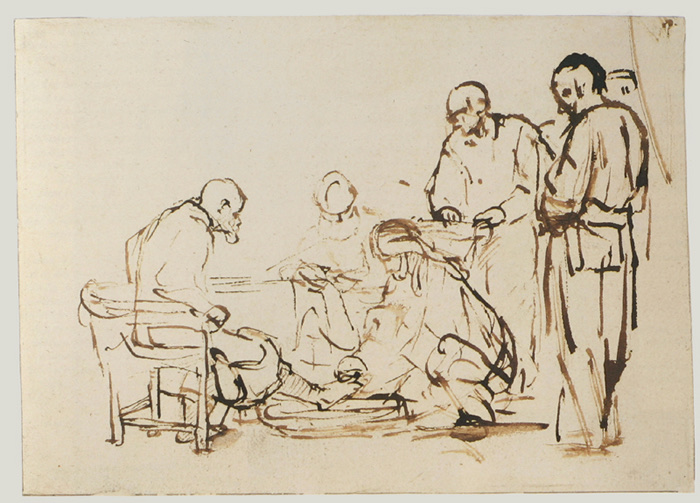
In chapter 13 of John’s Gospel we find the story of Jesus washing the feet of the disciples, the task of a slave. He later tells them that they must do the same for each other.

Rembrandt depicts the moment when Jesus washes Peter’s feet. He protests that he will never allow Jesus to do this menial task for him. Jesus says that only in this way can Peter have a share in his life. Peter then goes over the top and asks to be washed all over. Jesus is patient but makes it clear that any idea of being better than others is precisely what he is trying to get rid of.

Rembrandt wants to show what is involved in washing feet. He is not concerned with symbolism but with the posture which a person must adopt if he is going to wash feet. Jesus is hunkered down, balanced securely, so that he can reach out towards the feet. He is not playing games but seriously focused on the job in hand. He does not glance upwards at Peter, nor backwards at the other disciples. He is doing a practical kindness, a tender service.

Perhaps Rembrandt was remembering his depiction of Jesus healing the leper, the way he abolishes the distance between sickness and health. Here, while retaining his role as teacher and Lord, he abolishes the distance between commander and commanded, teacher and pupil. There is only a sharing of life: a dusty foot and a hand that washes it.

In a few strokes Rembrandt has depicted the radical simplicity of Jesus’ gospel.