In this series of blogs I am trying to understand the blessings of Jesus, which I translated in my blog of May 29, 2018, and have taken singly in subsequent blogs.

Happiness for those who show mercy:

mercy will be shown to them.

“Will be shown” – This kind of passive phrase in biblical writings usually refers to God who is not named out of reverence, but (as I will argue) here it may also refer to the habit of mutual forgiveness and compassionate care in the Christian assemblies.

The Greek ”eleémones” is used in the Gospels to refer to forgiveness of the neighbour, and to caring love, especially for the needy. On the one hand therefore it means restraint of condemnation, punishment and revenge; on the other it means the activity of forgiveness and practical compassion.

The Gospel narrative is full of instances of Jesus’ mercy, especially towards those designated as “sinners” by the righteous, and of his active care of the sick and the possessed. It is also clear in Matthew’s gospel that his announcement of God’s mercy was considered scandalous by the religious authorities. Jesus also announced in vivid language that the mercy of God would not be available to those who have no mercy on their fellow human beings. We do not need to take his words about weeping and wailing and gnashing of teeth too literally, or to conclude that the hard-hearted will never be forgiven, but we would be right to worry about the ultimate futures of those responsible for separating children from their parents at the USA/ Mexican border. They’d be well- advised to fireproof their asses.

Jesus’ blessing, however, promises happiness to merciful people, when the evidence suggests that his acts of mercy aroused the hatred that led to his murder, and that in many modern societies merciful people are mocked, patronised and often denounced as harmful. “Do-gooders” is a term of abuse. How then should we understand the happiness of the merciful?

The first answer is that acts of mercy promote human solidarity, although they are not done with that motive. Those who are forgiven are often enabled to form loyal and merciful relationships with others including those whom they have wronged. Those who are cared for often desire to show similar care to others. To be part of such a process of mercy is a genuine happiness, evident in first Christian assembly described in Acts 2 and 4, but also for example in the Buddhist Community of Plum Village in France or in the many groups of addicts who follow a 12 -step programme. This is in no way a smug happiness of conscious virtue, but rather a determination that neither past wrongs or present needs should inhibit the pleasure of being alive, with others.

The second answer is to do with the response of God. Jesus taught a shocking reciprocity between human and divine behaviour: forgive as our debts, as we forgive our debtors. Surely Jesus was not saying that God would allow his actions to be determined by human beings! It seems disgraceful, yet he went out of his way to assert it: “for if you do not forgive others, neither will your father in heaven forgive you.”  But this is no more than the obvious fact that those who condemn others will not inagine that they need forgiveness, nor will they trust in any teaching about God’s mercy to sinners, so they are already half- way to hell and in need of rescue. The same is true of those who exercise no compassion towards the needy. They will never imagine that they are in need of God’s compassion. Those who exercise mercy, however, will seek it from those whom they have wronged and from God if they are believers. They will trust in human and divine forgiveness, and will know the happiness of living in a climate of mercy.

And if that happiness were to catch  a hard-hearted person unawares, even just for an hour, or maybe even a minute, it might turn them towards the mercy they have despised.

Of course Jesus was promising an eternal mercy: in the world to come, in the Rule of God, mercy will be offered by God and the merciful will be able to receive it; kindness will be offered and the kind will be able to receive it. Jesus had such respect for human choice, that he could not imagine even the merciful father overuling the choices his children had made. Perhaps we can only say of the unmerciful, that God will wait for them to turn. But the merciful, even if their sins are as heavy as mine, will know mercy and be happy.


This series of blogs is devoted to exploring the blessings of Jesus set out in Matthew chapter 5 which I translated three blogs ago. Today I am looking at the fourth blessing:

Happiness for those who hunger and thirst for justice:

they will be satisfied.

Most of these blessings sound paradoxical; indeed in this case it seems perfectly obvious that justice- seekers are rarely satisfied, and that the more comprehensive the justice sought, the less likely it is to be found. Often people who have sought and obtained a limited justice go on to tackle greater and greater injustices, as for example Ghandi, who from his beginnings as an opponent of racism in South Africa tackled the greater problems of colonial rule in India, and was still working for social justice when he was killed. Was he satisfied? It seems that if we say he was satisfied we deny the continuing, burning commitment to radical justice which makes him important.

If we can ask the question about Ghandi then we can also ask it about Jesus, who proclaimed the arrival of God’s justice in his own ministry yet died on a Roman execution stake, as the victim of a Jewish kangaroo court. Was Jesus satisfied? Some Gospels mitigate the savage irony of Jesus’ death with pious utterances, which do not ring as true as the cry of anger accusing God of desertion that we read in Mark and Matthew. Even if we doubt all versions of Jesus’ last words, we can admit that John’s “It is finished” is probably meant to tease the reader into some recognition of Jesus’ satisfaction.

In this context I always think of something I once read in a newspaper and half-remember:

A TV company had sent a reporter, cameraman and driver into an African famine zone to get firsthand reports. The truck they used smacked into a huge boulder, wrecking the stearing and spilling the team out into the sand. At first, because of the heat they were glad to see the sun going going down, but afterwards, in intense cold, getting no phone signal, stood and shouted for help, although they could see nobody. Thinking they might freeze to death, they huddled together and waited. Out of complete darkness some men approached them, signalling them to follow. After an hour’s walk they found themselves in a small tribal settlement, where women attended to their wounds and bruises, before leading them to a warm shelter, where at last, they could sleep.

In the morning the headman of the village told them that they had very little food, because of the famine. Some of their number had already died of malnutrition. He apologised that they could not feed their guests as they would have wished, but invited them to share what they had. The tribe gathered in a circle, perhaps some thirty people including children. In the middle was a large wooden board, on to which families placed what food they had: a few tubers, some animal bones, one bit of something like bread. The headman blessed the food, broke it up, and passed it round. Each person had a morsel of tuber, a lick of marrow,a crumb of bread, except the children and nursing mothers who had double.

The journalist wrote that he had never experienced such absolute justice, nor had he ever felt so completely satisfied.

This incident is the best commentary I know on the so-called feeding of the 5000 by Jesus, where a body of people shares the little it has, yet all are satisfied. The explanation of the mystery is that every step towards justice is just, just as every step towards peace is peaceful. And every step is also a foretaste of the final justice promised by God, so that in addition to the present instance of justice, there is the prospect of something complete. The faithful person can be happy in the present instance of justice confident that more is to come. Martin Luther King the day before his assassination spoke of his happiness that he had climbed the mountain and seen the promised land: mine eyes, he said, have seen the glory of the coming of the Lord.

Yeah, maybe that makes sense for the great activists and saints, but what about the poor, the oppressed, the enslaved, the despised and rejected of our world, who may not have any chance to do more than long for justice, for whom there is only the longing without any instance of justice? For them the happiness is knowing that in God’s time they will receive recompense for all their grief, while their persecutors will get justice for their evil.

Surely I’m not meaning heaven and hell? Yes, better believe it, I sure am. But does God not forgive all sinners? No, God offers forgivness to all, but only those who are sorry for their evil can receive it; the rest remain in the darkness they have chosen. Some modern theologians dismiss this view of justice as primitive and in any case, beyond our knowledge, but I insist that unless I can trust in the justice of God for the oppressed of the earth, I cannot believe or worship.

There is every evidence in the Gospels that Jesus knew the present happiness of small justice achieved, while risking his life for the greater justice to come. His blessing issues from experience.


My last two blogs have explored the first two beatitudes or blessings of Jesus as reported in Matthew Chapter 5. The third of Jesus’ blessings is hard to translate. I have given it as:

Happiness for the gentle;

they will possess the Land.

The KJV has:

blessed are the meek for they shall inherit the earth

The word “praeis” is found in the Greek Old Testament at Psalm 37:11 where it translates the original Hebrew “anawim” which means afflicted, poor, God- fearing. Perhaps it’s not very different from the first blessing on “those who demand no power over others”, with in this case an emphasis on not demanding/ not having land. Every person in Israel was meant to inherit some of the land given by God. Powerful people, however , grabbled land for themselves. Gentle people might often end up landless.

The verb “ kleronomesousin” in Greek does have the sense of inheriting, that is, possessing what God has given. It does not mean only a legal right, more a social fact. The Greek “gey”can mean the earth, but here it is probably a reference to ”eretz yisrael”, the promised land.

So, how can the dispossessed, landless, gentle people “possess the land.”? The answer is in Jesus’ words to his disciples ( Mark 10: 29) that those who have given up family, houses, fields, to follow him will receive these gifts back tenfold in the shared life of the assembly of Jesus, where possession is communal. The gentle people are ready for this sharing which brings great human wealth and happiness. There is a future dimension to this blessing but Jesus knows that the happiness starts now, even in the midst of dispossession and poverty, where gentle people trust his word.

Those who are not gentle, but are ready to grab the land and its resources for themselves, are not happy, for the price of this kind of possession is insecurity, vigilance and the threat of violence. But if any such accept Jesus’ teaching, they will find themselves welcomed by the sharing assemblies, and will be converted by the happiness of possessing nothing yet posessing everything – as St. Paul puts it, “penniless, we own the world!”

So, the blessing is fulfilled already even in the midst of a greedy society where the rich and ruthless “possess”the land. But more is promised which has not yet arrived: The assemblies of Jesus offer a fuller measure of shared life, but they are in turn only a foretaste of the life of God’s Rule, which will come one day.

The Assembly where I minister at present has a drop-in free cafe twice a week for anyone who wants food and company. Those who attend have suffered multiple deprivations, but are ready to welcome me with grace and humour. They have very little but they know how to share. There are many sorrows in their lives but they know the happiness of shelter, warmth, food, affection and dignity. Many religious assemblies in this city provide something similar, and are committed jointly to creating a more just society.

I can see and experience the truth of Jesus’ blessing in these communities, but it is a revolutionary teaching in a society like Scotland, where so much land is in the hands of the idle aristocracy or has been increasingly grabbed by very rich institutions and individuals. Land which might well provide a living for refugees or homes for the poor, is being used for the various forms of killing which delight the powerful. This does not justify any violent expropriation of those who own too much of our common inheritance, but it would justify gentle people insisting on electing a government that would very gently pass land reform laws to bring back into public control and for public benefit, land that has been alienated by unfettered capitalism and medieval privilege.

Meanwhile faithful disciples should model themselves on the Assembly described in Acts chapters 2 and 4 which allowed gentle people to possess “the land” together.


Last blog began a series proposing a spiritual discipline based on the beatitudes or blessings of Jesus which can be found in my translation there. In this series I firstly investigate each blessing, after which I will suggest a way of using them all.

The second blessing is:

Happiness for those who grieve:

they will be comforted.

Jesus trusted in the Rule of God which would one day fully establish God’s will on earth, and he saw this rule arriving in his own ministry of teaching and healing. The happiness he promises does have a future dimension, but it begins in the present.

How can that be true for people who are grieving? This grief is not limited to personal bereavement, although it includes that, but covers also personal and communal grief at disasater, atrocity, oppression , poverty and injustice. How can there be any happiness for those mourning the death of a partner or a disaster which has affected a whole community? The Grenfell Tower disaster caused both personal and communal grief, so it provides a real test. Can there be any happiness for those survivors and relatives of victims?

The present public enquiry hints at an answer: although grief is not lessened by being shared, indeed it has in some instances been sharpened, the acts of speaking the grief and of listening to it confer a sense of privilege, of the preciousness of human sorrow, of the uniqueness as well as as the commonality of each particular sorrow, that constitutes a kind of happiness which those untouched by grief will never know. Is it mere rhetoric to call this happiness if it does not wipe the tears away? I don’t think so. Sure it does not lessen grief, but rather offers a profound experience of human solidarity to set against it, a happiness fragile but undeniable which does not deny the grief.

This precious solidarity is present wherever grief is shared, whether in a public investigation such as the Grenfell enquiry, or by two women in a maternity ward whose babies have been stillborn. The trust in which such grief can be shared is not a relationship only of the moment, but one which includes a future commitment to each other’s welfare and to a justice which tackles the causes of suffering. Anyone who is invited to share a sorrow, either as speaker or listener, is encouraged by Jesus’ blessing to trust this small good thing out of which the sorrow and its causes can be faced.

A230E2BD-FCFA-42B9-853B-39ECFAC2D199

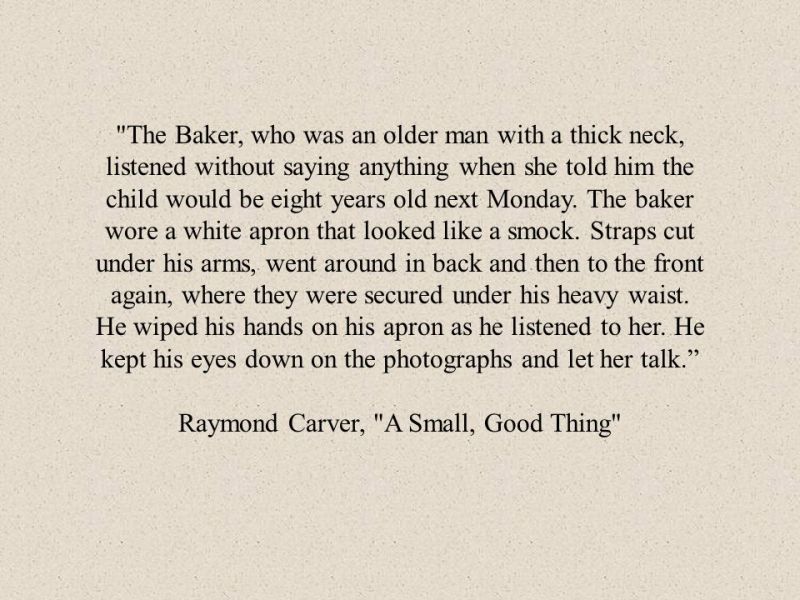
One of the very great pieces of writing I know is Raymond Carver’s short story, “A small good thing,” which recounts the tragedy of a young boy’s death, on his birthday, after a car accident. The terrible grief of his parents is accentuated by repeated phone messages from the baker whom the mother has engaged to make a birthday cake. He mistakes their lack of response as an attempt to ignore the deal they have made with him, and becomes slightly aggressive in his demand for payment. In the extremity of grief the mother decides to face up the baker, whether to shame him or destroy him is not clear. In the early hours of the morning the baker opens his bakery to them and is faced with the appalling fact of the child’s death and the inappropriateness of his messages. Instead of running away, or defending himself, the baker asks them to sit down, and serves them some of his new made bread, which creates a moment of peace in which they all recognise that the bread is a “small good thing” to set against the very large bad thing which has happened. Then the parents can talk and grieve with this stranger whom they know will understand. This summary in no way does justice to the beauty of the story – please read it for yourself- but it serves to model the happiness which arises from the shared truth of grief. Another American, e e cummings, wrote of this in a poem about his father:

His sorrow was as true as bread;

no liar looked him in the head.

The happiness of shared grief cannot be created by the lies of official regret, or the pious lies of conventional religion, or the intrusive lies of “sympathetic” media: it requires the recognition of fact: what happened and to whom it happened. This is nothing to do with the fashionble fatalism which says, “shit happens”: the fact is that tsunamis happen, but fires happen through negligence, chemical warfare is waged, terrorists kill people, children die of preventable disease, evil is done.

And when we open our hearts to share our own or another’s suffering, a fragile happiness is done.


I keep fairly fit on a diet of slow running and yoga, but I’ve noticed to my annoyance that in spite of these I’ve been developing a paunch which is certainly nothing to do with my liking for cheese and wine.

I reacted by looking online for “paunch- busters” and was astonished to come up with thousands of routes to a new slimline me, many of them simply fraudulent as they were using my body – shape problem to persuade me to sign up to everything from  Traditional Chinese Medicine to a Two -Week Holiday Programme of Tantric Sex. Although I was tempted (by the Chinese Medicine of course, since as a traditional Scot I’m averse to any sexual practice that lasts more than 2 minutes 57 seconds), I opted for some arduous crunches that I vaguely remembered from football training.

It occurred to me to wonder whether remedies for spiritual paunchiness were as well provided as for the physical variety. In fact, although the search for “spiritual disciplines” throws up all manner of offers, there’s not much recognition that a person’s spiritual condition might be flabby and bloated. Nor do the voluminous works of the “body/soul/ spirit” industry have much to offer to the needy people who want something just to see them through a day on which they face poverty, statelessness, addiction, chronic illness or disability; so two of the common ailments of the spirit, over-indulgence and deprivation, may go unhealed. That’s because the spiritual guidance sector sees itself as peddling a range of remedies much as a “health” shop peddles vitamin compounds and ginseng. They are consumer options rather than answers to real need.

The offerings of traditional religion, on the other hand, are deeper and more arduous: the Christian Ignatian Exercises or  Buddhist Zazen are not lightly undertaken because they require serious commitment if they are to be beneficial; and are not well-suited to a secular lifestyle because they were developed in monastic communities.

As a habitual bible reader, I know that there are small disciplines based on biblical material which address the needs of rich and poor alike: the ten commandments for example are the basis for both Jewish and Christian disciplines of daily life. The  Catholic Christian use of the Psalms is another example. I have in the past suggested the use of the Lord’s Prayer as a communal discipline. But in the following series of blogs on this site I want to advocate a discipline based on the Blessings or Beatitudes of Jesus, found in Matthew chapter 5 verses 1+12:

Happiness for those who want no power over others:

The rule of heaven belongs to them

Happiness for those who grieve:

they will be comforted.

Happiness for the gentle:

they will possess the Land.

Happiness for those who hunger and thirst for justice:

they will be satisfied.

Happiness for those who show mercy:

mercy will be shown to them.

Happiness for those who have clean hearts:

they will see God.

Happiness for the peacemakers:

they will be called God’s children.

Happiness for those persecuted in the cause of good:

the rule of heaven belongs to them.

Happiness for you, when they hurt you and persecute you and slander you for my sake,

Be full of joy and delight

Because the reward which awaits you in heaven is huge.

For in the same way they persecuted your ancestors, the prophets.

(My translation)

I intend to work through each of these, but in truth to enter into one of them sincerely is to enter them all.

These are not blessings in the churchy sense. The Greek “makarios” points to a person’s good fortune,  success or happiness, which are blessings in the old sense of blessings which are counted. Jesus is insisting that real happiness will come to certain people whom he proceeds to define. We can say that he was looking to God’s rule or heaven’s rule when all wrongs would be righted, but he also said that people should see this rule already present in his struggle with evil spirits. The sort of people named by Jesus would be rewarded by the rule of God now and in the future, but their happiness starts now.

Jesus was telling both those who practised these virtues and those who rejected them, that contary to conventional wisdom, happiness was to be found in them.

That’s what we want, whether we are the poor and powerless who long for something better, or rich and powerful who think there is nothing better than what we have: happiness. The first blessing is hard for the rich and powerful to believe:

Happiness for those who want no power over others:

the rule of heaven belongs to them.

The Greek says “poor in spirit” designating the those who are content with modest means and status, the Hebrew “anawim” who are often mentioned by the prophets. This is not a blessing on abject poverty, which is as Bernard Shaw said, “a crime and the mother of crimes,” but on the capacity to walk lightly on the earth, accepting others as equals.

This is a hard one for me, as I often have a proud spirit that wants to dominate others, although I have no desire for wealth and find it reasonably easy to give it away. But I detest losing an argument or being less popular that the next man. Why can’t others see that I’m right and charming?

How can I enter into this blessing of Jesus?

Well, he’s cunning: Right up front he promises happiness. Indeed he makes no demand at all. Simply points to where real happiness is to be found. Can he be right? The only way of checking it out is to try it. In this case that means letting go the desire to dominate and watching out for what happens. And yes, certain things do happen. Firstly I can relax with others rather than being ready every minute to fight for position. I can notice with interest and sometimes pleasure, what others are like. After a while perhaps I begin to appreciate the equality I enjoy with these others and to resent those who are always trying to be top dog. Already some happiness has come my way. That cunning promise has led me into a change of mindset, in which my wrong desires are disciplined not by threat of punishment, but by happiness! How extraordinary that what may make me a better person is neither condemnation nor even a rush to be righteous, but the ordinary experience of happiness.

When I get this far, I have begun to enter Jesus’ blessings but there’s much more to discover.


People who ask themselves in some moral dilemma, “What would Jesus do?”are no more naive than the rest of us, but maybe have greater confidence than most of us, in the contemporaneousness of Jesus. I use that word deliberately so that it’s clear I am not challenging his relevance. I suppose the classic Christian teaching is that Jesus was raised from death to be re-united with God, and is therefore as up to date as God. I agree with this of course -I’m nothing if not orthodox- but I just have this difficulty that when I imagine Jesus in contemporary society I imagine him as a first century Jew let loose in the here and now, with the wisdom and manners of his time and place.

There is every evidence from the gospels that Jesus was immersed both in the traditions of his people and in their contemporary troubles as a country conquered by a world empire. He is not at all like the Dead Sea Scroll people fleeing corrupt society for the desert caves, nor like a pharisee calling for holy living to maintain religious independence. He seems to have been an artisan with a passionate commitment to the immediate justice of God. His understanding of the economic life of ordinary people is seen in his parables, and his compassion for human need in his healing work.

Indeed the whole Christian doctrine of incarnation, that Jesus is the wisdom of God made flesh, depends on particularity: Jesus must be of his time and place, otherwise he is neither flesh nor fowl. “The Wisdom was made flesh and dwelt among us, and we saw his splendour – the splendour of the Father’s only son- full of kindness and truth”, this is either a historical statement or it is mythology. Jesus can no more be separated from his environment than any other being. He was and is, Jesus of Nazareth.

Perhaps then we can square the circle by saying that Jesus WAS a man of his time and place, but that NOW after his resurrection he IS as timeless as God and can relate equally to all times and places. That sounds a shrewd move, until we ask who exactly he is now. If we say he is the same as he always was, then he is still Jesus of Nazareth; if we say he is different, we risk making the incarnation irrelevant.

Traditional theology found a way out of this problem by telling a mythological story. God’s Son is “begotten” in eternity by God and shares God’s life; as part of a Trinitarian mission to rescue humanity, he is made flesh as Jesus of Nazareth, living and dying as a human being, but raised from death with a body (and soul!) marked by his incarnation, to continue his existence as the eternal Son of God. Even this story is carefully adjusted to avoid the notion that the Trinity learned something new through the incarnation.

I’m not sure if this helps me imagine a Jesus who might show me how to deal with Brexit or Donald Trump or my neighbour’s constantly barking dog. Certainly we could admit that the language of Jesus guiding our decisions is itself mythological and really means no more than taking his story into account in our living. That would give us some clarity: the Jesus we know is back then; we as modern disciples are the crucial link between Jesus of Nazareth and his contemporary relevance. Guided by the Spirit in the community of believers, we can say, “Jesus tells us to dump Trump.”

Amen. But it’s still not quite good enough. Believers want to speak about the agency of Jesus in their lives, as well as their own agency. St. Paul’s teaching about Jesus Messiah as a body in which each believer is a function, is a radical way of describing what’s happening in the life of believers: as they choose to share their lives with Jesus, they become the flesh of God’s Son, who continues his ministry in the world through them.

This kind of sharing is the basic mystery of Christian faith, and Paul’s body metaphor  is a way of pointing to it. There’s no way I can prove that Jesus acts in the world through me. In fact, as aoon as I write these words, I can see how ridiculous they are. Through me? Jesus? Aye, right. I can just about believe that Jesus acts through Muriel who runs the church drop-in cafe for people who struggle with addiction, but that he can act  through me is surely stretching a metaphor too far. And yet, yet, sometimes I want that to happen. I have a rough idea of what Jesus of Nazareth wants me to do, and I go for it, blindly, hoping that my sinfulness will not mess it up. At such moments I’m taking a risk based on the story of Jesus. But maybe, just maybe, Jesus is also taking a risk, entrusting some aspect of his ministry to me, and hoping I won’t mess up. The situation I’m trying to describe is very near the heart of faith, which is however not a solemn mystery, but more like a very robust joke, well actually an appallingly vulgar joke, in which something holy is placed next to something filthy, as when the creator put the organs of sexual love beside the organs of urination.

What I’m trying to say is that I often end up playing the role of asshole in the body of  Christ.

Amen.

TIMELINE FOR THE RECENT DISCOVERY OF LIFE ON MARS….

04/07/2018

NASA LEAK : A “senior source” at NASA reveals on WhatsAp that its miniaturised MarsDog had discovered life on the planet in the form of “something like a grasshopper”

O5/07/2018

PRESIDENTIAL TWEET: Sure is a great moment for American science. But don’t worry buddies, if the grasshopper turns out to be a bad hombre, your President is ready to nuke….

06/ 07/18

WORLD MEDIA: Images from Marsdog, released by NASA, show something like an insect whose movements are “not quite right”, “jerky”, “mechanical” raising the suspicion on some quarters that it is a drone. Probably an American drone according to The Russian Space Agency, designed to fool the world that NASA has triumphed; a Russian drone according to the White House designed to spy on American skills.

08/07/18

NASA PRESS RELEASE

Sophisticated computer imaging and spectroscopic analysis reveals that the object/ creature is made of organo-silicates. Some molecules of such substances have been  developed on earth, but nothing of this complexity. Life forms based wholly or partially on silicon have been the stuff of science fiction for a long time. On the other hand it could be the technology of a civilisation more advanced than ours. Marsdog cameras have shown that the thing has avoided/ evaded capture by its scoops and grabs.

09/07/18

UK NEWSPAPER THE SUN

WORLD WELCOMES SANDY!! The alien is made of silicon and silicon is sand, so it’s obvious what it’s name should be. We hope he’s happy, but wait a minute, IS HE ALONE OR DOES HE HAVE A PARTNER?? Called ALEC SAND RA??!!

AND IF SO, HOW DO THEY DO IT??!!! UP-SAND DOWNS OR IN-SAND OUTS.????

ONLY IN THE SUN- TOMORROW

10/07/18

SCIENTIFIC AMERICAN

EXCRETA PROVE ALIEN IS AN ANIMAL

Marsdog’s eye cameras have caught the Mars creature in the act of excreting, leaving a small, but perfectly formed cube a bit like concrete behind it. The most natural explanation is that the creature is what it looks like, an extraterrestrial grasshopper, which inhabits the silicon wastelands of Mars. This discovery suggests that a bigger version of the beast, if well-fed, could lay a decent driveway for you without really trying….

11/07/18

POPE SAYS SANDY CREATED BY GOD

As there is no mention of Mars in the Bible, could Sandy be the creation of a different God? The Pope along with the Chief Rabbi and the Ayatollah Khamenei denounced the idea of another God asserting that there is no other God except The Trinity, and …eh…Jehovah and um…last but not least, Allah. Although the planets are not named in the Bible or the Quran, believers have always assumed that their God created them, and would therefore logically be responsible for any life found on them.

The Pagan Association of The Americas has already claimed that of course, Mars, the God of War, is the creator of life on his planet. A representative of Thomas The Tank Engine Worshippers has insisted that the Fat Controller is the creator of Sandy as well as of Tank Engines and Yogi Bear.

12/ 07/18

MORE MARTIANS?

Almost all the ecologists on earth are united in arguing that Sandy (and his kind) cannot be the only form of life on Mars. If the grasshopper feeds, he probably eats other forms of life; and of course, unless he is the top predator, he may in turn be eaten by some kind of Martian bird. So far however, Marsdog has not identified any. This being the 12th of July The Orange Lodge of Belfast has identified Sandy as a good proddy insect and supporter of Glasgow Rangers Football Club, who unlike earthly grasshoppers is uncontaminated with the colour green. How do they know all this? Well, he’s a Sandy isn’t he, not a Tim, easy. Of course it would have been better if he as called Billy but you can’t aways get what you want. Posssibly the things he eats are Tims.

13/07/18

DAY OF THE GRASSHOPPER

Today at noon New York time all those millions tuned into The Marsdog webcam hear Sandy speaking to them. Afterwards they find that the audio recording of Sandy’s speech is silent. Yet all are agreed they heard him say something like this:

“Dear Earthlings, you think of me as Sandy Grasshopper, but I want to tell you the truth, that none of us Martians is an “I”  because we are connected each one to each one, sharing all our thoughts and  actions, so that “We” can learn very rapidly indeed. Our intellect is not based on a central brain but upon dispersed understandings linked together so that no experience is wasted. We are intelligence; we are knowledge. At this moment I can share the perceptions of a sister on the other side of this planet, along with commentary from numerous brothers and sisters, near and far.

We have been aware of you for some time, indeed for long before you started leaving your superannuated technology on the surface of our home. We bear you no ill will although we do not share your carelessness, arrogance and violence; but we do not think you have learned enough wisdom to welcome your presence here.

We  are averse to all forms of violence, but we are not without means of protection. Watch, please!

(At this point the viewers saw Marsdog ascending rapidly into the Martian sky, where it waved its antennae frantically, before gracefully descending to the surface.There were no noises or signs of power)

If you try to return here before you have abandoned your destructiveness, you can be sure your plans will not succeed. We wish you well. Goodbye.”

Journalists and media sources went into prolonged communication orgasm at this event, many of them trying to describe its meaning, none better than the Scottish Daily Record -famous for its frankness-

COSMIC KICK IN THE NUTS FOR NASA

14/07/18

Presidential Tweet: These goddam alien insects have got it comin to them. I am not afraid of a bunch of talkin cicadas. Tomorrow I will order a response with our nuclear missiles to this provocation. We shoulda known that a Red Planet would not be fit for Americans.

15/07/18

Statement by USA Head of Armed Forces:

Yesterday the armed forces of the USA forcibly removed the President from office to protect the nation and indeed the world from his childish and suicidal tantrums. God bless America!

16/07/18

Statement from the Vatican

His holiness Francisco has emerged from a day of prayer and meditation with this call to repentance:

Seeing that the unspoken basis of our faith has been the position of human beings as the pinnacle of God’s creation, a conviction determining alike our worship, morality and ecclesiastical order; and seeing that this basis is now proven to be an illusion, by the existence of an advanced civilisation on Mars, we call for a week of prayer and repentance throughout the world church, followed by a new ecumenical council in Rome to decide our future, if we have one. Anyone who doubts the seriousness of this crisis may reflect that I have recently defended the sacrament of Marriage as being designed only for the union of a man and woman. But what about the union of two Martian organo- silicate creatures with each other? Or more profoundly, can Jesus offer salvation to Martians, or is an ORGANO SILICATE SAVIOUR required for that purpose? We have a lot of thinking to do.

17/07/18

MEDIA REPORTS

Sources report widespread panic and suicides amongst fundmentalists of all religions together with revolutions in numerous countries where undemocratic regimes have been swept away by millions of protestors carrying flags with the slogan:

GIVE US THE GRASSHOPPERS

although there is no evidence that the mysterious Martians would be prepared to govern the earth.

18/07/1

ALL MEDIA

An obscure but very intelligent media agency, advertising itself as “ xtremejesus.co from Dundee to the world,” has claimed responsibility for hacking NASA and presenting the whole Martain saga, as a VIDEO PARABLE FOR OUR TIMES. What is left of UK security services are attempting to find and bring this joker to justice.

19/07/18

Scottish Daily Record headline:

SILI -CON


I made a promise in my last blog to continue my thoughts on the universe as an image of God, but this blog will be a slight sideways step as a result of being on holiday last week in the west highlands of Scotland, near Poolewe. The area is popular with geology students because it is composed of sandstone and quartzite resting on a bed of gneiss, an order which is occasionally inverted due to the phenomenon called the Moine Thrust, and to volcanic events. In particular, near Poolewe there are huge outcrops of gneiss, which are immnsely old, perhaps 2.5 billion years old. To touch something that old is in itself moving, not least in the realisation that this ancient rock and one’s own contemporary humanity are products of the one process of evolution. The gnarled surface of the rock is somehow familiar to someone like me whose own surfaces are getting a bit gnarled with age.

OLYMPUS DIGITAL CAMERA

The gradual discovery of the ages of the rocks of which the earth is composed, took time and intellectual daring on the part of the first geologists, not least because the notion that the earth was only some 6000 years old was derived from the Bible and therefore sanctified. Together with those who studied the origin of species, these investigators not only questioned the factuality of Genesis but more importantly the notion of a benficent creator God. For embedded in the sandstone, for example, were the fossils of thousands of species that no longer exist. It began to look as if the creator was a bit careless with his creatures. There were clergy who claimed that the fossils could be of animals drowned in the flood, but the evidence suggested that there had been repeated extinctions over time.

The poet Alfred Tennyson was aware of the work of geologists, such as Buckland and the Scottish pioneer, Lyall, who patiently noted the evidence of the antiquity of the earth and the vast number of extinct species. In his poem, In Memoriam, in which he reflects on the death of a dear friend, Arthur Hallam, he includes, for the first time in English literature, the facts proposed by geology:

There rolls the deep where grew the tree.
O earth, what changes hast thou seen!
There where the long street roars, hath been
The stillness of the central sea.

The hills are shadows, and they flow
From form to form, and nothing stands;
They melt like mist, the solid lands,
Like clouds they shape themselves and go.

Of course Tennyson is not simply reporting these facts; he fashions them as part of his language of feeling; even as he defines their intellectual shock, he embodies their mystery in clear images. Earlier in the poem he had wondered at nature’s preservation of the ‘type’ or species and her carelessness with individual lives, but later he realised that the truth was a good deal worse:

So careful of the type?” but no.
From scarped cliff and quarried stone
She cries, “A thousand types are gone:
I care for nothing, all shall go.

“Thou makest thine appeal to me:
I bring to life, I bring to death:
The spirit does but mean the breath:
I know no more.” And he, shall he,

Man, her last work, who seem’d so fair,
Such splendid purpose in his eyes,
Who roll’d the psalm to wintry skies,
Who built him fanes of fruitless prayer,

Who trusted God was love indeed
And love Creation’s final law—
Tho’ Nature, red in tooth and claw
With ravine, shriek’d against his creed—

Who loved, who suffer’d countless ills,
Who battled for the True, the Just,
Be blown about the desert dust,
Or seal’d within the iron hills?

No more? A monster then, a dream,
A discord. Dragons of the prime,
That tare each other in their slime,
Were mellow music match’d with him.

OLYMPUS DIGITAL CAMERA

The fate of extinct species suggests the possible extinction of humanity. Tennyson gives the troubling facts full value by representing them in eloquent and witty verse, allowing the reader to grasp how painfully they have entered his consciousness, and how unassailable seems their argument against religion and humanism.

It is startling to realise that what Tennyson sets against the challenge of these facts, is the one fact of his grief. Throughout the poem he gives so many instances of his tender love for his friend, and as many of his profound woe at his absence, that more than one contemporary reviewer wondered if such feelings were appropriate between men. Tennyson is less concerned with the propriety of the relationship than with discovering his identity as the one who has felt these emotions for  a person subject to natural processes. The death of Arthur Hallam does not invalidate the relationship or his emotions: they are as real as the processes of change. His identity as a friend of the dead man becomes the turning point of the poem:

That which we dare invoke to bless;
         Our dearest faith; our ghastliest doubt;
         He, They, One, All; within, without;
The Power in darkness whom we guess;
 
I found Him not in world or sun,
         Or eagle’s wing, or insect’s eye;
         Nor thro’ the questions men may try,
The petty cobwebs we have spun:
 
If e’er when faith had fall’n asleep,
         I heard a voice, “Believe no more,”
         And heard an ever-breaking shore
That tumbled in the Godless deep,
 
A warmth within the breast would melt
         The freezing reason’s colder part,
         And like a man in wrath the heart
Stood up and answer’d, “I have felt.”
 
No, like a child in doubt and fear:
         But that blind clamour made me wise;
         Then was I as a child that cries,
But crying, knows his father near;
 
And what I am beheld again
         What is, and no man understands;
         And out of darkness came the hands
That reach thro’ nature, moulding men.
Once upon a time I thought that Tennyson was just opposing his emotions to the facts. But no, the whole poem has built up the author’s identity with his feelings: he is the one who, in this place and time, loved this other man who has died and is unwilling to relegate his grief to the waste bin. The relationship and its emotions just as much defines his identity as do the new scientific discoveries: they too are fact. The entire poem is a way of saying, “I have felt”. It is in the confidence of this identity that the poet can face reality:
“And what I am beheld again
what is,”

/

The human being who loves, sees in the darkness the ‘hands’ that mould humanity. He is not referring to a natural process but to a personal creativity that transcends nature.
It is a momentous claim somehow modestly made. The reader does not think that Tennyson has gone beyond the facts he has presented. The immense vulnerability of this male mourner who can characterise himself as widowed, his very fragility, begets trust. His openness to his dead friend tempts the reader to share his faith in its importance. For we realise that his identity is not that of the isolated subject but rather of the person-in-relationship. The heart insists that it should not be considered as a mechanical pump but as an organ of love and sorrow.
This is a wisdom that comes from a close acquaintance with death, the brevity of life and the incomprehensible injustice of nature. It is “blind clamour” that makes him wise enough to see his individuality as dust, but his self-in-relation with human beings and God, as diamond.
Tennyson does not insist upon, indeed he may not have noticed, the similarity between this awakening and the classic Christian faith described by St. Paul
Jews demand miracles and Greeks look for wisdom but we are announcing a crucified messiah, offensive to Jews and foolish to Greeks; but to those who are called  by God, a messiah who is the power and wisdom of God. For the foolishness of God is wiser than human wisdom and the weakness of God is stronger than human strength.”
Through his continuing love of a person who has died an untimely death, and his broader awakening to a universal process of change and decay, Tennyson rediscovers a robust faith; in his bond with Hallam he has found something like the weakness of God, which gives him reason to assert that the “spirit is more  than breath.”
I would not like to claim the wisdom of a great poem for myself but only state that my own love of the Scottish landscape has been increased rather than diminished by the science which tells me that “the hills are shadows and they flow / from form to form, and nothing stands.”

The great Jewish philosopher Martin Buber famously distinguished two fundamental types of relationship in human experience, which he entitled “I – Thou” and “I – It”. In the former a person encountered another person and saluted him/her as the “other” , as a being transcending one’s own being. In the latter, the human person recognised some-thing which could be admired or studied or bought or sold, that is, as a being outside oneself but subject to one’s understanding or will.

Obviously human beings could deal with their fellow human being as both Thou and It, although Buber insisted that all profound relationships involved saying ‘Thou’ to the other, whether human, animal, vegetable, mineral or divine. Authentic religion in his view should never treat God as an “it” to be manipulated for one’s benefit, but always as the THOU encountered in and through every “I – Thou” relationship.  Blaise Pascal in the account of his conversion exclaims, “The God of Abraham, Isaac and Jacob, not that of the philosophers and scholars!”

The Theology of Karl Barth is founded on a distinction between the transcendent, personal God revealed in Christ, and the human, all too human constructs of natural theology and philosophy.

All the above have led me throughout my life to imagine a personal God (“God may not be a person, but he/she is personal.”), and to consider impersonal images of God as inferior and wrong. More lately I’ve begun to reconsider this using the first chapter of the book of Genesis as a sounding board.

Human beings are there said to have been created in the image and likeness of God, which is of course a justification for thinking of God as personal. But, as advocates for animal rights have asked, “Is there anything in animals which corresponds to the creator? Or anything in God which corresponds to say, the tiger?” To answer that question affirmitively is to depart not only from Genesis but also from the classical interpretation of the Bible as a whole.

Certainly to go further by asking if there is anything in the physical universe which corresponds to the creator, anything in God which corresponds to a black hole, is to open oneself to the charge of being zany.

Yet what about this?

Tyger, tyger brning bright / in the forests of the night

what immortal hand or eye/ dare frame thy fearful symmetry? ( Blake)

or this?

my will and my desire were turned by love

the love that moves the sun and the other stars (Dante)

For Blake the tiger is made in the divine image and likeness; for Dante the physical universe can co- respond to the love of God.

Surely these poetic examples remind us of occasions when we have seen the image of God in an animal, or understood that the heavens are telling tue glory of God. This last phrase from Psalm 19 reminds us that the Bible also says that animals and the physical universe speak of God. Well, yes, of course orthodox scholars will reply but they only do so as creatures or created things, not as bearers of God’s image. I invite the reader to enjoy reading chapters 39 and 40 of the book of Job, and to deny that its author has learned something about God from the goat, the ostrich and the hippopotamus, and that he is consciously questioning the notion that only human beings carry God’s image and can therefore understand his purposes. Perhaps many will accept animals as honorary humans, for after all we often do relate to them as Thou and not it.

So then we are left with the question, “Is the universe, its processes and history stamped with the creator’s image or not?” To answer this question I want to return to orthodoxy which insists that any discussion of the image of God must start with Jesus Christ, in whom it is perfectly seen. Barth would say the discussion stops there as well: nothing can be added to Christ, but orthodoxy would say that in the light of Christ, the universe becomes intelligible.

The story of the  virgin birth of Jesus is a way of saying that he is at once the child of God and the product of the universe.

He is the child of God through the love and faith of his family and people in which he is nourished, and through his own faith in which he offers himself to God. Another way of  saying that is to define the actor in all these events as the Holy Spirit, the God in whom we live and move and have our being.

He is a product of the universe in respect of his mind and body, which are wholly human. He does not have a son of God implant. His body is a product of the basic processes of the universe such as gravity. It obeys the physical laws of energy and the chemical laws of atomic and molecular interaction. It has developed from the first forms of life on earth, especially the developments of the eukaryotic cell, of multicellular animals, animals with backbones, life on land, the death of dinosaurs and the success of mammals, the emergence of apes and the naked ape called homo sapiens, all these provide the human dna of Jesus which is determined by the mating of Mary and Joseph…..

! But you said it was a virgin birth…??

The virgin birth is a truth of faith and not a bioogical fact. The ancients seem not have known about the ovum, so imagined the female tending the seed of the male. In the case of Jesus this doctrine says that Jesus’ identity as child of God is more important than his human seed: The Holy Spirit takes the place of the male. It’s a clumsy way of explaining the uniqueness of Jesus as a child of God. John’s Gospel rejects it and substitutes the phrase, “The logos became flesh and dwelt among us”, which is simpler but just as mysterious.

Nothing in the story of Jesus denies that he is a product of what we would call evolution, as well as of God’s spirit. St. Paul calls him the second Adam. That’s a momentous fact because it gives biblical writers permission to imagine Jesus as the purpose of creation, and ultimately as a participant with His Father in creation, like Lady Wisdom in Proverbs chapter 8. “All things were made through him and without him was not anything made that was made.” This links together the material process of the universe and the divine process of overcoming human evil and perfecting creation.

Jesus God’s child is also the natural process the Bible calls flesh which is shared with all living things. This dimension of Jesus is not a person to whom we can say, Thou, but the set of natural functions we know as human body-and-mind, an IT in Buber’s terms, which is nevertheless God. In this crucial instance, that of the Son of God, the express image of God’s being, a process of evolution becomes an image of God. Something impersonal composed of the same energy, matter and processes as the remotest galaxies, has become an image of God.

Is there a theological case for claiming the whole cosmic evolution as a divine image?

More in next blog

My daughter drew my attention to some remarks, published in the Guardian, by Elena Ferrante about Christianity and the Gospels, which seemed to me unusual and full of insight:FBCF6EF2-043C-4074-A683-09BFE660094F

“It happened when I was around 16. I read the gospels one after another, and the entire life of Jesus seemed terrible to me. The resurrection itself I found terrifying: not a comforting conclusion. I hope I’ll have an opportunity to recount that adolescent experience of reading in detail. Here I will say only that the story of the gospels seemed to demonstrate at every step that human nature, beyond some arrogant declarations of its centrality, was depraved, devoted to either crucifying its own kind and all other living beings, or getting crucified.”

I do not have this experience of the Gospels, but I can imagine the impact they might have on a teenage girl full of hopes for her life, and perhaps guided in her interpretation of them by a Catholic penitential perspective. There’s nothing in them about ordinary living and work, about growing up, exploring relationships, sexuality and talent; nothing about music, literature and art; nothing about travel, nature, culture and the planet. But they do present human beings as tested by the presence of God, by exposure to the perspective of the eternal foreigner. Ferrante’s comment that human nature is presented as depraved, “devoted either to crucifying… or getting crucified….” is a shrewd recognition that the gospels tell the story of Jesus as an ultimate conflict between God and the powers of evil, in which “ordinary living” is given very little room to breathe. They offer only the choice between the crucifiers and the crucified, and yes, the resurrection is terrifying precisely because even after the crucifixion, the disciples are not allowed to accept the defeat of Jesus, and return to ordinary life: he’s back, alive, and resumes the conflict with evil, through them.

There are no shades of grey in the Gospels, no subtleties of character such as would interest a young woman gifted in the depiction of character. Here there are only needy people who know their need, powerful people who know their power,  and Jesus with his band of disciples committed to meeting the need and facing down the powerful. Human life is a battlefield on which the powers of evil have all the big battalions, while the forces of goodness must rely on rescue coming from a God who will not however, rescue his own dear son. Ferrante’s right, it’s not an attractive picture.

But none of the Gospel writers speak in the tones of extremism or hysteria: their tone is always sober and matter of fact; this is the way things are. They are not popular reading with people whose lives are relatively free from suffering and oppression, but make immediate sense to the millions whose lives have always been under the cosh of their own weakness or the wickedness of others. Relatively comfortable believers like me, who appreciate the benefits of reason, law, democracy, not to mention music, wine, laughter and the quiet of mountains, think that the availability of all good things still depends on taking sides in the battle against wealth, arrogance, greed, selfishness, self- righteousness and intolerance in oneself and others. Read from that perspective, the Gospels are a story in which I always find myself, usually in the character of a cowardly disciple.

E0D3DEA3-5939-4457-B603-B35FF431B1D5All of this is not a dismissal of Ferrante’s reaction. Christianity does have an issue with the starkness of its fundamental narrative. It is the issue wonderfully depicted by Dostoevsky in the episode of the Grand Inquisitor, who succeeds in convincing Jesus that an institutional church with manangeable rules, rituals and rewards meets human need much better than the wild gospel proclaimed in Galilee. You don’t need to agree with the Inquisitor to wonder how some of Jesus’ terrible words can make sense to say, the young, able, single mother with two children, whom I met at a church family event last week. Yes, she knows a bit about betrayal, but above all she wants to put that behind her as she learns the arts of survival, for herself and her children, in the world as it is. And yet there she is, drawn to make contact with the body that acts in the name of Jesus.

Perhaps the answer to my question is to be found in Ferrante’s other criticism of the Gospels, that they see the welfare of human beings as all – important, to the neglect of other living creatures and the planet itself. That’s true, and it shows why the church has always said that the Gospels are only part of its scripture, which includes the whole of the Jewish bible, with other prophetic voices like that of Jesus, but also with voices which announce the wisdom of God’s creation, as Jesus did too. He praised the wisdom of the creator in making the sun rise on the just and the unjust. He placed his own mission within the will of the creator to perfect his creation. In the church’s theology the rescue of humanity is placed within the story of the creation of the universe, the Son comes to do the will of the Father.

There is room here for some hard work by the church, to formulate a doctrine of creation, in terms that use the best science available, placing human life in an ecological and universal context. Indeed, that is exactly what the author of Genesis did in his/her time, with a radical story of a God who has to learn enough humility to work with human -all -too – human beings in the rough and tumble of their chequered lives, rather than imagining he can solve the problem with a flood. The great stories of Abraham, Sarah, Jacob, Rachel, Leah, Joseph and his brothers are full of the nitty gritty of human families, living along with their flocks and crops, while struggling with their creator. 7F22F303-69F4-4212-80D3-DE171FE04DDE

This presentation of Christian faith might help Elena Ferrante and many others, to put the Gospel story in a wider context which does justice to all life and not only to God’s splendid, disobedient and often destructive human children.