Brexit27th Dec.

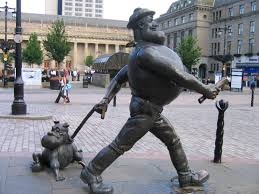
Couple of days after Crimbo but still no sign of the fitness watch I ordered from Amazon. Not for myself you understand. Definitely not. I may be 19 stone but I’m totally fit. I could easy run 100 yards if it wasn’t bad for my heart. No, its for the missus. Like I said to her when she was peching a bit carrying the turkey, “Yer gettin’ a bit porky dear,” I mean she’d hardly the breath to serve me. She didnae take it well. “I notice yer no’ gettin’ off yer fat arse to help me!” Now I’m not an unreasonable man, so I went straight online and ordered her one of those fitnesss watches that does yer blood pressure and measures how many steps you take in a day an’ that. So when it arrives she’ll have to admit I’m helpful. Might even get her to pay for it.

28th Dec.

Still hasn’t arrived. So I send Amazon a bit of stiff feedback and they have the impertinence to send me a standard email mentioning festive holidays for staff. Bloody typical! So there’s all these foreigners working for Amazon because no sensible native would work on these conditions and then they want a break at Crimbo as well! Like how many of them know anything about the meaning of Crimbo? I mean Santa Claus and yer turkey an’ that, they’re British, yeah.Like when it says O come all ye faithful it doesnae mean come all ye from bleeding Bosnia an’ Romania and poxy Poland. Anyway, if they take these rotten jobs away from us natives, at least they could work at Crimbo so we can get our orders on time.

And that’s another point when I think about it. Foreigners are too ignorant to deliver stuff for Amazon. I mean take yer average Bulgarian. Like he might know the road to… eh the road to…. the Black Sea or the Dardanelles – or is that in Turkey – and yer Pole might know the way to the Tatar mountains, but that’s no good for getting to Dundee or Forfar.

I say this to my stupit brother-in-law who’s arrived to scrounge a drink, and he tries to tell me that hardly any EU immigrants works for Amazon for that very reason, but  it’s all poor Scottish boys who’re officially self-employed with delivery firms that don’t allow toilet breaks. He thinks he’s won the argument until I say, “Just take a look at the names of the the bosses of they firms. It’s all things like Jaconelli and Scorpani, and guess what that means: Mafia! That’s another great gift from the EU. Before we had our own scumbags. Now these immigrants come over here and hijack our criminality sector.

He just shakes his head and says he must get to his bank because they’ve refused him an overdraft. When he tells me he’s with Santander, I just chuckle and ask him if he knows where they come from.

The Sunday before Christmas Sam woke up angry. In fact, he’d gone to sleep angry the night before. Now that he was nine, he reckoned he didn’t need to write silly letters to Santa Claus. No, like a sensible person he had simply asked his parents for what he wanted, namely, the new United home strip, the one his even his pal Jimmy didn’t have yet. He knew it was a bit pricey, but after all, it was Christmas. His mum hadn’t promised it, but she hadn’t said no either, so he thought he was in with a good chance. But that was weeks ago, and although he had peeked every into the cupboard where they always hid the presents, there was no sign of the strip. All sorts of other presents for other members of the family but definitely no strip, and now Christmas was only two days away. Only two days! He’d begun to accept that they’d decided on some other stupid thing instead. So, he was angry.

And it didn’t help that he’d got to go to church for the family service where he was supposed to act the part of of Melchior, a wise man. “I bring you gold for a king,” he thought, wondering not for the first time what use gold would have been to a baby. The cat was sitting at the top of the stairs, so he gave it a week kick, which made him feel better. During breakfast the dog was under the table, so he kicked it just to be fair to the cat. After breakfast his wee brother aged three wanted him to play, so he gave him a secret kick as well, and he started to howl.

Still angry, he left the house to walk to the church, noticing that Gemma Smith aged 5  from up the street, her with the sweet smile and the beautiful singing voice, which always annoyed him, she was standing, greeting on the pavement. Somehow that made him feel good, and ignoring her, he marched to the church. He noted with satisfaction that Gemma failed to arrive to sing her solo.

Once he had knelt before baby Jesus and said his line, he took his place just to the right of the crib, which meant that as everyone was singing Away in a Manger, he was able to give the holy crib a good nudge with his right foot. Immediately after, he felt a sharp tap-tap at his ankle, and looking down, saw that the baby Jesus was holding up his hand towards him. As he hesitated, the baby nodded, and he grasped the baby’s hand with his own.

Afterwards he would have liked to be able to describe what happened next. It was like a journey, yes, but a journey through nothing, through no space and no time, so that immediately he was in another place, a bit like a huge garden in the middle of which was a wooden bench, on which was seated the baby Jesus, looking remarkably, well, remarkably in charge of everything.

”Hello, Sam,” said the baby Jesus.

”Where am I, please?” asked Sam, feeling a little scared as well as daft to be talking with a baby.

”Beyond the universe,” the baby Jesus replied, “You can see if you look down.”

He did look down then at the millions of galaxies with their billions of suns and their trillions of planets, spinning in dazzling light for ever and ever and ever. In an instant he panicked and turned to run, but quicker than a thought a creature with wings picked him up, and placed him safely on a soft surface. The baby Jesus laughed, “Don’t be afraid, you’re on my hand.” Sam looked and it was true. The baby’s hand  was larger than he was. Somehow he was still able to be angry.

”I’m not staying here!” He shouted, kicking the hand, and jumping over what seemed to be a wall. He ran like the wind for minutes, then stopped to look, and saw that he was not pursued. Ahead of him was a mighty mountain. If he got over that to the other side, he’d safe from that baby and his hand. Oh the climb was hard, rough rocks, tangled heather, steep ridges, terrible cliffs, but at last he gained the summit, and was able to take his time descending the other side. He’d done it.

”Well done, Sam” the baby Jesus said.

Sam saw that he was back on the baby’s hand. “The mountain,”  he gasped, “What happened to the mountain?”

”In all that time,” the baby told him, “and with all that effort, you have climbed from one wrinkle in my hand to the next.”

Sam knew that the baby was speaking the truth. He was silent.

”I want to tell you two things,” baby Jesus said.

“Firstly, the creatures you sometimes think are small and unimportant are bigger and more important than you can imagine.

”Secondly, all gifts are good gifts.

Do you agree?”

”Yes,” said Sam, “I’m sorry about the kicking.”

”We all get angry sometimes,” the baby Jesus said smiling. “See you in church.”

Again he journeyed through a dark nothing, and came to, suddenly awake, in his own bed. It had been a dream, he realised.

He was careful to stroke the cat, pat the dog, play with his wee brother, before leaving for church. But there, standing greeting on the pavement was Gemma Smith.

”What’s wrong, Gemma?” he asked, laying an awkward hand on her arm.

”I fell and twisted my ankle, and I can’t walk properly and I’ll never get to church to do my solo!”

”If I kneel down,” Sam said, “You can climb on, and I’ll give you a piggy back to the church. Can you manage?”

He felt a bit daft in front of his mates, arriving with a wee lassie on his back, but he wasn’t too bothered. When he knelt before the crib with his gift of gold he remembered his adventure, and maybe so did the baby Jesus, who gave him a big wink.

”What are you hoping to get for Christmas?” the minister asked him as he prepared to carry Gemma back home.

“The new United strip,” he said confidently, “but all gifts are good gifts.”


Christ tempted1. Have you finished?

2. You should know better than to imagine I will ever be finished testing your faith. I will always be here, with you, in you…

1. In me? Surely not, unless I give permission you cannot be in me!

2. Ah, child of God, haven’t you guessed?

1. No, but you’ll tell me…

2. We’re not completely separate, you and I; I can ask because you’re already asking; I can doubt because you’re already doubting…

1. But you have shown me things I didn’t know, things I could not have invented….

2. I didn’t say we are completely the same, but you’ll admit that my thoughts are not foreign to you.

1. I can’t deny it, to my shame. But you’re against my convictions, opposed to my ministry…

2. I’m opposed because somewhere in yourself you’re also opposed. If there is no door, I can’t get in. So come on now, are you ready to give up your foolish mission, which as you suspect, can only end badly?

1. No. My father has sent me; I can’t refuse.

2. Dear, dear, your father, is it? Have you seen this father?

1. No but…

2. Touched, smelt, tasted him maybe?

1. But I have heard him. He speaks to me.

2. When he is speaking, can anyone else hear his voice?

1. No. This is not the hearing of the ear, but the hearing of the soul.

2. And what language does the father speak? Hebrew? Aramaic? Greek maybe?

1. He speaks the language of love, which is holy and should not be mocked.

2. I won’t mock, child of God, but why are you so sure that this father is not an invention of your soul, your noble soul that wants the dreams of your ancestors to be true, that the present evil age will pass away, and the new age of God’s goodness will dawn………… through you.

1. I do believe these dreams…

2. So God and you are not separate in truth. You speak and call it the word of God, you do something and call it an act of God. In reality, there’s only you; the father is a fiction.

1. We are not separate, but in your words, terrible spirit, we are not completely the same. The father does not force his way into unwilling lives. He can work for justice because I want to work for justice, he can heal because I want to heal.

2. But you only believe this; you have no proof.

1. If I can believe in you, surely I can believe in him!

2. But he wants you to do and say things that are foolish and dangerous, whereas I just want you to have a happy life. And remember all the evil that will be done in your name, and in the name of your father.

1. You showed me the evil, but you didn’t show me the good. The father permits evil, as you say, but he creates good. That’s fact. You may not be able to know it, but I and many others know that goodness is created every moment. That’s why I’ll listen to the father’s request.

2. I hope you see some good, Child of God, before you see some of the other stuff that’s got your name on it.

1. Amen.


Christ tempted1. These huge buildings, is this one your very own cities, Spirit?

2. As in all cities, I have considerable possessions here. This one is called Glasgow, in the nation of Scotland, which the Romans called Caledonia, the birthplace of an eminent Roman called Pontius Pilatus.

1. A man of blood, I’m told…

2. But we have moved forward some two thousand years, when human beings have built machines to fly in the air – you see? – and to speed along their roads, and to kill others at a great distance, yes, many changes, and yet here still your followers remember you and gather in what they call churches, to worship you along with your father…

1. God forbid they should worship me…

2. Ah, but they do, Son of God, in some cases along with your mother also…

1. How she would have laughed!

2. Often their meeting places have spires pointing to heaven, see there, and here, and here…

1. Why do they display the shape of the Roman execution stake?

2. That may one day be revealed to you. But look, here is one of your followers, a man who is admired because he helps boys to enjoy physical sports.

1. He should be a happy in what he does for them.

2. He should be, but he isn’t, because when he served as an altar boy in your church, your priest abused him by touching his private parts and raping him. Now he does the same to the children in his charge. No, Son of God, you can’t stop him or confront him, you are in my power, we are observers only.

1. It would be better for such a man that he be thrown into the sea with a weight around his neck! But I suppose amongst many disciples there are bound to be a few who go wrong?

2. Unfortunately, Son of God, the law courts of this and many other nations are discovering thousands of cases of such abuse carried out within your church by its leaders, both male and female.

1. But these crimes are utterly contrary to my teaching and example!

2. Indeed so, but they do arise from the power you gave them. Will you not entrust them with your joyful message and the management of your assemblies? You may teach them to honour children, but their power will enable them to abuse them.

1. God forbid!

2. As you know, God may forbid, but he will not prevent.

1. You say I will give them power, but you are wrong: I will ask them to be slaves to each other and to all in need.

2. I do not need to argue with you Son of God, but invite you to look at the evidence. A large part of your following is ruled by a priest in Rome, who is called their papa, and all priests are called father by their flocks. Even if the good man in Rome tells them to be slaves, won’t they have great power? And if they have it, won’t some abuse it?

1. So I will entrust them also with my specific commandment about welcoming children and never hurting them.

2. Yes, you will, my dear man, but they will pervert that very commandment to gain access to children. You cannot stop them, but if you do not entrust them with your message, your mission will end with your death. How much good would your followers have to do, to balance they evil they will bring on the world?

1. I thought you might be in favour of evil, terrible spirit. Why are you warning me in this way?

2. “In favour of evil”? No, no, just anxious, as always, to protect humanity from the worst follies of God.

1. Ach, thanks for bringing me here – the fresh breeze off the lake, the fishing boats coming into port, the wee hills of home..,

2.  Capernaum, yes, your place Son of God, but let’s just check. Perhaps you recognise this old fisherman guiding his boat to the shore..

1. Reuben Barezra, of my parents’ generation, a fine man! But….

2. Yes?

1. He died three years ago, in the prime of life. I helped to bury him, so….

2. Indeed, you’re right, we’ve gone back a few years in time. We can’t interfere of course, but we can observe

1. Ah!

2. A cry of pain, Son of God? Perhaps you’ve seen someone else you know….

1. Yes, there is pain, but also sweetness..

2. You’re looking at Rachel, daughter of Isaac the blacksmith, a fiery young woman certainly, and very beautiful, oh and who is this young man who joins her on the lakeside road?

1. (Silence)

2. She smiles at him as he walks beside her, and slips her arm through his…

1. Enough! That’s enough, terrible spirit. Yes, I loved her.

2. “Loved”?

1. No, “love”, in truth, I love her still although she’s married to a good man, and has a child.

2. So why did you reject her?

1. I didn’t reject her. I asked her forgiveness for the way I’d chosen which I couldn’t invite her to share…

2.Why not? Isn’t that the focus of your message, imviting people to follow you, imcluding women.

1. How could I ask people to leave their family lives, if I travelled with my wife?

2. So you deprived yourself and her.

1. Yes, some people make themselves eunuchs for the sake of God’s kingdom.

2.The damage you’ve done to yourself, you’ll do to others…

1. Damage, Spirit?

2. Because you choose to be celibate, you throw a shadow on the body, on sexuality, yes and even on women, which some of your followers will appreciate, and make darker. They will say that in order to be perfect, they must follow your example.

1.Those who know me will know my love of the body, of the joining of flesh, and of my sisters; those who do not know me but speak in my name, speak only for themselves.

2. But if, out of respect for your celibacy, vast numbers of both men and women, leave flesh amd family to live holy lives away from the temptations of the world, you’ll approve their rejection of God’s gifts?

1. It is a damned lie that we must all enjoy all good things at all times. Sometimes our fight for goodness means foregoing enjoyment in order to be free for the battle.

2.But still, Son of God, you long for your Rachel in your heart…and flesh…

1. Yes. I’d be inhuman not to.


Christ tempted


1. It’s the largest city I’ve seen!

2. This is Rome, Son of God, a city which is forever associated with your name.

1. Of course I know about Romans and their Empire….

2. I understand that by the end of your life, you may know more….

1. Why have you brought me here?

2. I’ll show you why, but firstly I have to tell you WHEN I’ve brought you here. We’re in the time of the Emperor Domitianus some sixty years after your untimely death, and we’re about to follow this crowd on one the great Roman roads, the Via Appia.

1. They seem happy, both men and women, often with children…..

2. They’re going to see a spectacle provided by the Emperor for the amusement of citizens, while it is also a terrible warning to the enemies of Rome, as you see, Son of God….. I notice you have gone pale with distress at what you are witnessing……

1. I have already, in my own land, seen a crucifixion or two. But so many men, on so many crosses along the road! And worse, so many people, including children, gawping at this sad evidence of human evil.

2. You may notice near the crosses, small groups of women who are weeping. These are the mothers, wives and sisters of those who are being punished.

1. May God comfort them! But what did these men do, to earn this pain?

2. As you might say, Son of God, they learned to do God’s will on earth.

1. You’re mocking me, my friend. Just give me the facts.

2. In Rome the citizens accept as a respectful custom that at certain altars set up in public spaces they will burn a pinch of incense to the divine Emperor. Everyone does this. It’s no more significant than saying they’re glad to be here. Even enemies of the state, who desire to overthrow it, burn the incense because it hides their purpose. Even some Jews do it, while remaining faithful to God, believing as someone sensibly said, that you can give to Caesar what belongs to Caesar, and to God what belongs to God.But your followers refuse to do it.

1. And for that omission, they are condemned to this!

2. No, no, this is merely the end point. Romans are merciful. First they torture them and let them go if they promise to be good citizens. Many of your followers have benefitted from this generosity.But some, determined to do God’s will rather than Caesar’s, have chosen this extremity. Is yours a good legacy, Son of God?

1.I did not invent the Romans

2.But you did invent the stubborn people who oppose them.

1.Perhaps these victims of the state trust me and my teaching but if so, they have freely chosen to do so. I may have introduced them to the Father, but they are acting as his children in their own way and in their own time.If they believe that the honour of God requires this sacrifice, I bow to their courage. If the Romans were half-civilised they would avoid such abominations.

2. But you can’t deny surely that these deluded disciples are following your example in refusing to bow to Roman authority even in the face of torture and death….

1.You forget I am human, unlike you, my friend, and have no knowledge of the course of my own life.I will advocate neither rebellion nor violence against Rome. I will encourage people to work peacefully for God’s rule in the world.

2.And here they are, dying for that advice. The least you can do is to accept responsibilty!

1. That’s because you have a false view of leadership: you think leaders demand obedience from their followers and can claim credit or accept blame for what they do. In fact good leaders present clear example and wise guidance. If their followers do well, the credit is their own. If they take risks, the courage is their own. If they make changes to the leader’s guidance, the responsibility is their own.I followed John the Baptiser, but he is not responsible for any good or ill done by me.

2. To give one’s life for a cause, Son of God, is to make the cause more important than life. You may come to realise just how dangerous that can be.


Christ tempted


1. Peace to you, Son of God.

2. And to you, peace, child of heaven.

1. For a long time I’ve been going to and fro upon the earth, but I remember where I belong.

2. I was half-expecting you. After all this time in the desert I was getting bored talking to the rock-badgers.

1. I think I can assure you that I won’t be boring.

2. So welcome, with whatever you bring me. It couldn’t be food could it? That bag on your shoulders? I could break my fast with no dishonour after thirty seven days. To be truthful I’m so hungry I could eat these stones.

1. If you really were the Son of God, surely you could change them into bread.

2. As it is…..

1. We both know you can’t…..

2. So your logic says….?

1. You’re not the Son of God.

2. The logic is good but it only works if your premise is true.

1. You mean …

2. Where is it written that a Son of God must be able to perform tricks with stones? Isn’t that such a trivial notion of closeness to God that you must have known I’d reject it.

1. I thought it probable.

2. So why use it?

1. I thought I should push you to define what on earth you mean by thinking of yourself as God’s child. If it’s not miracles, what is it? Is it worth troubling the world with it?

2. It’s being able to call God, Dad.

1. That may be interesting for you, but why should anyone else be bothered?

2. Can we move a little into the shade of this rock? You’d be right of course if it was merely a matter of personal privilege. But I call him that because I am able to do his will in the world: to speak his truth, to do his justice, to offer his love, to bear his suffering…

1. You alone?

2. No, not at all! If I can, so can anyone, that’s the whole point, that’s how God’s kingdom will come, when his will is done on earth as it is in heaven. That’s how the ruler of this world will be defeated.

1. Oh dear, yes. So there will be a message, there will be followers, there will be a belief that you are the Messiah and even if you fail, they’ll be ready to carry the message to the ends of the earth. Oh dear.

2. What’s this strange sorrow? You’re not known for your compassion.

1. My compassion is my opposition to the half-baked schemes of God, who’s always trying to catch up with the mess he’s made of creation, while congratulating himself on his wisdom. But a Son of God with similar arrogance is an additional burden for me to bear.

2. You have me wrong, my friend. I’ll claim no privilege, demand no power, claim no titles, start no wars, but only convince some men and women that they too are God’s children.

1. Son of God, have you any idea how their message will conquer the world, how much power it will give to those who use it, how much suffering it will bring to those who are abused by it, how much evil will be done in your name?

2. I do not.

1. Then I must educate you. We have a journey to make, together, but you’ll find me good company.

(more to follow)

I left my last blog with an unanswered question about unanswered prayer: what can be said about those who pray for a loved one, or for the cause of justice, and experience no answer – the person dies, the cause fails? I used the example of Jesus himself, praying to be spared torture and death. His prayer is depicted as agonised, but God’s lack of response is made respectable by the Jesus’ submissive words, “Nevertheless, not my will but yours be done.” Clearly if submission to God’s will were the whole of faithfulness, asking God for anything would be a waste of time. Instead Jesus represented his own cause with words and tears.

Let’s take a look at what’s going on here.

Believers talk about the presence of God, but of course they do not mean that God is available like some kind of supernatural gloop. Better theologies say he/ she is present as person to person. But how is this divine other experienced? Again not as a a divine spook, but rather without material presence. The usual way of describing this is to use the word spiritual. But where does a spiritual presence happen? Surely in the mind, or better, the imagination, of the believer. We imagine God. That does not mean that God is unreal, just that we contribute, through what we have learned, to the image of God that we recognise when we speak of God’s presence.

When we pray, ths imagined image is very important. For example, is the presence male or female or somehow both or neither? That will depend on what we have learned about God from our sources and our religious community. When we say our prayer was unanswered, we mean first of all that what we asked for did not happen. But secondly we may mean that we did not even experience a negative response, some sense of God saying “no.” There are people who have reported to me their sense of God’s refusal of their petition, sometimes accompanied by comfort and  encouragement to wait. In most cases, these refusals were seen as espressions of God’s love.

It may well be the case that some experiences of God’s silence come from an inadequate imagination of God which cannot see “no” as a possible answer. If so, richer learning may help the believer to a richer prayer life. Biblical and other resources can help people see prayer as a more varied drama than they had previously imagined. (Caution: the training of the imagination for prayer is not a confession that “it’s only a pious game.” God uses our imagination as well as our other mental processes.)

But there are occasions where experience of the silence of God is final. The ears of our best imagination can detect nothing. We may like Jesus, feel that God has abandoned us in the time of our greatest need. Like most of humanity we are left to face whatever suffering comes with whatever resources we can muster.

At such a time I would encourage people to imagine that God has fallen silent a)because there nothing that God, who never intervenes by force in the world, can do about the suffering; b) out of respect for the human person who is suffering; c) because there is no suffering which is not also suffered by God. This may not be at all comforting to the suffering person, but it may give courage to bear what even God cannot change.

Did I just write “God CANNOT change”?

I mean God cannot change it without ceasing to be the God he/she is, one who gives total freedom to creation, from particles to human beings, to develop towards perfection. Whatever mistakes are made, whatever evils are committed, God will not impose his/her will, but will only work by persuasion. To do otherwise would be foreign to God’s nature. If climate change leads towards the extinction of life on earth, God will not intervene to stop it.

So when we bear the destructiveness of nature or the malice of humanity, we share the pain of God as God shares ours, in the partnership of suffering love, of which the brutal death of Jesus is the historical sign. If in faith we can imagine this, then in spite of God’s silence, we can still pray and maintain that partnership, even saying to God as the poet Paul Celan did in the name of persecuted Jews, “Pray to us, Lord, we are here.” The weakness of God makes this strange equality possible.

Paul says that those who share the labour pains of God in Christ will also share the glorious freedom of the children of God. In the world of time, this is promised in the future, but those who move out of time, dying as partners of the suffering God, may experience this victory “now.” This of course is still a product of my imagination schooled by the church and its bible. But if my imagination of this victory is mistaken, then I would regard the whole of my faith as nonsense. So beyond all other prayers I pray for this victory, for the creation and for myself, trusting that neither I nor the Bible are mistaken, and that the One whose suffering I have shared will let me share his/her splendour.

Maybe this is not what has been traditionally taught about prayer, nor does it meet the requirements of fervent souls whose hands are ever in the air, but it is all the better for that.


The Lectionary, a prescribed list of Bible readings for every day of a three year period, used by many Christian denominations, tells me that this coming Sunday I should provide some kind of meditation on the story of Hannah from the first book of Samuel in the Bible. Samuel was a prophet and leader of Israel during the reign of  its first king, Saul, and Hannah was his mother.

FBCA54EE-6382-4791-9262-35A1014D5EFF

The story of his birth goes like this. Hannah was one of the wives of Elkanah, who loved her in spite of the fact that she remained childless while his other wife had many children. At times Hannah was mocked by the other, making her bitter and determined that she would conceive. She went to the sanctuary and prayed that Yahweh God would give her a child. In fact she promised that if she gave birth to a son she would dedicate him to God, that is to the work of the sanctuary. The presiding Priest Eli seeing her mouth moving with no sound, accused her of being drunk, but when she responded with her story, blessed her and her prayer. She went home, lay with her husband and conceived, giving birth to a son whom she named, Shemuel, or Samuel in English, which she thought was connected with the verb “Sha’al” to ask, as she said, “I asked him from the Lord.”

Subsequently, she takes the weaned child and offers him to the Priest for the service of God. The story also gives her a song of thanksgiving to God which emphasises that God has no respect for human status and often raises up the downtrodden and despised. It was used by the Gospel writer, Luke, as a model for Mary’s song, the Magnificat.

What has this story to say about prayer?

It looks as though Hannah’s prayer is a success. God pays attention to the childless and humiliated wife by giving her the child who is destined to be a leader of Israel. She has gone public with her humiliation by going to the sanctuary to confront God  with it. She does not shout aloud, but she prays in the “presence” and tells the Priest what she is doing, so that he adds his weight to her petition.

But she has of course altered her own desire for a child to include her vow that he will be dedicated to God. The reader is meant to feel the weight of this vow and to imagine the wrench of giving over her toddler into the care of the sanctuary. She does not know in advance that the child will be a great leader and that she will be honoured as his mother. She simply offers back to God the child whom God has given to her.

So, good result? Prayer works, especially if what we want can include some kind of bonus for God? But if we believe that God intervenes in worldly events then we might also say that God intervened to make her childless, SO that she would pray to him/ her, and humiliated SO that she might promise her child to the sanctuary, BECAUSE from the start God had destined the child of Elkanah and Hannah to be his/her servant. Behind the dreams and desires of human beings is the dream by which God channels his/her goodness into the world. Something like this view of the overarching imagination of God may have been in the mind of the author of the books of Samuel, who was one of the greatest storytellers ever.

But can I share his sense of God, and in particular should I encourage people with urgent concerns to pray as Hannah did, in the expectation of a positive outcome? Indeed should I myself pray expecting a positive answer, and if I don’t have that expectation, why should I pray at all? The playwrite John Osborne once compared the God of prayers to a hoover “that not only doesn’t beat as it sweeps as it cleans, but actually blows the bloody dust all over the house.” In my work as a clergyman I have known so many situations where people prayed in faith and agony for some good to happen, and it did not. It did not happen. One can say, God has his better purpose. One can ask why mere humans should expect God to arange the universe to suit them. But the truth is it did not happen. It did not happen and the child died. It did not happen and dementia got worse. It did not happen and he did not come back alive from Iraq. It did not happen and they were in Japan when the Tsunami arrived. The good did not happen, but the bad thing did.

And of course, if people have been told to pray, then when it doesn’t work, they sometimes blame themselves. If they had lived better, or had more faith, it would surely have worked. To the shame of the church, sometimes its representatives have defended God by blaming humanity.

An omnipotent God who controls worldly events, sometimes intervening in response to prayer and sometimes refusing to do so, is a powerful but not very likeable invention. Hannah might ultimately disown a God who made her childless so that she would promise her child to his service, just as I would disown a God who allowed Jean Andrew’s girl to die of cancer, but found a parking space for the Baptist minister because he prayed.

I believe in a God in whom we live and move and have our being, who never intervenes, even when Jesus prays for his life to be spared. My invention is of a God who clears a space within the divine being for creation, which continuously takes place through the divine energies, just as a foetus in the womb grows through the energy of the mother. All of creation is continually nourished by God’s creative wisdom. But human beings are given a choice whether to recognise themselves as God’s children, consciously accepting God’s wisdom, or not. When human beings decide to be God’s children, divine goodness flows into the world through them.

When we express our profound desires in prayer to God, we first of all test our wisdom against God’s, our version of what is good against what we know of God’s goodness. This is what Hannah does: she expresses to God the bitterness of her heart. She who has been created by the God of life to bear life has been left barren. He has humiliated and disregarded her. Her prayer has no false piety, but she speaks with passsionate honesty before God. Somewhere in her prayer she meets the divine wisdom, which gives life to all things; and mysteriously her own womanly creativity aligns itself with God’s and she no longer demands but offers herself as God’s partner in goodness, and her child as God’s servant. By expressing her passion to God, she has opened herself to the passion of God.

Now she can go back home with a smile to lie with her husband and conceive. Yes, like many Bible stories, it makes good sense even to readers who have no faith in God. Surely her anxiety and shame about not conceiving are psychological and physiological barriers to conception, and once she has got them out of her heart before God, she is ready to conceive.

The author of Samuel would not have expressed his theology as I have. His way was to work through a succession of subtle stories, involving passionate and sometimes ruthless human beings, to express his profound sense of the involvement of God with his people, God’s desire that they should share divine goodness. These are not simple stories, but had been told and retold by his people over years, gathering new insights, and incorporating new truths. Clumsy, doctrinal interpretations of his work have turned them into mere historical accounts or moral lessons, sapping their energy and hiding their humour.

We can begin to recapture his vision by seeing Hannah as she is: a feisty, angry and passionate woman who tells her soul’s truth to God, and finds herself seduced by God’s desire, to give life to her people through her child.

Yes, yes, you may say, prayer is OK when it does what it did for Hannah, but about Jesus and Jean Andrews? That requires another blog.


I love poetry, but find that the public poems associated with Armistice Day, are the sort that cause the hearers no trouble, leaving them with a vague sense of heroism and sacrifice, rather than anything that might give awkward glimpses of the reality of war. The poets of the 2nd World War are less celebrated than those of the 1st War, perhaps because their response to its horrors is less horrified and more experienced than their predecessors’. There is nothing in their works like the astonished anger of Wilfrid Owen but sometimes their laconic acceptance of the nature of war is itself their most powerful protest against it.


FC22F48D-2428-427C-8237-FD8DDCB88FE9
A dead German soldier beside his bicycle

Here is a poem by Keith Douglas who fought in the North African desert battles and was killed in Normandy.

“Three weeks gone and the combatants gone
returning over the nightmare ground
we found the place again, and found
the soldier sprawling in the sun.

The frowning barrel of his gun
overshadowing. As we came on
that day, he hit my tank with one
like the entry of a demon.

Look. Here in the gunpit spoil
the dishonoured picture of his girl
who has put: Steffi. Vergissmeinnicht.
in a copybook gothic script.

We see him almost with content,
abased, and seeming to have paid
and mocked at by his own equipment
that’s hard and good when he’s decayed.

But she would weep to see today
how on his skin the swart flies move;
the dust upon the paper eye
and the burst stomach like a cave.

For here the lover and killer are mingled
who had one body and one heart.
And death who had the soldier singled
has done the lover mortal hurt.”

This poem is from the desert where, as in the case of the first Iraq war, the remains of arms and men are preserved long after in the hot dry air. The poet pays attention to an enemy, without prejudice or sentimentality. He was a killer who had tried to kill the poet, but failed and persished.

The real emotion of the poem is conjured by the picture of the dead man’s girlfriend, stuck in the gunpit, with her message, “Steffi, Vegissmeinnicht.” Steffi ForgetmeNot. Well now he has forgotten her, as his decaying corpse is mocked by the pristine state of his weapons. His humanity is recognised by the stroke of genius in which the poet imagines how his girl would feel if she saw him now:

“how on his skin the swart flies move

The dust upon the paper eye

and the burst stomach like a cave.”

The insult to his body along with the thought of his girl, move the reader to grief and recognition of what war does.

The final verse sums up by stating that this man was both a lover and a killer, a life-giver and a death-giver, and that in this case, death has wiped out life and loving. This dead foreigner is given his dignity by the poet, but only as part of a sad acceptance that war puts in question the dignity of all its participants. It is not a loud and angry poem, nor does it preach a message, but once you read it you know that remembrance has to be more than poppies.