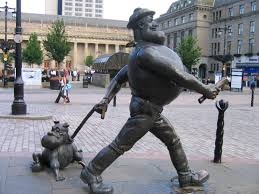
I recently found this carefully written on the wall of a restaurant toilet in Dundee:
Brexit’ to be followed by Grexit. Departugal. Italeave. Fruckoff. Czechout. Oustria. Finish. Slovakout. Latervia. Byegium. Scotfree….
I’ve no idea where the wit originated but there’s something very Scottish about choosing this method of communication.
This other response to Brexit was sent me online by a Scotswoman:

referring to the Remain vote in Scotland and London. I’ve culled these flowers of wit for St. Andrew’s Day because I think they illustrate my notion that Scots are not especially brave or bright but they just may be the one of the funniest cultures in the world. Now let me qualify that a bit. Without doubt the Irish are the funniest at “laugh till the tears come” humour, just as the Russians are tops for the darkest humour in the world. But Scotland gets the gold for what we would call “pawky” humour, meaning humour that is sly, indirect, and subversive. I admit this claim has been bolstered by hearing a few days ago on the radio the sweet surrealist musings of Ivor Cutler, famous for his saying, “Imperfection is an end; perfection is only an aim.”
I’ve used the word “pawky” which may be unfamiliar to readers outwith (Scots for “outside” of an area) Scotland and Northern England. It derives from a anglo- saxon word “pauk” meaning a trick or stratagem, and is used to describe a dry and dissident wit. There is also a tradition of savage wit in Scotland, but it is not pawky, which refers to only to utterances which have a certain lightness and indirection. The pawky person does not charge at her target like a bull, but moves a little to the side, the better to find a weakpoint. When Billy Connolly wants to puncture a kind of pious pity of his Parkinsonism, he remembers his doctor’s advice that in public he could conceal his trembing hands by putting them in his pockets. “But then when I saw what this looked like on camera, I realised it wouldnae work……” The obvious vulgarity of much of Connolly’s wit dsguises its delicate fantasy, its pawkiness.
I grew up in Glasgow with many pawky people, not least the hero of my teenage years, Gibb Gillies, a friend of my family, whose capacity for the sideways look at people and events was a constant delight to me. He was the headmaster of Scotland Street Primary School, and ever ready to test my knowledge.
“Who discovered America?”
“Christopher Columbus,” I answered.
“Did all these Indians live there all that time without discovering it?”
or
“Was Jesus a Christian?”
“Of course,” I answered.
“You mean he believed in himself?”
or
“Is Jayne Mansfield a stoatir?” ( Well-built woman)
“Oh aye,” I answered.
“Exactly what is it about her that stoats?” (stots)
I knew the answer to that one but he knew I couldn’t manage the adult langauge to tell him.
The pawky Scot is a bit sceptical about the relics of St. Andrew. Knowing that the Scots Crown and Clergy were anxious to get into the lucrative pilgrim trade, we realise the sooner or later some bits of some apostle were bound to end up here. We had plenty ordinary second string saints before that, Columba, Aidan, Mungo and the rest, but obviously their dessicated bits and bobs were not good enough to put us in the premier league for pilgrimage, and so they had to be relegated with Andrew’s arrival.
The Reformation Church may have made some mistakes – it wasn’t noted for its lightsome heart or pawky humour- but it surely did get right the notion that the biblical word “saints” meant the whole people of God, as a community and individually. My older friend Gibb who was utterly devoted to children throughout his life, and was prepared to educate me for life in his spare time, is a more relevant saint to me than the good Apostle, who as Simon Peter’s brother was doubtless experienced in shuffling out of the spotlight. Throughout some fifty years of ministry, I’ve served the saints, and although they have been often at odds with me, (and often rightly) I’ve never ceased to see them as holy and to marvel at their gifts. With their own pawky wit they have never ceased to demand that I recognise them, and myself, as ordinary grade sinners, whom only Jesus would recognise as anything else.
Aye, Jesus. That reminds me that I like to think of Jesus as having a Scottish side, and therefore a pawky sense of humour expressed perhaps in calling his flakiest disciple, “The Rock,” or in travestying the judgemental nonsense of Pharisees by a mime of writing in dust, or indeed by healing an apparently dead girl by saying, “Time to get up, my wee dove.”
His firm conviction that known sinners and the poor were the preferred subjects of God’s kingdom, may also be called pawky.

 The guilty verdict and life sentence passed today on Thomas Mair, for the murder of Jo Cox MP, brings sombre thoughts, not least because rhe murderer shares my surname and nationality. There is something about the face to face stabbing amd shooting of a defenceless person which seems particularly barbaric, although I know that targeted drone strikes are in fact worse. Any butchering of a human being for political reasons diminishes us all.
 “You have heard that they said, Thou shalt not kill. And if anyone does kill he must answer for it to the court. But I say this to you. Anyone who is angry with his brother shall answer for it to the court; and anyone who calls his brother worthless will answer to the Council, and anyone who slanders his brother will answer for it in hellfire.”
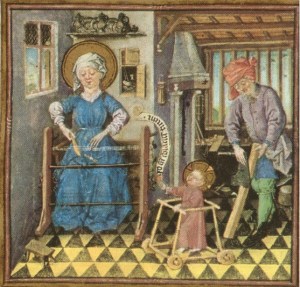
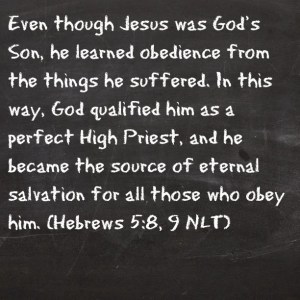 The logical answer given by some theologians is that of course we cannot learn pefection but must be born again through the spirit to share in the divine life of Jesus and of the Father. They called this theosis, becoming like God. I see the point of this theology and admire its scope and severity, and for a moment I’m tempted to dismiss all this blog as crude, worldly, banter which cannot conceive of either the corruption of human nature, or of the divine perfection that rescues us. Tempted but not convinced, for in all its logic this theology does scant justice to the human capacity to learn or to the one who taught perfection, the Rabbi from Nazareth who ate and drank with sinners and “learned obedience through suffering.”

 As I say, I can only make suggestions for my tradition. The food bank I support is run by Muslim people and distributes to non-muslims. It is called, “Taught by Muhammed.” I am sure that true Islam has much to contribute to opposing the forces of hatred. My local Sikh temple with its open kitchen and fellowship is already breaking down barriers. Green politics, of which I am an ignorant admirer, will surely develop its own relevant opposition to those who hate their own planet. And so on.
 Yes, I suppose I agree with Scottish and English footballers wearing poppies at their match on Friday, but I do not agree that the poppy is not a political symbol. It used to be a-political, I think, as long as you weren’t a Kraut or a Nip, but in the last five years it has become a symbol above all of a kind of politics that elevates the UK, excusing all its crimes and glossing over all its current contributions to international disorder, at the expense of Johnny Foreigner, especially if he lives or works here. Hugh McDiarmid once said that Scotland would not be free intil the last minister was strangled with the last copy of the Sunday Post. I do believe that the UK will never be sane until the last right-wing bigot is buried with the last copy of the Daily Mail protruding from his mouth. Of course I hasten to add that Jesus loves even right-wing bigots, but He is famous for being less particular than most of us.
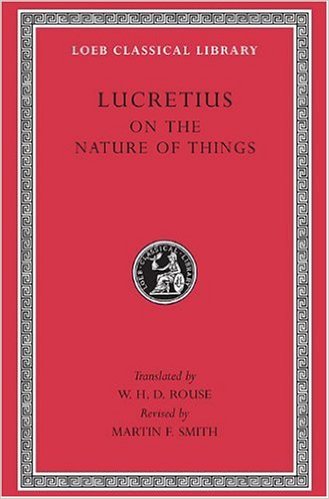 But maybe, just maybe, it was carried into modern speech by the Scottiish tradition of classical studies from the great Latin poet Lucretius. As all readers of his epic poem “De Rerum Natura” / “On the Nature of Things” will be aware, Lucretius wrote of how the universe is composed of atoms, and everything in the universe of combinations of atoms. But he notes that if the motion of atoms was completely regular they would fall separately through space and never collide with each other, so that nothing complex would exist. He therefore posits an irregular motion that moves atoms from a regulat path, and calls it “the swerve” (clinamen in Latin). This allows some indeterminancy into what would otherwise have been a completely determined and unproductive universe. If we are tempted to laugh at this notion we should remember that modern physicists have postulated a similar force which they call “inflation” to explain how the perfectly regular outward explosion of energy from the Big Bang produced the irregular clumps of energy which became stars and galaxies and bloggers.
 xtremejesus