Steve Ignorant of the former punk band “Crass” is my hero of the week because when he was asked on BBC Radio 4 why he had been invited to attend an academic conference, he replied, “‘Cause I’m very clever” which genially exposed one of the underlying assumptions of the interviewer. He also spoke well of how punk had rescued him from apathy and frustration when he was a young man, and given him a genuine opportunity to express himself.

Those who remember Crass will agree that they were good at expressing their anarcho-pacifist views in the most aggressive words and music; that they truly were not in the business for fame or money; and that they were generous towards the causes in which they believed. Steve’s own generosity towards his local lifeboat team led to him becoming part of the team, after they’d showed him “it was important by chucking him into the water and pulling him back on board.” He sounded like an honest, humorous and intelligent man.image

He reminded me that young people aged 15- 25 in Britain now are even more likely than his generation to feel disregarded, blocked, patronised and betrayed by the people who hold power and wealth. And that they do not have any significant cultural/ political movement like punk to give credibility to their feelings. Of course a minority of kids do very well, the lucky ones whose families have the resources to help them towards decent education and fruitful work, although even some of them find that the debts they accumulate through education leave them struggling to pay for their housing and still looking for parental support in their 30’s and 40’s.

But many others exist at best on minimum wage employment or exploitative contracts in which they are treated as self-employed, without sick pay or pension. At worst they exist on benefits which are deliberately calculated to be insufficient for survival. In a world where they are continually told of unprecedented opportunities for all, they find themselves looking from a restricted present towards an impoverished future. All of this is the fault of older generations, especially those now aged 55-75 who benefited from the post war socialist settlement in Britain but failed to protect it for their children and grandchildren in the face the ignorant capitalist prejudice known as Thatcherism. My daughter has had less support from the state than I had; and if I had grandchildren or great grandchildren they would have considerably less than her, in a society whose enabling social institutions have been laid waste by neglect.

I can understand young Muslim people opting for jihad less out of radical conviction than out of despair at the bland destruction of their generation’s hopes in Britain and hope that there might be something worth living and dying for. I think Daesh well- understands their condition and might easily turn their propaganda towards youthful non-Muslims as well.

That Hollywood lovie, Michael Caine, popped into Britain last week to advocate the return of National Service, although he was quick to say they shouldn’t be sent off to fight anywhere. It would knock the nonsense out of our young people, stiffen their sinews, teach them how to die on the Brecon Beacons, rather than wondering how they can make their Asda wage last till the end of the week. The reason this solution is so popular is that that it is cheaper than actually creating good educational and working opportunities for our young people; and the reason it hasn’t ever happened is that although cheaper it would still cost something, and might involve – God help us- raising taxes.image

Jesus of Nazareth attracted young men and women to the radicalism of his cause by confronting the comfy complacencies of his nation’s establishment with the promise of a kingdom that gave dignity to the excluded and the disregarded. There are a few of his churches trying to do the same today but not many. I’m grateful to Steve Ignorant for reminding me of a raucous movement that made young people aware of their own gifts; and of its relevance to politics and faith today.

imageIf any sensible enemy with nukes wants to take out the UK, a pre-emptive strike on Faslane might be an obvious move; it wouldn’t get rid of our Trident missiles but it would be a start. It also would wipe out a substantial bit of West and Central Scotland and render life even here in Desperate Dansville a tad precarious, so I think that any politician who votes to continue the sad charade of M.A.D (mutually assured destruction) should at least take up residence in the affected area. I look forward to Mrs May being amongst us here in Scotland and bringing her button with her in case she needs to push it. (“PM says she will push nuke button”- House of Commons 18th July 2016)

I understand that Mrs May has to say that, as the shaky credibility of the deterrent argument depends on our enemies -who are they? – being convinced we mean it. But in fact I’m not sure that even a rabid Tory would seriously want to fry millions of  say, Korean babies, because millions of ours had already been cooked. Perhaps at that point the utter futility of nuclear response would be evident. If we were ever attacked in this way, it could be our possession of nukes and our stated willingness to use them that had prompted the attack.

I have always assumed that no Christian person could approve of issuing a threat of nuclear destruction against any other nation or of preparing the means to do so. The difficulty is Jesus, to be honest. I can imagine someone saying, I’ll fry your babies in the name of Britain. Or I’ll fry them in the name of Capitalism, in the name of the U.S.A, in the name of wee Vlad Putin, in the name of Democracy, in the name of The Donald, in the name of Allah, in the name of the Honour of Aggrieved Husbands,  in the name of Christianity, yes……….but in the name of Jesus? Maybe it’s just me, but I find it impossible to associate Jesus with even the teensiest threat of frying babies.image

People have tried to reason with me. Why bring Jesus into it at all, they ask, can’t we keep religion out of politics? Can’t we do our killing in the name of Theresa and our praying in the name of Jesus? Or they argue that Jesus would be in favour of nukes because he was in favour of using a whip on the temple traders. Or they suggest that threatening to fry babies is actually a way of obeying Jesus’ commandment to love our enemies, as we’re only doing it for their own good. Or they cut the cackle and say right out that although some of what Jesus taught is good,  he does need a complete makeover in the response-to-aggression department, along the lines of, “If someone strikes you on your right cheek, a good smack on the head with a  hammer will prevent repetion.”

None of this has convinced me at all. I think it’s as plain as your nose that Jesus and nukes just don’t go together, and that anyone who claims faith in Jesus while advocating nukes has invented his own Jesus and left the gospel Jesus behind.

Of course, there will be those who say that Jesus couldn’t envisage the kind of threat that comes from North Korea or Daesh, or China. We just need to be adult and keep our weapons as a way of balancing their power to damage us. If we get rid of them , then we’ll be invaded, taken over and forced to eat rice or wear hijabs. In face of this argument I always say, oh yes, like  Norway! For everyone knows that because it has no nukes Norway has been taken over by North Koreans who have made them alter the angle of their eyes, and by Daesh who have ordered their whole population to go on annual pilgrimage to Mecca, and by China who have forced them to labour for next to nothing making trainers, while getting to work on bicycles. Godsake who would want to be a nukeless Norwegian?

Well actually, almost everybody. The fact that Norway is one of the most equal, prosperous and happy societies in the world, seems to have escaped the people who think this way. In fact if we could promise that every country could be like Norway if we gave up nukes, I guess the populations of most countries would vote to do so tomorrow.

Ah but we wouldn’t any longer have a seat at the top table of the world’s nations, to which you cannot be admitted without twiddling your nuke. And that top table has been so instrumental in making the world a safer place, where the rule of international law is respected, nobody starves, or is enslaved, or goes without medical care; and no nation is afflicted by internal violence or external terrorism…….

In reality, maybe getting rid of the top table would be an essential start to a better world.image

Och, I’ve made all these arguments a thousand times before and heard the contrary arguments from the other side. But I must admit that the Trade Union argument this time fair took the wind out of my sails. They basically argued that the loss of employment involved in cancelling Trident was totally unacceptable by socialist standards, whereas on the other hand the employment of skilled workers in constructing and maintaining systems for frying babies was totally acceptable. Of all the specious arguments put forward in the debate over the past weeks, that is the one that has given me the most grievous insight into the corruptibility of the human heart.

Lord Jesus Christ, who rebuked your disciples for wanting to send fire from heaven on your enemies, rebuke the rascals who would use violence in your name, and inspire those who want to walk in your way, so that with you they may confront the crucifying powers of the world, and with you win the victory, Amen.


imageAT the end of last season Celtic Football Club sacked its manager, Ronny Deila, for not delivering the kind of results the Board expected, and with a flourish of trumpets unveiled their new manager, Brendan Rodger, who had been sacked by Liberpool FC for not delivering the kind of results their Board expected. Since then the Parkhead publicity machine has not ceased to provide tasty sound bites about how the great days of Celtic as an all-conquering European football force are just about to return. All eyes therefore were on Celtic’s  qualifying match yesterday with the minnows of European football, The Red Imps of  Gibraltar. Naturally Celtic were thrashed 1-nil, and were lucky to escape greater humiliation. Seasoned observers of Scottish football would of course have predicted that if there was a way of wresting disaster from the jaws of victory, a Scortish team would find it; but shrewd pundits might anyway have spotted this was a classic David and Goliath set-up.

The D v G scenario of course features the small weak force against the gigantic strong force, and includes the pre- match boasting of the latter; but it also includes the fact that this is a David home game, in which the small one knows what works and what doesn’t. David, the wide boy from Bethlehem, may never have seen a fully-equipped Philistine warrior before, but he knew instinctively that this unwieldy over- armoured monster was a sitting duck. If my shrewd pundit had been reviewing the contest for Chosen People TV and noted David’s body language and the gleam in his eye, he would have advised the Philistines to have the extra large coffin waiting in the wings. Unfortunately for him the hard- of-thinking thug didn’t see what was coming, and in no time at all his supporters were on the way home complaining, “The boy done terrible; he lost the heid.”

In the case of the Red Imps of Gibraltar, they must have guessed that the combination of an Astro Turf pitch, southern European temperature and a modest competence with a football would see Celtic off. I wish I’d placed a bet on it.image

The Bible interprets such events as revealing the invisible arm of God who secures victory for his minnows even against overwhelming odds. A more profound and counter-intuitive version of this is found in Isaiah chapter 52:14 – 53:12, the song of God’s servant, which speaks of how the arm of God has been revealed in one who was a man of sorrows and acquainted with grief, suffering injustice, humiliation, torture and death; but becomes the instrument of God’s forgiveness and healing for many nations.

In the religious tradition of Israel, this strange prophecy was taken as an image of Israel herself, suffering many defeats from the big boy nations, so that God’s blessing might come to the whole world. Doubtless Jesus of Nazareth grew up with that prophecy amongst others, and may have seen it as a guide to his own destiny. Certainly his first followers took it as a prophecy of his rejection, execution and resurrection, of the one faithful in weakness against overwhelming odds, bringing God’s goodness to the world. Even his apparent defeat was a victory in their eyes. This  very radical and almost contradictory version of the David and Goliath theme is a central motif in the Gospels, the Letters of Paul and the book of The Revelation. In the latter the David/ Jesus figure is called the Lamb, while Goliath is transformed into Babylon, the Beast from the Sea, the Great Dragon and The Satan, the enemy of God. All the apparent defeats of  the sacrificial Lamb and his followers by the powers of evil are seen as simultaneously victories of God’s goodness in those who are faithful to it. From a worldly point of view they are terrible defeats but from the point of view of the Spirit they are victories, because the victims’ trust in God’s goodness is unconquered, and they share the glory of the Lamb in the world to come.

As a rather reluctant and fearful follower of the Lamb, can I share this faith? On the whole I would very much prefer not to be beaten up by the Goliaths of this world -one or two tastes of what they can dish out left me grateful not to have had more- but I have also seen the suffering courageously endured by my heroes great and small. I can easily affirm that their resistance to evil and commitment to goodness is a splendour of the human spirit, but do I really believe that it is a victory, not a loss of life but precisely a fulfilment of it? Can it be true in something more than a poetic sense, that their battle has mysteriously taken place on home ground, and that the well-aimed stone of their courage has dented the forehead of the devil? Are they in fact now enjoying the life of God? Bernie and Goliath

Well, yes, that’s my faith. Whether I can live by it is another question, but I do believe it, I believe in the victory won by all the small people like Dietrich Bonhoeffer, Chico Mendes, Rosa Parks, Mahatma Gandhi, Helder Camara, Alice Scrimigeour, David Haines, the medical staff of MSF killed in Syria, and thousands of others, who looked Goliath in the face and knew they had the beating of him. I will certainly not have earned it as they have, but Lord, I want to be in that number.


Tanveer Ahmed who killed Asad Shah, a Glasgow shopkeeper with a wonderfully ecumenical faith, stated that he did so because  his victim was “insulting the Prophet, peace upon him.” This routine prayer of peace for Mohammed and war against anyone who dares to interpret his teaching differently from the speaker, should be of great concern to all religious people, because it articulates a kind of fundamentalism that has besmirched Christianity, Judaism, Hinduism, and even Buddhism, as well as Islam. Islamic fundamentalism is most similar to the Christian variety in that both rest on complete allegiance to the text of a holy book, which however requires interpretation as any book must. The fundamentalist interpretations of the Noble Qur’an and the Bible are similar in that they are partial, stupid, and utterly authoritarian. image

They are partial because they prioritise some parts of the holy book as opposed to others. In the case of Islam, this means prioritising the anger of Allah to the exclusion of his compassion and his mercy, which in turn leads to an unbalanced interpretation of texts about Jihad. In the case of Christianity it means ignoring most of the teaching and example of Jesus.

They are stupid, in that they reject the use of human reason. All arguments must bow to the authoritative word of the holy text. All facts must be ignored if they seem to contradict the holy text. All people must be seen not as they are, but as they are defined in the holy text. All of this involves a complete abandonment of human intelligence and a disciplined commitment to stupidity.

They are authoritarian in that all attempts at different interpretations of the holy text have to be forbidden; only the one, official interpretation, disguised as the literal meaning of the text, is permitted, on pain of expulsion from the religious community, or perhaps, death at its hands.

An open, intelligent, democratic Glaswegian Muslim was killed by a partial, stupid, authoritarian Muslim because he had dared to question the fundamentalist interpretation of his faith.  My own experience of hate mail received in the wake  of my public support of gay clergy, in which the vilest sexual abuse and threats of extreme violence were often signed,”A CHRISTIAN” taught me that the name of Jesus does not exclude fundamentalist hatred.

It is an urgent task, I think, for all genuine belivers in all religions to call time on all fundamentalisms. Secular societies are responsible for many evils but this one is the responsibility of religion. But how should we tackle it?

The first necessity is to identify it, and for that purpose I would like to offer to the world a cultural product of my native Glasgow: the bampot test. I should explain that “bampot” is a Scots term for a “foolish, worthless fellow,” otherwise called an “eedjit” or “nutter”. The chief characteristic of a fundamentalist bampot is his hatred of facts, especially those that might get in the way of his convictions. So, if you are in the business of electing a Minister, Imam, Rabbi or Guru, the first question prescribed by the bampot test is:

Is every word in our sacred writing equally and literally the word of God which must be believed and obeyed?

If the person answers ,”yes” he or she is a bampot, because he refuses to recognise the fact that all writings are written by fallible human beings.

If you have any doubts about the person’s bampotism, a second question can be asked:

How did the universe come into existence?

If the person tells a story of how it was raised from the deeps by the sacred turtle of the south seas, or fashioned from nothing by the Creator God in one week some four thousand years ago, he or she is a confirmed bampot, because he refuses to recognise  the facts about the universe established by the sciences.

image
Tea house in Toronto

Once you have made a firm diagnosis of bampotism, you should refuse to allow the sick person to exercise any authority on your religious community, while gently offering him or her free access to the debampotification course which I have devised and can deliver, under the title:

THE FACTS ARE FRIENDLY; GOD IS IN THE FACTS.

Once fundamentalists are refused employment and deprived of influence over decent believers, that is, once this illness has ceased to confer power, prestige or wealth, it may cease to be endemic to religious communities.

Christian readers may have noticed that my definition of fundamentalism applies mainly to the Reformed Churches with their reverence for the scriptures, while Roman Catholic Churches and Orthodox Churches may seem to escape these strictures. Far from it. It’s just that in these cases the place of the Bible is taken by the Ruling Hierarchy of the churches. A Catholic who thinks that the Pope and the Bishops of his church are infallible is just as much a fundamentalist as any bible-basher from Bathgate. He or she is suffering from a bad case of Sancta Ecclesia  Bampotissima and requires urgent treatment.

image
Dr. BIlly Connolly, Bampot Detector

Yes, and as I broaden my thinking on this matter is strikes me that of course there are politicians who cannot see beyond their ideology, celebrities who cannot think beyond the latest fashion, scientists who are unable to contemplate anything that is not susceptible to scientific proof – yes all of these may also be caused by virulent strains of the bampot virus, but as a religious person I have to put my own house in order before I venture outside. As a mere semi-retired Christian minister I cannot be responsible for the near universal bampotoscopy that is required.


Back in the dear dead days of the late sixties there was a splendid arts and politics journal published in Edinburgh under the title “Scottish International”, committed to an open, ecumenical Scottishness that always saw Scotland on a map of the world. It was edited by a brilliant young man from Kilmarnock, Robert Tait.

imageHis radical breadth of sympathy comes to mind now when the alternative to a various forms of toxic English nationalism appears to be some kind of Scottish nationalism. If I want to live and work in a society which is more free, equal and fraternal than that of the present UK, my best option is support for the SNP, at least until another referendum has established Scotland as an independent nation. I am heartened that there has been an increased support for this in the wake of The Brexit vote, because it indicates that our nationalism is outward looking, especially towards Europe.

From a Christian point of view, nationalisms look more like a barrier than a way forward: Christianity began with the breaking down of Jewish nationalism and the establishment of multiracial, multinational, assemblies of believers. It was the genius of St.Paul to see clearly that the gospel of Jesus was for all human beings, and to set out on his own transgressive mission that took no account of nationality. The painful adjustment of Jewish believers to this new identity is charted in the New Testament. He did not think that nation states and boundaries were of any great importance in the business of communicating the love of God, although of course he was operating in a world already united by Roman imperialism. His new vision was not only for himself but for his converts whom he urged to recognise their common belonging, by giving aid to their impoverished brothers and sisters on the other side of the world, in Jerusalem.

Can this sort of Christian faith really be allied with any sort of nationalism, however open?

The Christian conviction that nation states are not all that important suggests that decisions about communal life should be taken by those who are affected by them. The modern principle of subsidiarity as I understand it, proposes something similar; that decisions should be taken at the most local level that is feasible. In the fairly recent past, city and rural councils in Scotland had much more power and responsibility that they have now, due to the desire of central government in the UK to have no local opposition.I think their powers should be restored and even extended. There are also a whole range of decisions that could be taken for the whole of Scotland, by an independent government. I would like to see the injustices of global capitalism removed from my significant territory, and the benefits of radical justice established within it. My commitment, therefore, to gaining the inhabitants of that territory real autonomy, may at least be compatible with Christian faith.

And yes, I do have a deep longing that the self-serving expectations of bankers and CEO’s of large companies, the contempt of ruling elites, the braying voices of those who think themselves self-made, the sub-fascist propaganda of press barons and their prostituted journalists, the flatulent outbursts of cushy seniors who’ve had a good life thanks to a decent society and now want to pull up the drawbridge before their grandchildren can have the same, the lunatic economists who hold to a policy of infinite growth on a finite planet, the loud opinions of those who have no knowledge of history and no concern for the future, and the killers who wait in the corners knowing that they’ll be needed soon if not already; yes a deep longing that this whole clamjamfry may be deprived of any influence over a nation that has suffered them too long. That’s why I want independence.

Well, part of why I want it. The other part is my desire to belong to a reasonably just and well-run nation -something like Norway would do- confident enough in partnership with similar nations, to work for the ecological, economic and political peace of humanity and its planet. My acquaintance with the young people of Scotland tells me that many of them would like to live in such a nation, and would be excited by the opportunities it would provide for their creativity. But it also tells me they won’t hang around forever; that if Scotland does not provide a home for their egalitarian energy, they’ll go somewhere that does.image

“Scottish International” – the old 1960’s masthead still points in the right direction.

*clamjamfry, Scots:  rabble, crowd, noisy gathering


image

This week the media carried the story of how officials of an English Hunt fed fox cubs to its foxhounds to give them the experience of killing and devouring their appointed prey. It was an example of how some human beings continue to look on animals as material for either their nourishment or their pleasure, without any sense of the worth of the creatures they farm, train or kill. Although in this instance the focus of sympathy was meant to be the fox cubs, I also felt for the hounds which are not naturally hysterical killers, but are perverted into such by this kind of training. I am not a sentimentalist: foxes also kill; that is how they survive; but only human beings kill for fun.

I want to ask about the roots of this human cruelty and whether it may be connected with some of our more immediate political concerns, such as racial prejudice and terrorism.

I recently read an astonishing book by the Icelandic author SJón, The Blue Fox, in which a Christian priest hunts down and kills a rare arctic vixen which has blue fur. It emerges in the narrative that he has previously got rid of a Downs-syndrome girl in his family by selling her as a sex slave to some sailors. She is eventually cared for by the hero of the book, who learns her strange language and treats her with tenderness. The bitter hatred of the priest for anything and anyone whom he regards as merely animal is seen as the way in which he asserts his intellectual and spiritual superiority as a human being favoured by God. The book is a parable about the kind of power that protects life and the kind that destroys it.image

There is reasonable evidence that many so-called primitive societies recognised the common interest of living things and displayed reverence for them in their customs. In the creation story in the Bible, human beings are planted in the midst of the living world as “likenesses of God” to continue the creator’s management of all creatures, a plan which is challenged when the human beings decide to become gods on their own terms, seeking the “knowledge of everything”, as the means to power over everything. The Bible story, which probably dates from the 8th century BCE, has already identified human arrogance as the root of evil, specifically of the never-ending struggle for power. This excess of self-regard and lack of appropriate reverence is identified in Greek drama as “hubris”, the quality which brings ruin on individuals and their families.

It is an arrogance which infected even Christian theology, in its misunderstanding of the creation story as a justification for treating animals as if God had no love for them; and for viewing the natural world as merely a God-given resource for the good of humanity. This divinely sanctioned arrogance has been over many centuries built into the ideology and practice of capitalism and its major opponent, state socialism, both of which have treated the natural  world as an infinite provider of the raw materials of economic growth. Both systems believed that the ruthless  application of the right economic practices would deliver an unending supply of goods and services.

Except, except… State socialism in the first instance discovered that even the savage pruning of millions of human lives and the destruction of millions of acres of natural habitat could not supply human need; and then, even as the capitalist world rejoiced in the collapse of its opponent, it began to be aware that its ruthlessness was depleting its own resources, polluting its own environment, and causing the over-heating of the planet.

The capitalist response has been exemplary: smear the reputation of any scientist who  points out the destruction of the environment; deny the truth of global warming; insist that capitalism can provide for the lives of all humanity- while actually restocking its weapon systems and boosting its armed capability, so that when the crunch comes, the capitalist economy will supply the major capitalist nations, and the rest of the world can go to hell or face annihilation. That’s why nobody in the UK can tell you what our nuclear deterrent is for; it’s for dealing with the countries that might threaten our supplies of food, water and energy when the environmental shit hits the fan. This is not the sort of thing governments want to publicise, but of course they all know that the world can never live as richly and wastefully as the richest nations, and that the era of energy wars is fast approaching.

The rise of right-wing nationalist parties in the “western” world and of terrorist groups elsewhere can be explained as a response to the big lie of capitalism, that it’s good for everybody. These groups, often composed of people disregarded by government, have sussed out the terrible truth: the system will not supply everyone and when the bubble bursts, it will be first -come, first -served. So better grab power now, for your nation, class or religious group before it’s too late. That’s why they foment hatred against foreigners, migrants, other nations, other religions; people need to be trained for what is to come, they need to get a taste for blood…… image

Which brings us back to the beginning. The evil is arrogance. Not just our individual arrogance, nor even our religious or national arrogance, but fundamentally our arrogance as a species. We refuse to see  ourselves as part of the web of life and utterly dependent for our flourishing on our fellow creatures. We have been content to remain ignorant about their contribution to our  lives, from the millions of bacteria that live in our guts, to the great whales whose decline is a measure of the dying of our oceans.

Citizens need to wake up to what is happening in their societies and in the world. Christain churches need to repent their bad theology and neglect of God’s creativity. There is a modern children’s hymn with the refrain, “yes, it’s God’s world after all”. Indeed it is, but most people don’t believe it; they think the world belongs to them, or their group, or their nation, or their religion.

Yes, this is a rant: the conclusions I’ve reached are not backed with adequate evidence. But I wanted to get this argument with all its connections down on the page, because when even decent people living in a land of plenty start telling me that there is no room for refugees, I can smell the rottenness  in the air. “By the pricking of my thumbs/ something wicked this way comes”.


imageThe nifty bit of abuse in my title comes from a Christmas song by Sydney Carter who imagines Mary and Joseph “knocking on the window on a Christmas Day” and getting the answer:

“No we haven’t got a manger, no we haven’t got a stable

We are Christian men and women, always willing never able”

It’s unfair of course, but it is does sum up a lot of Christain hand-wringing at the state of the world, while the churches, bible bloggers included, offer diddly squat to make it better. The U.K. church’s response to the Brexit referendum may be a case in point. They have made justifiable criticism of the mean -mindedness and outright racism of some of the debate; they have worried about the effect of the U.K. Exit on European peace; they have protested that God is concerned with people rather than boundaries, and especially with people who have no countries and no homes.

So let me suggest two practical responses that any church can take.

  1. It can help identify usable dwellings within its own parish that might, with Government help, house refugees, and it can publicly commit itself to welcoming refugees and helping them settle over years rather than months. It can notify its local council and the Scottish Government of its desire to help in this way. This is a practical response to the fact that Brexit will make it harder for refugees to come here. Churches in Scotland will find that some German churches already have experience of what can be done
  2.  It can work to establish a twinning arrangement with at least one church in the EU. Most denominations want their churches to do this kind of thing through their bureaucracies, which like to keep power in their own hands. Individual congregations should assert their independence and competence to make contacts and pursue friendships with congregations in Europe. Such linkages have four purposes at least: a) to celebrate our common faith and mission in Europe.  b) To share information about worship, education, pastoral care, and outreach which can enhance the life of both partners. c) to encourage mutual visits that build personal friendships. d) to make real especially to younger people our belonging together across boundaries. The reality of a European union is not totally dependent on what nation states and their governments decide to do, but upon the determination of citizens to build cross-border institutions and personal ties. Perhaps we should always have started to build Europe from the bottom up rather than the top down.image

These responses are far from being the only right ones, but they tackle real problems which are exacerbated by Brexit; the plight of refugees and the increase in nationalistic hatred of foreigners throughout Europe. They also hold out a chance for churches to take the lead in a social issue rather than being dragged kicking and screaming in the wake of change.

These initiatives would also be fun, because they involve contact with other human beings. Boredom comes from exclusivity and closed doors; fun, excitement, hope and pleasure come from openness. When Jesus spoke about himself, he did not say, “I am the Wall” (like Mr. Trump); he did say, “I am the Door.”


Its only four hours since it became clear that the UK as a whole had voted to leave the EU, and only some minutes since the Prime Minister announced that he would stand down in the autumn. Too soon, therefore, for any disciplined reflection on this result, except to record how proud I am of Scotland and my fellow citizens, that we have shown our acceptance of inter-national cooperation and our rejection of racism, by voting 62% to remain. Of course we never saw ourselves as masters of the world, as the English did – even if we shared their imperialism, we were in fact their first colony- nor do we have the levels of immigration experienced in certain parts of England. Still, we have clearly shown our different political values in this vote and I hope they will guide our future.image

I promised to devote this blog to a consideration of what theologians call eschatology, that is, thinking about the end times. The classic Christian doctrine is that in the end time, Jesus will return in glory to judge the living and the dead; that God will create new heavens and a new earth; and that God’s people will share the divine life forever and ever. I guess that very few of the believing people in the churches I serve either know or believe this teaching, but believe rather in individual judgement and reward at the end of their own individual time. Few believers now hold to the concept of a future general resurrection and universal judgement with the possibility of heaven or hell. The eschatology of the faithful has been privatised.

Of course any just judgement has to be personal. I wrote in my bible blog yesterday (emmock .com) that I see the final judgement of Jesus as happening in a time aslant historical time but impinging on it, so that every day is judgement day, every day people are welcomed into the light of God’s love or left in the darkness they have chosen. When I call God “the beyond in the midst”, I mean that God’s goodness (Jesus/ heaven) is available to me here and now, where I may choose it( life) or spurn it (death). Of course there is a sense in which evil people do not choose death; they choose wealth, power, violence, lies, lust and so on, but they are always aware that these goods are devoid of life. They are choosing the death of their humanity and in their own end time they get what they wanted. Good people may be afflicted by evil or tempted by it, but they know that it offers no life, and therefore choose to reach out towards a goodness, which in their end time reaches out to them and gives them life.

But that is a personal vision. What about the world in which we live? What about the countless people who never had a chance to be persons because of oppression and deprivation? What about the ecosystem of the earth and our fellow creatures? What about the universe and its evolution, including perhaps forms of life of which we at present know nothing?

The bible offers visions of the end which are broader and deeper in their scope than individual salvation, and which give content to the believer’s prayer, “Your kingdom come; your will be done on earth, as it is in heaven”. In this blog I’ll use just one of these, leaving other vision for subsequent blogs. Here it is:image

The Peaceful Kingdom Isaiah 11: 1-9

11 A shoot shall come out from the stock of Jesse,
and a branch shall grow out of his roots.
2 The spirit of the Lord shall rest on him,
the spirit of wisdom and understanding,
the spirit of counsel and might,
the spirit of knowledge and the fear of the Lord.
3 His delight shall be in the fear of the Lord.
He shall not judge by what his eyes see,
or decide by what his ears hear;
4 but with righteousness he shall judge the poor,
and decide with equity for the meek of the earth;
he shall strike the earth with the rod of his mouth,
and with the breath of his lips he shall kill the wicked.
5 Righteousness shall be the belt around his waist,
and faithfulness the belt around his loins.
6 The wolf also shall live with the lamb,
the leopard shall lie down with the kid,
the calf and the lion and the fatling together,
and a little child shall lead them.
7 The cow and the bear shall graze,
their young shall lie down together;
and the lion shall eat straw like the ox.
8 The nursing child shall play over the hole of the asp,
and the weaned child shall put its hand on the adder’s den.
9 They will not hurt or destroy
on all my holy mountain;
for the earth will be full of the knowledge of the Lord
as the waters cover the sea.

This dates from the reign of King  Hezekiah of Judah 715-687 BCE, and comes from the pen of the first prophet Isaiah, who communicated to the rulers of his people what he believed to be God’s message, in vivid diatribes and visions. He was open to the politics of his nation and area, capable of assessing these out of a profound grasp of his religious tradition, and of expressing his assessments in language of beauty, precision and wit.

Here, towards the end of his life, he provides a vision of how his God will fulfil his promise to the great King David, that his dynasty will last and will be fruitful. In this vision Isaiah was looking I think into later, if not the last, times.

The instrument of God’s transformation will be a politician! In this case, a king of the Davidic dynasty, who will bring God’s rule to the people. He will not be a superman, but rather a man inspired by the fear of God, and moulded by God’s spirit. The qualities which are developed in him are not supernatural, but human: wisdom, understanding, counsel and might. This ruler sets aside propaganda and makes judgement in favour of the poor and the humble of the land. His harshness towards the wicked is shown by the force and accuracy of his words. His whole character is bound together by goodness and faithfulness. This description is given by a man who knew kings and their frailties yet trusted that God’s purpose would be achieved through a human ruler, by human means.

But then the vision makes an extraordinary leap. The establishment of social justice will lead to a paradisal peace in which all enmity will be abolished between predators and prey, and between animals and human beings. The reconciliation of animals with each other is twice emphasised by their gentleness to children. It is a vision that still brings a catch to the voice almost three thousands years after its composition. The abolition of the need to kill in order to eat does away with the most fundamental of all types of violence and convinces the reader that it is not necessary.

The summing up emphasises this possibility:

they will not hurt or destroy – that’s the result, and it is achieved by the universal knowledge of God:

for the earth will be full of the knowledge of the Lord

as the waters cover the sea-

-that’s the means: the prophet declares that the impossible possibility of peace will come through human knowledge and action that is rooted in the creative impulse of God.

image
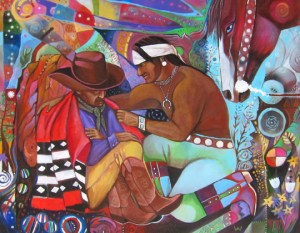
Notice how the transformation comes through a peace treaty with native Americans 

I’ll conclude with some brief points about this text.

  1. It is set in this world of human beings and other creatures
  2. It is set in history yet transcends it.
  3. The events are encompassed by God’s presence but they are brought about by human action.
  4. Government, in this case by a King, is envisaged as necessary for justice.
  5. The opposition will be destroyed by the truth and wisdom of the ruler’s judgements.
  6. The Government is inspired by the character of God to dismiss lies and attend to the needs of the poor and the gentle.
  7. The life of the ruler is bound to the life of God.
  8. The ecosystem is returned to the state described in the vision of Genesis, in which there is no predation amongst creatures, no enmity between humanity and animals.
  9. Human justice is the precondition for this transformation, but does not define its scope. The just society flowers into the garden of Eden.
  10. This vision of the last times finds its imagery in a story of the first times, completing the arc of creation

We should note that all species including humanity are what they are because of predation, amongst other factors. Does this invalidate the vision? I think not, as Isaiah knew he was appealing from the real condition of the world to God’s original intention for it. This is the way he marks the transcendent nature of his vision.

All of these points deserve incorporation into Christian teaching about the end time.


The image of Nigel Farage the UKIP leader unveiling a poster at the weekend is unintentionally comic as well as racist. A small, slightly apologetic, sad man (what we would describe in Scotland as a “wee bachul”) stands in front of a picture of hundreds of vibrant human beings about to burst into a Greek field. He is telling us that this will destroy life as we know it. This swarming mass of needy people in Greece will trample the Union Jack, abolish private education, occupy our parking places with their camels, close our ale houses, defeat us at football, force our men and possibly our women to grow beards, and deliver the editor of the Daily Mail to be martyred by crazed ayatollahs.

AAAAAAAAAARRRRRRRRRRRGGGGGGGGHHHHHHH!!!

The end of the world will arrive if we don’t vote leave on Thursday.

Pull my finger...

On the other hand, a responsible man in a suit with a very red face – can he really be our PM? – assures us that on the contrary, all the rich humanitarian policies of his government- constant  reductions in welfare benefits, cutting down on the huge numbers of costly people with disabilities and throwing alylum seekers into detention centres – these shining examples of social justice will be no more, unless we vote remain on Thursday. If we vote leave, the floodgates will be open for hordes of slimy alien creatures, led out of the sewers  by Boris Johnson and Michael Gove, to terrify the nation in a feeding frenzy of right wing ruthlessness. Most of these treacherous creatures will be indentifiable as Tory MPs and colleagues of the honourable PM.

UUUUUUUUUUUURRRRRRRRRRRRGGGGGGGGGGGGHHHHHHH!!

If we do vote leave on Thusday, the end of the world will arrive.

I have always been attracted to the apocalyptic utterances of end of the world prophets. I loved the dismal street preacher of my youth, who would stand in Sauchiehall Street on a wet November afternoon giving the punters the glad news that the end of the world was nigh. Most of his damp audience looked as if they would consider this outcome a blessed release. I particularly liked the transatlantic group who knew that the world would end at midnight on 31st January 1983, at which hour they gathered on Mont Blanc, as instructed by their prophet. By breakfast time on 1/1/1984 scores of bedraggled creatures were back at ground level, lamenting the fact that they would now have to pay their hotel bills.

Given the poor record of all such prophecies, you might think that even the loopiest orators would avoid them. But no, all we need is a political, moral, religious or ecological crisis, like for example the possibility of Turkey joining the EU in 50 years time, for the manic street preachers to grab their placards and point to Armageddon.

Jesus entrusted his followers with the task of announcing the arrival of God’s Rule, which some saw as an apocalyptic event, but He saw as the robust communication of God’s goodness here and now. Knowing however that there were plenty loopy prophets around, he counselled them to pay no attention to the voices saying, Tomorrow in Jerusalem, or Next Week in Damascus, and to continue abolishing poverty, healing the sick, welcoming the outcast, and staying hungry for justice.image

I hope the UK votes to remain in the EU, for, degraded as it is, it remains a reminder of a generous vision and a stimulus to a fraternity that might lead to greater liberty and equality. Political choice is often a matter of achieving small gains or preventing small losses.

But if it votes to leave I shall not be closing down my blog and getting my climbing boots on for the ascent of Mont Blanc. Like the 8-05 Scotrail from Dundee to Glaagow, the end of the world will have been postponed again.


image
Luminous Angel

The murder of Jo Cox MP by a man shouting, “Britain first!” has caused public horror and the temporary abandonment of the ritual exchange of lies and insults which has taken the place of rational debate about membership of the EU. Suddenly even the worst offenders, most of whom are well-known public figures, are seen with solemn faces, deploring violence and urging more protection for MPs. Doubtless the public will regard their solemnity with the same scepticism as their rabid splutterings.

My particular concern is that the BBC whose newscasts have for weeks given publicity to intemperate allegations and slurs, whose presenters have given airtime to routine lying and called it balance, now has the impertinence to put on black ties and ask if there’s something disrespectful about the way we treat our politicians. Indeed, responding to the terrible death of a young woman with hours of vapid discussion may be another kind of disrespect. The very news engine which has gorged on political abuse is now chewing its way through the tragedy of a human death.

The atmosphere in which we currently do our poiitics is seriously polluted, and therefore dangerous, even if, as it may turn out, it had little to do with the murder of Jo Cox.

I immediately think of two classic Christian texts.

The first is the sermon on the mount in which Jesus quotes the commandment against killing and goes on to to forbid violent and denigratory speech against another person. I have to admit that I have not often preached on this text, perhaps because churches have their own internal arguments which do not always avoid harsh words. I may have been guilty myself of words designed to demolish rather than to refute. Like all teachings of Jesus, the link he makes between violent action and violent words is wise and radical. The mental and emotional disposition in which we dismiss others as worthless is violent even if we manage to restrain ourselves from anything worse than words. Clearly if we permit violent public discourse we encourage acts of violence. More positively, if we encourage peaceful public discourse, we discourage acts of violence.image

The second is Simone Weil ‘s book, “The Need for Roots” written during the Second World War. In it she lays down what she calls “needs of the soul” the most sacred of which, she says, is truth. Human beings in society need truth and suffer from lies. She writes this sentence: “We all know that when journalism becomes indistinguishable from organised lying, it constitutes a crime.” She goes on to ask why it is not punished, and seriously proposes making it a crime to publish lies. She knew that this would lead to howls of democratic rage from the habitual liars, but suggested a special sort of independent judiciary to deal with such cases. Perhaps we need to recognise that public lying is a crime and the mother of crimes, and that a press free of political control need not be free of all control.

These issues have been of concern to me for some years, but may be of greater public concern in the wake of public savagery.