
“Teeth will be provided….”
The street evangelist was entertaining his small crowd with some grisly warnings about the fate of sinners: “And if you do not heed the call to repent brothers and sisters, you will end up for all eternity in the fires of hell where there is weeping and wailing and gnashing of teeth!”
“Eh heh,” objected an old woman with a gummy grin, ‘ I’ve got nae teeth left.”
“Dinna think ye’ll be spared,” the preacher advised, “TEETH WILL BE PROVIDED!”
Is such confidence in the resourcefulness of God’s wrath enviable or merely laughable?
Attempts in modern theology to dismiss the threat of divine judgement as somehow sub- Christian are made questionable by the fact that some of the most direct warnings of judgement are attributed to Jesus himself. And even if scholars question the accuracy of the gospel record, it is evidence that at least the first Christians did not see any contradiction between judgement and the character of Jesus. As regards the resurrection Jesus appears to have agreed with the Pharisees who taught that those who observed Torah would have a personal place in the world to come. There is no clear evidence that they also taught divine punishment for those who did not; perhaps missing out on new life was considered punishment enough.
Jesus however is on record as promising punishments as well as rewards. A typical bit of teaching is his injunction, “If your right hand brings you into temptation, cut it off and throw it away! It is better for you to lose a limb than for your whole body to be thrown into Gehenna.” Gehenna was the Jerusalem rubbish dump which became a symbol for God’s wrath. When He spoke of the judgement on towns that refused hospitality to his messengers, he didn’t mince his words, ” Sodom and Gomorrah will fare better on Judgement Day than that town!” The parable of the great judgement in Matthew 25 may not be the exact words of Jesus, but the notion of God’s Judgement separating humanity into sheep and goats is not foreign to Jesus’ teaching.
These images of divine reward and punishment are common to the New Testament, except the Gospel of John, which explains that evil people pass judgement on themselves, because they choose the darkness rather than the light. For this Gospel people choose the hell they inhabit in this life and the next. God through Jesus only wants good for his children, but will not force people to be good. God gives them the choice and will respect their choice for all eternity. This seems to me a positive interpretation of Jesus’ teaching: those who turn towards God’s goodness will live in it; those who don’t, won’t.
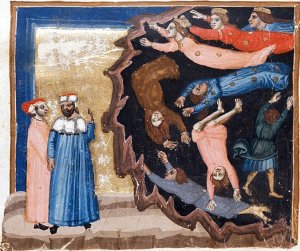
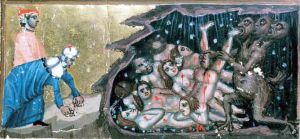
This gives a clue for the development of Christian thinking which is fully expressed in Dante’s Divine Comedy: God’s love moves the sun and the other stars, but human freewill may choose to be moved by it or not. In the after-life people get what they have chosen. Those who are in Inferno “want” to be there, even although they know they have made and continue to make a wrong choice; those who are in Purgatory “want” to be in paradise, but not enough, and must persevere until their desire is stronger; those in Paradise “want” God’s love, even although they may have at times been sinful. Dante knows that his poem is metaphorical, but it is not a mere gloss on worldly experience. Rather it points to a mystery that cannot be fully captured in human thought or language.
If Mr Abedi, the alleged Manchester murderer thought that he would be rewarded by God for killing children, women and men I believe that he was wilfully mistaken. I say wilfully because he was making a fundamental choice about what he wanted: a world ruled by death. Faced with God’s love, he will be given a new choice: he can admit how wrong he is, and submit to centuries of painful and humiliating repentance, only ending when he obtains the forgiveness of his victims; or he can have the death he desires. (Dante believed that the determining choices are made in this world, and that there is no wriggle room after death. I respect his view, although I disagree with it.) Those who have recruited and instructed killers by distorting the Noble Qur’an are more guilty than their disciples, have chosen death more decisively and are more likely to be utterly extinguished. The same is true for all agents of death in the world and their masters, in the USA, Syria, Israel, UK, Russia, indeed in most nations of the world: they stand under judgement.
Yes, all this is picture language, but it is not intended as an image of the inner life of murderers or the moral struggles of society. It is intended as gospel, as the announcement of good news. When the great oppressive city of Babylon is destroyed by God’s power in the book of The Revelation, the saints sing, “Alleluia! And the smoke goes up forever!” They enjoy God’s justice and applaud it. Inasmuch as I can offer to my oppressed brothers and sisters a chance of justice in this world, I will work for it, through the organisations for justice and peace which I support, and through my political allegiance, but knowing how little can be achieved I also want to offer them the gospel that their persecutors will not finally win. They will get theirs. And the oppressed will not finally lose. They will have life and all tears will be wiped from their eyes.

This is not the aort of language that modern liberal Christians are supposed to use, so I guess I’m not one of them. Again, I confess that my language is pictorial and points to a mystery which itself is described by the book of The Revelation. In God’s Kingdom, the Lamb is in the midst of the throne; the one who has been oppressed and sacrificed shares the rule of God, the intelligence of the victim makes the final judgement: “whatever you have done to the least important of my brothers and sisters, you have done to me.” Teeth will be provided.

 I have no clear idea of how the specific knowledge that I will gain, can become useful to me, but I do know that I will find the sources of information used by the book and familiarise myself with them. The discerning reader will realise that this kind of search for equal expertise is doomed, as no sooner have I caught up with one source of information than I will be presented with another. Yet this sad comedy is the continuing story of my intellectual adventure.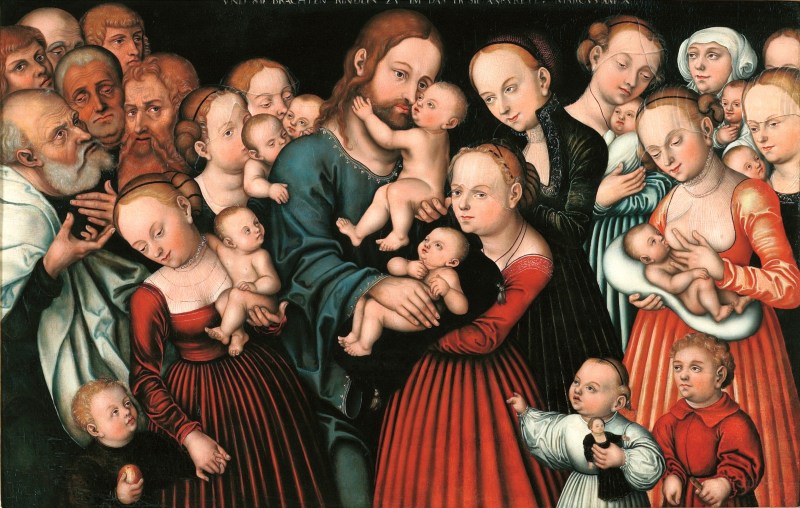


 St. Paul wanted his Corinthians to know that their bodies were temples of the Holy Spirit. He taught that their bodies were mortal and therefore subject to decay, but open to an ultimate transformation into the splendour of spiritual bodies, through the power of God’s spirit. But even now, in the midst of their struggles, that Spirit would, if allowed, take up residence in their mortal bodies. “Therefore,” he urged, “honour God with your bodies.” A glimpse of ultimate splendour could be seen in the lives of ordinary people who were learning to love each other as children of God.




 The prayer of Jesus is relevant:

 This “dustiness” does not negate the revelation that I am made in the image of God, for God is the life which humbly shares itself with all creation; nor does it exempt me from the duty of representing God’s rule, which persuades all creation towards the perfection of shared goodnesss. Me and my microbes are called to cooperate.
 xtremejesus