Sceptical readers – and they’re the kind I want- will have noticed that in my blogs on reclaiming Jesus I have drawn my evidence of Jesus’ character from the memories of his life and teaching contained in the gospels, that is, from who he was. But of course the relevance of Jesus for Christian believers depends on who he is: namely, the risen Jesus, the Son of God. Indeed the story of Chrstian faith as told in the book of The Acts of the Apostles, starts with the bodily ascension of the risen Jesus to the “right hand” of God, where he is installed as the agent of God’s universal rule. In time this picturesque story was transformed into the doctrine of the Trinity whereby God is defined as Father, Son and Holy Spirit, and Jesus becomes the only begotten Son, one person with two natures, divine and human, at some distance, you might say, from the carpenter of Nazareth.

So if I declare myself Christian, am I thereby declaring that Jesus is alive?

I think so. To believe otherwise would be to make nonsense of not just of traditional doctrine but of Easter for example, and of Holy Communion.

But exactly what do I mean when I say that Jesus is alive? I’ll start by saying what I do not mean.

1. I do not mean that the corpse of Jesus was reanimated, stuck around his old haunts for forty days, then took off into the sky like a rocket. The bones of Jesus or their residues, are in Palestine.

2.  I do not mean that Jesus is present with me or anyone else as a supernatural quasi- physical presence, a spook,  intervening in worldly events, by for example, curing disease.

3. I do not mean, nor does my church, that bread and wine “really” change into the body and blood of Jesus at Holy Communion.

4. I do not mean that at some point in the future chosen human beings will be rapt into space to meet Jesus

So what’s left? Well I have absolutely no trouble singing:

“Christ is alive! No longer bound

to distant years in Palestine

He comes to bless the here and now

and dwells in every place and time

(part of an easter hymn by Brian Wren)

For the Christian tradition, the fundamental fact about Jesus is that he is God. He did not become God when he was raised fom death, but was always God in his human life and death. God is the goodness which does not belong to the universe, but which is giving  birth to the universe and in which the universe exists. Although that suggests that God’s goodness is utterly separate from the universe, the truth is that this goodness is not isolated but shared. Shared goodness requires a partner, which is the universe and all its creatures. We should interpret cosmic evolution as the process of that sharing. I cannot know how that goodness is shared by galaxies and black holes, but I can glimpse it to some degree in the ecosysstem of which I am a part, and in the creatures with whom I share this life. With creatures who possess the capacity to choose, however, God’s sharing is limited by their willingness. All people have the special dignity of this relationship to eternal goodness, choosing whether and to what degree they will share it.

Jesus is the human person by whom God’s goodness is completely received. Or to put it another way, God is the one whose shared goodness is completely given to Jesus. In the adventure of sharing Jesus’ human life and death, God learns something new, just as God has always been learning through the sharing of her life, for sharing means the willingness to engage with what is not oneself: in God’s case, with her creatures. In Jesus God experiences the splendour and the agony of goodness in this world, while in God, Jesus experiences the goodness that goes beyond the worst the world can do. The resurrection and ascension of Jesus mean what God has learned through sharing his life and death; and what Jesus can teach his human brothers and sisters through sharing the creativity of God. Jesus is alive in God, whose shared life is also called the Holy Spirit.

This theology is my way of explaining my sense that Jesus is more than a historical person, that he is present to me in my relationship with the planet, my neighbour, the church, my mortality, when I choose to open my life to his; and that the gospels were written by people who already knew this. They could have simply recorded the life of Jesus as a past event which had a great influence. Instead they chose to trust the story of Jesus’ resurrection and ascension and to imagine the life of Jesus as God’s life on earth. They did so because it seemed to make sense of the faith community in which they lived and of their own experience as disciples of Jesus.

It’s the same for me. In my life I have known so many acts of kindness, compassion, honesty, doubt, humour, and courage, by good people that I am happy to imagine them as the physical presence of Jesus in my life. That is not to diminish the individuality of their actions: the more truly they are themselves, the more they are also Jesus. Of course, all this could be described without bringing Jesus into it at all. As a believer I have to use my imagination to see it this way, and I have no evidence to prove that I am right to do so. But maybe I am right, just as I may also be right to hear in the despair of the poorest families in Dundee, the anger and grief of Jesus’ demand for justice; or to feel in the beauty of a fresh morning in the Tay Estuary, the humour of Jesus who tells me I’m lucky that God makes his sun rise on the bad as well as the good. Above all, I may be right in imagining that when I’ve done things that damage others or myself, Jesus tells me that God is not interested in my sins, they are forgiven so that they can be left behind, as I once more open myself to the goodness that is God.

That may seem an awful lot of imagining, but through the disciplines of the Christian community – worship, prayer, bible reading, care of the sick and the poor – it has become second nature. It occurrs to me that this second nature, which is never a secure possession but always a gift, never perfectly formed but always existing in tension with my arrogant first nature, may be the promised salvation which made me a disciple in the first place.


.

I am a founder member of change.org, a website which keeps updating me with the latest petitions on important national and international issues. It is continually dismaying in its information about those who cause injustices and continually inspiring in its information about those who oppose them. Sometimes I am irritated by being told of terrible situations because I cannot take action against them all, but more often grateful to be given a chance to do something however small.

1862BEFD-E5D8-4926-B3FF-EA38E2048F71

Today I received an update on a petition I had already signed to dissuade the Israeli government from destroying a village school in Khan al Ahmar, Palestine, to enable further Jewish settlement. I say Jewish, rather than Israeli,  because the government itself distinguishes between Arab and Jewish citizens. The threatened destruction of  the school and village is an example of the racist policies of Israel. No specious words about the historic suffering of Jewish people can justify a prejudice far more blatant than anything shown by Jeremy Corbyn. (If you would like to sign the petition go to change.org and The Tyre School)

I have been readng recently about the historical genome research of David Reich and others, who have been able to map the movements of human groups throughout prehistoric times far more clearly than has been possible until now. His conclusions are important:

1. All modern humans are descended from Africans.

2. Homo Sapiens groups moved out of Africa in several waves of emigration, and at least some mated with Neanderthals, so that all modern humans have some Neanderthal genes.

3. A completely different race, the Denisovians, whose remains were recently discovered, has also contributed its DNA to some modern humans.

Further research may disover other groups of modern humans. The uniqueness of “homo sapiens” has already been disproved, although the primary origin of humanity remains African. I very much doubt if any of those cultures which assert their racial purity would be pleased with these findings: all of us are mongrels.

But the same research can show whether historic cultural changes are matched by changes in DNA. It would appear that often change was triggered by the arrival of a group with different DNA from the host group. The movement of peoples in settlement and conquest brought about an exchange of thought and technology. These encounters, which add to the genetic inheritance of a group, also enrich its culture.

The tendency of human groups to define themselves as separate races is exposed by modern research as bogus: all groups are mongrel, almost from the start.

The Bible has two great stories that bear on the issue of race. The first is the story in Genesis of the Tower of Babel in which the division of humanity into diferent races and langauges is seen as God’s way of splitting humanity so that it cannot challenge his rule. This wonderfully ironic tale interprets the proud races of humanity as merely a divide-and -rule strategy of God.

The second is the Pentecost story in The Acts, which shows God’s Spirit cancelling the division of races in a new unity, which is the shared life offered by Jesus. The tongues of fire include the diverse languages of the world in the one multiracial community of Jesus, who, rejected by his own race, becomes the means of overcoming racial division.

Both of these stories challenge the racial ideologies of humanity. St. Paul who knew this truth, nevertheless believed that there was a divine purpose in the racial identity of the Jewish people. I do not agree with him. I cannot see it as anything other than a tragedy, first of all for the victims of Jewish aggression, and then for the Jews as victims of the aggression of others.

Racial pride is exposed by science as a fiction and by Christian faith as a sin. The exponents of British, English or Scottish nationalism should ask if their chosen identity may not be fundamentally racist. One test would be whether it welcomes people of all races. In many societies there are large numbers of people impoverished by the capitalist economy, but persuaded by the agents of their misfortune that it is due to the immigration of other racial groups. These sadly deceived people become the aggressive upholders of racial purity or worse, of racial cleansing.

For me the tradition of Jesus has been helpful in exposing the racism which thinks it OK to destroy a village and its school, because the land is needed by people of a better race.


The ex Chief Rabbi of Britain, Jonathan Sacks is currently providing a thoughtful series of programmes on social morality for Radio 4, which pay close attention to the arguments of his contributors. But when he speaks on behalf of his religious community, as in his recent denunciation of Jeremy Corbyn, for alleged anti-semitism, he is less generous. I have written a few weeks back about the way in which pro- Israeli groups have misappropriated the term “semite” which refers to speakers of semitic lamguages, such as Arabs, Syrians, and Israelis, if it refers to anything. Their purpose in using this term is to suggest that the prejudice in question is neither as general as hating Jewish people, nor as specific as being opposed to the actions of the Israeli government, but rather a hidden Nazi desire to wipe out Jewish people from the earth. Jonathan Sacks is an efficient detector of this attitude, alleging its malign presence in some sneering remarks Corbyn made about English Zionists. My concern here is not to defend Corbyn from the charge of being anti- Zionsist and anti- Israeli, (these are political choices) but only from that of anti- semitism, which is seen as a racist choice and therefore allows Sacks to compare Corbyn to Enoch Powell. This sort of announcement is typical of the “official” Sacks, who in his very English way shares the tendency of Anglican archbishops to judge the moral condition of others, without being open to contrary argument.

This is a pity, for readiness to argue is one of the strengths of the Jewish religious tradition. The great texts of Judaism, the Mishnah and the Talmud, are full of argument, as are for example, the stories of the Hasidic Teachers. Such argument assumes that the experience of others is as valuable as one’s own and that human experience is always relevant to moral and religious truth. There is always a temptation for rabbis, priests, ayatollahs and ministers to elevate their own experience over that of others or to announce religious truths that are beyond experience.

Any attempt to reclaim the real Jesus from the distortions of his churches, would have to note that he liked argument. A large part of the four gospels is taken up with argument, and although we cannot claim complete historical accuracy for the gospels, it’s reasonable to claim that their common witness to the way Jesus went about his teaching is unlikely to be wrong. And there is no doubt that Jesus did appeal to human experience in his arguments, at least as reported by the first three gospels. He told stories for example, which helped  his argument because his depiction of human behaviour carried conviction. “ If your child asks for an egg will you give him a stone?” he asked, using the question to push his message: “If you, evil as you are, give good gifts to your children, how much more will your father in heaven give good things to those who ask him!” The person who argues in this way gives his hearers opportunity to challenge him. Sometimes the human  behaviour provides a shocking illustration of divine behaviour as in the story of the prodigal son where the human father is almost culpably forgiving but Jesus argues that this crazy love is offered also by God. Again Jesus is almost inviting his hearers to argue that the father in the story is soft and negligent.

The human experience of the land, its crops and its creatures, is also used by Jesus, in his stories of growth, for example, where the miraculous contrast between what is sown and what is harvested is used to give an image of his own strategy as the one who plants God’s rule on earth. Or he uses the most basic realities of nature to depict  God’s radical impartiality. “He makes the sun to rise on the evil and the good alike, and brings rain on the just and the unjust.”

The purpose of God is the good of human beings, according to Jesus, so much so that he can say even of the cherished day of rest, “The Sabbath is made for man,  not man for the Sabbath.” If something is not for the good of humanity, it cannot be the will of God. These arguments of Jesus take the feet from those who teach that God’s will is a mystery revealed only to those and such as those; or that it is revealed fully in scripture and simply requires obedience. In his arguments with the religious leaders he fillets their arrogance by showing that their teachings have been bad for people.

In these Gospels, being God’s son does not excuse Jesus from the responsibility to respect human experience and to foster human good. In the hurly burly of moral and religious disagreement today, we need his essential modesty and sanity, so that we can contribute to debate without arrogance and listen without condescension. The ex-Chief Rabbi can rediscover this virtue where Jesus found it: in his own religious tradition. Or to be fair, in his own radio programmes.

Polly Toynbee is a journalist of decent convictions and sometimes poor judgement. Yesterday she published an article in the Guardian, in the wake of the Pope’s visit and the row over anti- Jewish sentiment in the Labour Party. Her main point was that we should, as wise human beings, do away with religion, because all round the world religion is the cause of prejudice and violence. Yes, it’s true that in situations of violence we often find religious people. But it’s also true that in places of violence we often find people who drink water, wear shoes, have sex. Should we therefore deduce that water, shoes and sex are causes of violence? When we know that 80% of human beings call themselves religious, the mere concurrence of religion and violence may not be as significant as Polly thinks.

Of course there are occasions when religious identity contributes to violence, as in Pakistan, or Northern Ireland, or Myanmar. But given that in the case of Ireland the two religions are both Christian, it’s reasonable to ask if the religion produces the violence or is used by violent people to gain support. Still, it’s hard to deny that fundamentalist people of all faiths, who are certain their own beliefs are the only right ones, contribute to prejudice, social tensions and violence, alongside other factors. At the same time, we should recognise the immense amount of good done by religious people. The destitute and hungry people of Dundee can find a free meal at least twice a day, seven days a week, in this city; and all of these meals are provided by religious people, including Sikhs and Muslems as well as Christians. Most successful youth organisations in Scotland are connected to churches. These facts do not excuse the blind prejudice of some religious people, but they are less frequently publicised than the prejudices.

Religions are causes of prejudice inasmuch as they offer a specific recipe for salvation or enlightenment: those committed to their way will be saved or enlightened, while others will be left in damnation or ignorance. In those religious communities there is something scarce (salvation, enlightenment) which only some can get, and the true religion tells you how to get it. Clearly that sort of religion provides a training in prejudice.

At this point, perhaps we can again reclaim Jesus, who saw the capacity of his own religion, as represented by its Pharisees, for  arrogance and prejudice, and denounced it savagely. His gospel, his good news, was that there was no right way of gaining God’s love, because God freely gave it to all. In a way this gospel is almost anti- religious in that at one stroke it abolishes the power of religion to control the supply of salvation, or enlightenment. St. Paul’s bitter arguments against Jewish legal customs show that he grasped the appalling nature of God’s love, as Jesus had taught and demonstrated it. My guess is that Jesus did not intend to found a religion, but hoped that his fellow Jews could recognise the free love to which their religion at its best, had pointed, trust in it, and share it practically with each other and their neighbouring gentiles. It was his religion’s response, the murderous rejection of him by those who knew they were right, that determined the emergence of separate communities of people who trusted in Jesus.

The history of Chritianity is the story of how the radical communities establshed by Paul and others in the name of Jesus became a religion with priests and temples. As soon as a community imagines itself to be the gate-keeper of God’s approval, it becomes a religion, with all the dangers of prejudice and violence towards those who are outside it – the kind of thing that gets a good scolding from Polly. But if we were to reclaim the scandalously open love of God announced by Jesus, along with the profound compassion taught by the  Buddha, the noble fellowship initiated by Guru Nanak, the justice of Allah written down by Mohammed (may all their names be blessed!) we might persuade Polly and other critics that faith communities need be neither religious nor violent, while contributing to the good of humanity.

Of course if we trust in the God of Jesus we have to admit that he will not intervene, except through his creatures, to protect us from suffering. But that’s the theme for another blog.


A penitent Pope is still a Pope. Pope Francis may want sincerely enough to model himself on the saint from Assisi, but he is still the head of the huge hierarchy of the Roman Church, still a man who takes hierarchical power for granted, rather than seeing it as a problem for disciples of Jesus. This has led to a peculiar blindness which allowed him to call sexual abuse “caca” meaning shit, or filth, as the decorous translators rendered it. That’s a dead give-away. He sees the abuse as some kind of disgusting sexual perversion, rather than what it is: an abuse of power. Why does a dog lick its testicles? Because it can. Why do clergy abuse children and vulnerable adults? Because they can. And they can, because of the power they possess. The actions of a pope after all are usually under continual scrutiny – the excesses of the Borgia popes are a thing of the past, or have been transferred to the White House-whereas the Parish Priest retains an unchallenged and often unsupervised power in his parish. Should he act in ways that cause offence he will be reported to a Bishop whose greater power may protect him from the criminal law. Of course, hierarchical power may sometimes be in the hands of saints, but it’s interesting to observe how often it’s in the hands of those who love it.

As the laws protecting children and vulnerable adults from abuse have been applied  in all institutions in Scotland, there has been a greater measure of scrutiny of those who hold executive power within them. Ministers of my church, for example, have to undergo the same police checks as the lay leaders of children’s clubs. And rightly so. A church member discovering abuse reports immediately to the safeguarding representative who reports directly to the police. There are serious doubts as to whether this basic limit on ecclesiastical power has been accepted in the Roman Church, whose hierarchy does not want its fundamental structure to be questioned. The Pope’s horror at abuse does him credit, but it does nothing at all to stop what is fundamentally an abuse of the same power that makes him what he is.

If we are looking for a way forward for the church, we could usefully reclaim the Jesus who especially welcomed children, spoke gravely about crimes against them, and used them as a model for the powerlessness on which his community should be built. When he knew his disciples were bickering about power he took a child, telling them that they had to change and become like little children, emphasising that those who did so were the greatest in God’s kingdom. He promised that whoever welcomed a child welcomed him. He threatened that anyone who harmed one of his little ones would be better drowned in the sea. This last saying opened the category of “little ones” to include any powerless person who believed in him.

The implications of this teaching for the leadership of Jesus’ community are evident when he used another category of powerlessness to instruct his disciples, that of the slave. The force of his language is often lost because the Greek word for slave is often translated as “servant” which makes it all English upper class domestic.

”You know that those who rule the gentile peoples dominate them, and their great men wield power over them. But it shall not be so amongst you…..whoever wishes to be first among you will be the slave of all.”

If we look honestly at the structure of the Roman Church, is it more like the teaching of Jesus or the practice of the “gentile peoples”? I don’t think there can be much doubt about the answer. In spite of every person in the clergy saying that they are there to serve, there is no doubt that they can wield power if they choose to do so, and that the experience of that power opens them to corruption. I should add that although the structure of the Presbyterian church was devised to prevent that kind of power, by giving authority to elected elders, there is plenty evidence of both ministers and elders wielding arrogant power over the members of a congregation.

The leaders of Christian churches should share the powerlessness of Jesus. The apathy of church members often cited by clergy as a reason for the weakness of the church, is a powerlessness imposed by clergy who have taken all the power to themselves. Yes, there is a question about how there can be leadership without power over others, but there is an answer to that in the charismatic model proposed by St. Paul: God’s spirit provides people with the gifts needed to carry out particular functions in the “body of Messiah”, and such leaders have to persuade their fellow members to follow their lead, as Paul does all the time in his letters; he has to argue for the way of Jesus Messiah; authority is a matter of function rather than status.

Of course the church is an institution, as the theologian Dietrich Bonhoeffer knew. It exists in worldly space and time alongside other institutions. Its distinctiveness must be its absolute commitment to those who have no status in the eyes of the world, the child, the foreigner, the oppressed, and to the God who chooses to suffer with the little ones so that they may share his/her justice. In that church there can be no popery nor ministerial power, but only the community which “calls no man Father, for One is your Father, namely God.” The safety of children demands the reformation of the churches according to the teaching and example of Jesus.

None of what I have said here is original or profound but merely an exposition of what it means to be children of God, so how come I’m having to act as a teacher to the Pope?


I’ve been reading a biography of Tussy Marx, daughter of Karl, who spent her life working with people in Victorian England, both men and women, whose conditions of work and housing meant that scarcity was the constitutive experience of their lives. She could see that there were abundant resources for life on earth for everybody but that most of them had been appropriated by the possessors and managers of capital.  For Tussy as for her father, a shared abundance would only come at the end of revolutionary changes in the economy, but she laboured actively for small but vital improvements, such as the eight-hour working day.

Nothing seems further away from Tussy’s life of agitation than the teachings of Jesus about wealth. He told his disciples not to fret about food or clothing because God the Father had made a world of lavish abundance which could be seen in the feeding birds and the flowering plants. He spoke of the unrealibility of worldly wealth and advised them to work rather for God’s treasure, the sharing of justice, compassion and peace. At times indeed he recognised that His Way involved material and emotional sacrifice, but even then he promised rewards which would be humanly rich. He was very firm with people who wanted to hang on to their wealth, even to the point of mockery in his story of the rich farmer who is about to “grow” his enterprise when death takes him away.

So did Jesus live in a more prosperous society than Tussy Marx, or is his teaching unrealistic in simply not dealing with the struggle of many people for mere survival?

One might argue that Jesus’ society lacked the sheer oppression of the urban working class of Victorian England, but we need reminding how much work in Palestine was done by slaves, who had no rights at all. Jesus was aware of slavery and told many stories about slaves, and, as far as we know, he did not seek their emancipation. But he did want every person to share the abundant life, which, he taught, was available now.

One method for understanding Jesus’ improbable conviction of abundance is to look at his own ministry, especially his gathering of disciples, and to ask how it was funded. We know that St Paul funded his ministry at times by his own trade of leather-working, but the picture given in the Gospels is of a leader and disciples who had left their trades behind. This is asserted specifically of the disciples, but appears to be true of Jesus also.

There is no evidence however, that like early Francisans, Jesus and his disciples begged, nor that like certain other religious orders, they were funded by rich supporters. If we look at the communal life of the first believers as described in Acts 2 and 4, in which goods and possessions were shared for the benefit of all, we may suppose that they were continuing a life- style pioneered by Jesus’ disciples. Doubtless Jesus had been able, out of money saved from his business, to help fund his ministry. Perhaps some disciples were able to do the same. The women whom Luke describes as travelling with Jesus and his group as helpers, may also have made contributions. The gospel of John mentions a common purse, to which perhaps people who liked Jesus’ message could contribute: it will have been a hand-to- mouth existence.

But why did Jesus call this precarious existence, abundant?

He knew the distance between prophecy and fulfillment; he knew that he and his disciples were not living in the fulness of what he called God’s rule; the reality of suffering was all too evident. Recognition of that distance is the source of the sobriety of Jesus’ gospel. But he also knew that it was possible to live tomorrow’s life today; that in the midst of the present evil age committed men and women could establish bridgeheads of the age to come: outcasts could be welcomed into community; the sick could be healed; the powerful could be challenged; the sinners could be released from guilt; the poor could know the happiness of shared life.

Even now abundance is within reach for those who place their trust in the future rule of justice, freedom, peace, and goodness. Jesus never pretended that this was a substitute for the complete establishment of God’s rule; rather it was a foretaste, a pointer and a summons. Tussy Marx in the midst of so much busyness, so much endurance, so much achievement, so much responsibility, knew the fierce joy of living the future now, as well as the abiding pain of defeat and loss, as Jesus also did, believing that only those who share the scarcities of the poor, can share the abundance of God’s rule.


The evidence for Jesus’ trade is found in Mark chapter 6 verse 3, where the inhabitants of his own village, are startled by his new calling, and say, “Isn’t this the builder?” “Carpenter” is the more usual translation, but the word designated the local tradesman who worked in wood, metal, or stone, repairing and making articles necessary for fishing, agriculture, or animal husbandry, as well as houses and other buildings with their necessary furnishings, for human use.

How much reliance can we put on this one reference? Matthew 13: 53, which is based on this Markan passage, calls him, “The builder’s son” making his father the primary tradesman, which is likely to have been the case anyway. We must remember the lapse in time between Jesus and the Gospels, a minimum of 37 years in the case of Mark plus another 15-20 for Matthew. That, and the Gospel writers’ freedom with the information they received, should make us cautious in accepting this information about Jesus’ trade. Still, if we can trust the conservative nature of oral tradition about Jesus as it circulated in the first Christian communities; and if we can find no theological reason for Mark turning Jesus into a builder, there seems no reason to deny what he states.

Moreover, if the usual guesswork is correct, and Jesus did not begin his public ministry until he was around 30 years old, he would probably have been active in his trade for at least 15 years. This means that he would be a very experienced tradesman and local business man, with knowledge of technical and “financial”skills. In his day in Palestine money was replacing older forms of exchange and credit, so Jesus would have been familiar with the various forms of quid pro quo payment as well as currency payment. He would also have seen the gradual break-up of traditional the traditional rural economy with the advent of large estates owned by absentee landlords, run by slaves.

Is there any other material related to Jesus the builder which we can reclaim? I think there’s a great deal.

There is a range of material in the gospels connected with debt. Doubtless Jesus was used to being in temporary debt for say, supplies, and also to others being in debt to him for work done. The good management of debt-relationships is still necessary today for success as as a self- employed tradesman. Jesus’ teaching is uncompromising: securing the repayment of a debt should never be made more important than the relationship with the debtor. The person is more important than what they owe. He puts this understanding at the heart of his Prayer:

“forgive us our debts as we forgive our debtors”

Of course, this can be interpreted as “really” to do with the forgiveness of sins and wrongs, but it is also to do with breaking the punitive cycle of debt and impoverishment. Many in his day were made slaves because of their debts. Jesus was quite clear that people should cultivate the generosity of God, freeing debtors to make a new start. I’m sure that like any tradesman Jesus wanted his bills paid, but knew that his willingness to offer credit should not made into an instrument of destruction, just as God’s gift of freewill to his human children was not be a justification for destroying those who misused it. The generosity of spirit which does not take legal advantage is evident in Jesus and his stories of forgiveness, especially the one about the forgiven debtor who then shows no mercy to his debtor, Matthew 18: 21-35. Again here, there is of course a reference to those who wrong us, but the parable has economic implications also.

In Luke, chapter 4, Jesus speaks about the “ year of the Lord’s favour” by which scholars suppose he meant the Jubilee year, the forty ninth year (7×7 years), when the Jewish Law says that debts should be forgiven, slaves freed, and land restored to its original owner.(Leviticus 25) There is no evidence of how or whether this Law was ever obeyed, but Jesus’ reference may indicate that he saw it as fulfilled in his own ministry, that is, as a time when divine generosity would rule in Israel. The command in Matthew 5 not to turn away from the person who wants to borrow is further evidence for this.

I think that Jesus, who knew local commerce as well as anybody, refused to allow a predatory system of credit and debt to control personal and societal relationships, but rather pioneered a radical generosity which disrupted economic as well as moral oppression.

In today’s society, ruled by a capitalism more vicious than Jesus would have imagined, his utter refusal to bring economic sanctions on needy people, is a serious challenge to our system but even more to our own discipleship of Jesus.


Look at this:

Once again Jesus got into the boat and crossed Lake Galilee.[d] Then as he stood on the shore, a large crowd gathered around him. 22 The person in charge of the Jewish meeting place was also there. His name was Jairus, and when he saw Jesus, he went over to him. He knelt at Jesus’ feet 23 and started begging him for help. He said, “My daughter is about to die! Please come and touch her, so she will get well and live.” 24 Jesus went with Jairus. Many people followed along and kept crowding around.

25 In the crowd was a woman who had been bleeding for twelve years. 26 She had gone to many doctors, and they had not done anything except cause her a lot of pain. She had paid them all the money she had. But instead of getting better, she only got worse.

27 The woman had heard about Jesus, so she came up behind him in the crowd and barely touched his clothes. 28 She had said to herself, “If I can just touch his clothes, I will get well.” 29 As soon as she touched them, her bleeding stopped, and she knew she was well.

30 At that moment Jesus felt power go out from him. He turned to the crowd and asked, “Who touched my clothes?”

31 His disciples said to him, “Look at all these people crowding around you! How can you ask who touched you?” 32 But Jesus turned to see who had touched him.

33 The woman knew what had happened to her. She came shaking with fear and knelt down in front of Jesus. Then she told him the whole story.

34 Jesus said to the woman, “You are now well because of your faith. May God give you peace! You are healed, and you will no longer be in pain.”

35 While Jesus was still speaking, some men came from Jairus’ home and said, “Your daughter has died! Why bother the teacher anymore?”

36 Jesus heard[e] what they said, and he said to Jairus, “Don’t worry. Just have faith!”

37 Jesus did not let anyone go with him except Peter and the two brothers, James and John. 38 They went home with Jairus and saw the people crying and making a lot of noise.[f] 39 Then Jesus went inside and said to them, “Why are you crying and carrying on like this? The child isn’t dead. She is just asleep.” 40 But the people laughed at him.

After Jesus had sent them all out of the house, he took the girl’s father and mother and his three disciples and went to where she was. 41-42 He took the twelve-year-old girl by the hand and said, “Talitha, koum!”[g] which means, “Little girl, get up!” The girl got right up and started walking around.

Everyone was greatly surprised. 43 But Jesus ordered them not to tell anyone what had happened. Then he said, “Give her something to eat.”

Yes, it’s another story about Jesus, from the Gospel of Mark in this instance. We may feel it’s just another fairy tale about miracles. But perhaps we need to imagine the gospel writer and his original readers. We don’t know much more than that he/ she wrote in common Greek sometime around 70 CE, somewhere in the Roman Empire, for one or more communities of people who trusted in Jesus as a source of God’s goodness. In his story, Jesus appears from nowhere, is baptised by John, preaches the arrival of God’s rule in the world, calls disciples, heals the sick and eats with the outcast. He is presented as an explosion of life in a society and religion that has made an accomodation with death.

Here he deals with a woman who is an outcast because she is unclean due to her bleeding. Men have categorised menstrual blood as taboo/ unclean/ sacred, that is as anything except natural. Menstrual ailments therefore, were especially unclean. Now this woman who has heard about Jesus and trusts him, commits a double offence: as a woman she touches a man who is not her family and as an unclean person she touches another person, transmitting her uncleanness. The laws she breaks are ways of separating the woman from community and God, but her rash behaviour works: she knows she is cured. Jesus however will not let her remain anonymous and pushes her into a public acknowledgement of her daring. Then he acknowledges her and gives her dignity by publicly praising her faith. The taboos of society and religion should not stand between a person and new life.

Then Jesus is about to continue on his visit to a sick girl, but messengers tell the father that she has died. Jesus refuses to back off in the face of death, and asks for trust. The death is signalled by ritual wailing, which is part of the social/ religious separation of death and dead people from life and the living. No man should approach a woman who is not of his family, and no one but family should approach a dead body. Jesus deliberately breaks through these barriers insisting that the girl is not dead. With a few disciples and her parents he visits the girl, breaks the taboo and touches her hand, and says to her, “ Time to get up, little dove,” and she does. A girl on the threshold of womanhood has been rescued from death.

Notice what Mark has noticed: Jesus has dared to enter the place of death to rescue a living person, claiming that it’s time to get up. The incident is in itself a model of Jesus whole ministry, his fight against the powers of death, which include religious powers, to give life to people who are excluded, in this case women, locked out of life by social prejudice and religious taboo. Mark intends his readers to listen to Jesus saying to them that it’s time to get up, leaving behind everything that diminishes life. He means them to hear both the urgency and the tenderness of Jesus’ words and to apply them to their own lives, noting as Mark has noted, that Jesus paid a price for his disregard of religious rules, ultimately being consigned to the place of death.

The delicacy of this story doubtless owes something to a memory of Jesus’ dealings with women, but it it also owes its power to Mark’s perception of it, and of the contemporary needs of his community of faith. He enables them to know Jesus coming to find them in the place of death, and to hear him say to their souls, “Time to get up, little dove.”

This is what we reclaim when we reclaim Jesus. We are encouraged firstly to see all the ways in which we have compromised with or aided the powers that diminish life, as individuals, communities, societies and nations, and especially to see the victims of those powers.

Let’s  just take as an example from Scotland the appalling lack of care for mental illness. Firstly let’s see clearly how this puts people into the power of death. We have to get rid of the lazy thinking that sees the suicides of mentally ill people, and the deaths they cause, as simply terrible events: they are caused by our abandoning ill people to the power of death. Why do we do this? Because we refuse to pay for a proper heath service. But more than that, because we are content to compromse with the powers that diminish life. Surely we’ve done enough! That’s when we can hear Jesus telling us, “Time to get up!” We can hear this voice as members of a community that listens to this ancient story as if it were today’s news, because the Jesus who speaks in it speaks now as the living God. He has gone into the places of death to ask us to live in the power of resurrection. If we reclaim him and his way, we can live in the time of no compromise; we can become the ones who say to the victims of mental ilness, “time to get up, little dove.”


Enthusiastic believers are particularly enthusiastic about prayer. They are always wanting to pray with you or to enjoy “a time of prayer.” Special pieties auch as prayer in the spirit, prayer holding hands, prayer with hands laid on one, prayer across parishes or across continents, prayer breakfasts, lunches, dinners, not to mention speaking with tongues, are eagerly encouraged and practiced.

How does all this match up the Jesus we might reclaim from the Gospels? In particular, do we get a picture of Jesus as a “man of prayer”? Well not really. Matthew gives the instance of an agonised prayer in Gethsemane. Mark gives that also, along with an instance in which Jesus prays alone in the midst of a very active ministry.  Luke expands references to prayer, for example he adds prayer to Mark’s story of the transfiguration. He shows Jesus praying at cricial times, such as his baptism. We sense that he likes the idea of Jesus’ praying, but even so, limits it mainly to private prayer. John has Jesus pray lengthy theologically profound prayers, which are interesting examples of John’s own faith, but are not realistic examples of Jesus’ practice.

Matthew provides an explanation. He quotes Jesus’ teaching that genuine prayer should be private, brief and like the model Jesus gives. Anything public, anything that has one eye on being seen, is dismissed by Jesus, with the dry expression, “They have their reward.”

For Jesus, a relationship with the Father is the heart of faith, but as it is the human child talking to the one who is beyond all worlds, it must be secret, intimate, sober. As soon as it is made public its mystery is prostituted.

Jesus also shared happily in the prayers of the temple and synagogue, which were the common property of all believers, shared matter-of-factly or passionately as the occasion demanded. Such prayer was of its nature public and no one could pretend to do it better or more effectively than others.

On the whole, Jesus doesn’t come over as a very “religious” person. He spent most of his time, teaching, arguing and healing. He didn’t show or teach ways of drawing near to God, but rather announced the joyful news that God had drawn near to his people, and expected them to accept his way. Jesus seems not to brought a new way of being religious, but rather a new way of being human. His example, together with his teaching on prayer in Matthew chapter 6, is a sober challenge to all specious religiosity, and a call to something quiet, intimate and practical.


Two blogs ago I suggested that anyone interested in the idea of reclaiming Jesus should read through the Gospel of Mark, as a reminder of how the first Christians remembered Jesus. I’ve just obeyed my suggestion by reading the Contemporary English Version, which gives a very succinct translation. Here is a taste of it:

Jesus left and went to the region near the city of Tyre, where he stayed in someone’s home. He did not want people to know he was there, but they found out anyway. 25 A woman whose daughter had an evil spirit in her heard where Jesus was. And right away she came and knelt down at his feet. 26 The woman was Greek and had been born in the part of Syria known as Phoenicia. She begged Jesus to force the demon out of her daughter. 27 But Jesus said, “The children must first be fed! It isn’t right to take away their food and feed it to dogs.”

28 The woman replied, “Lord, even dogs eat the crumbs that children drop from the table.”

29 Jesus answered, “That’s true! You may go now. The demon has left your daughter.” 30 When the woman got back home, she found her child lying on the bed. The demon had gone.

Jesus Heals a Man Who Was Deaf and Could Hardly Talk

31 Jesus left the region around Tyre and went by way of Sidon toward Lake Galilee. He went through the land near the ten cities known as Decapolis. Some people brought to him a man who was deaf and could hardly talk. They begged Jesus just to touch him.

33 After Jesus had taken him aside from the crowd, he stuck his fingers in the man’s ears. Then he spit and put it on the man’s tongue. 34 Jesus looked up toward heaven, and with a groan he said, “Effatha!”  which means “Open up!” 35 At once the man could hear, and he had no more trouble talking clearly.

36 Jesus told the people not to say anything about what he had done. But the more he told them, the more they talked about it. 37 They were completely amazed and said, “Everything he does is good! He even heals people who cannot hear or talk.”

One of the things we should see in this excerpt is that Mark is a genius at telling a story. He doesn’t give too many details, but those he does give are all lively: Jesus wants to get out of the firing line so he goes out of his own territory, but he is too well known, and gets caught by this desperate woman. Annoyed he insults her by emphasising her foreigness with the term “dog” but the woman, out of love for her daughter, accepts the insult with good humour. Jesus realises what he’s said, and responds to her need. The girl is healed.

A_6
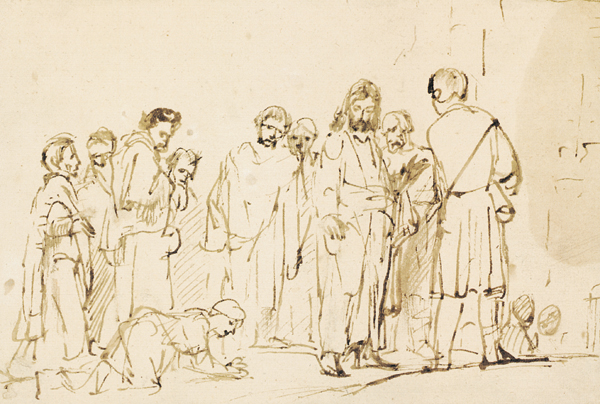
Rembrandt imagines the foreign woman pretending to be a dog

Then he heads back home via another sort of foreign place, an area colonised by Greek conquerors, the ten towns. People bring him a man who is unable to hear or speak. They want to see some magic, but Jesus takes the poor man aside, touching his ears with his hands and his tongue with his spit, telling him to “Open up!” And the man is healed.

Why does Mark put these two stories together? ( He almost certainly had no information about the real succession of events in Jesus’ ministry). The answer is in the command to “Open up!”  Initially Jesus had been closed to the woman, but she had been open enough to jolt him into responding. Their mutual openness allowed God’s goodness to help the girl. So when Jesus meets another needy person, who is closed to others by his deafness, he knows already that God wants the man to open up. The Aramaic word which Jesus used is very expressive. If you say it aloud, you can hear it as a powerful command.

Mark presents Jesus as a person who is open to God and other people and wants everyone to be the same.

Does the above passage chime with your image of Jesus? Is it a bit disturbing to think that he might have had his off-days, and have had to learn from a foreign woman? Is Mark’s vivid picture of Jesus’ physical gestures of healing not a litttle bizarre? And isn’t it very strange to think of a physical disability as something closed that needs opening?

But isn’t wonderful to hear for ourselves, for our lives, Jesus’ command to “Open up!” for we know that what makes us and all human beings wrong is our closedness.

As a minister I have known people, often very good people, to whom I was closed.  My relationship with them was via a persona that I offered in place of myself, which could therefore not be a genuine engagement. The current news issue about Boris Johnson’s characterisation of burqa wearers is not about their closedness but his. In the twenty five years of my association with a congregation in Northern Ireland I have learned how communities may close themselves off from each other, as well as how, with great fear and courage, they may open themselves to each other.

Jesus, the One who commands openness for himself and his followers, is relevant to our most intimate, as well as our most public, relationships. For that reason alone, he’s worth reclaiming.