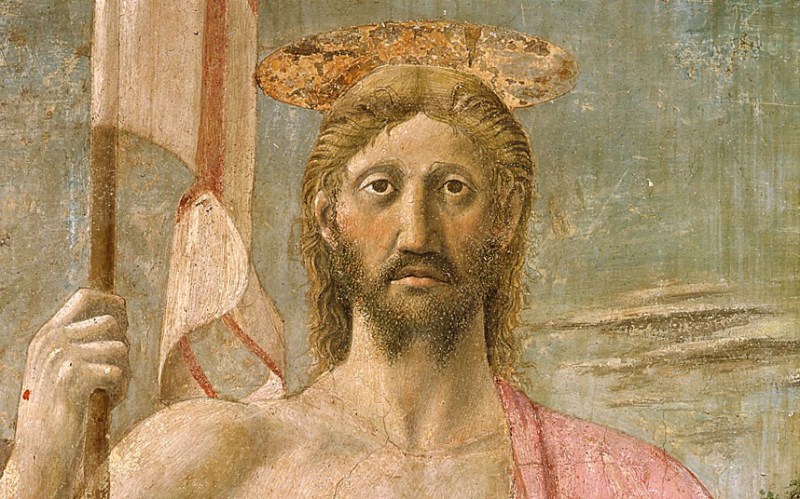
Enthusiastic believers are particularly enthusiastic about prayer. They are always wanting to pray with you or to enjoy “a time of prayer.” Special pieties auch as prayer in the spirit, prayer holding hands, prayer with hands laid on one, prayer across parishes or across continents, prayer breakfasts, lunches, dinners, not to mention speaking with tongues, are eagerly encouraged and practiced.

How does all this match up the Jesus we might reclaim from the Gospels? In particular, do we get a picture of Jesus as a “man of prayer”? Well not really. Matthew gives the instance of an agonised prayer in Gethsemane. Mark gives that also, along with an instance in which Jesus prays alone in the midst of a very active ministry.  Luke expands references to prayer, for example he adds prayer to Mark’s story of the transfiguration. He shows Jesus praying at cricial times, such as his baptism. We sense that he likes the idea of Jesus’ praying, but even so, limits it mainly to private prayer. John has Jesus pray lengthy theologically profound prayers, which are interesting examples of John’s own faith, but are not realistic examples of Jesus’ practice.

Matthew provides an explanation. He quotes Jesus’ teaching that genuine prayer should be private, brief and like the model Jesus gives. Anything public, anything that has one eye on being seen, is dismissed by Jesus, with the dry expression, “They have their reward.”

For Jesus, a relationship with the Father is the heart of faith, but as it is the human child talking to the one who is beyond all worlds, it must be secret, intimate, sober. As soon as it is made public its mystery is prostituted.

Jesus also shared happily in the prayers of the temple and synagogue, which were the common property of all believers, shared matter-of-factly or passionately as the occasion demanded. Such prayer was of its nature public and no one could pretend to do it better or more effectively than others.

On the whole, Jesus doesn’t come over as a very “religious” person. He spent most of his time, teaching, arguing and healing. He didn’t show or teach ways of drawing near to God, but rather announced the joyful news that God had drawn near to his people, and expected them to accept his way. Jesus seems not to brought a new way of being religious, but rather a new way of being human. His example, together with his teaching on prayer in Matthew chapter 6, is a sober challenge to all specious religiosity, and a call to something quiet, intimate and practical.


Two blogs ago I suggested that anyone interested in the idea of reclaiming Jesus should read through the Gospel of Mark, as a reminder of how the first Christians remembered Jesus. I’ve just obeyed my suggestion by reading the Contemporary English Version, which gives a very succinct translation. Here is a taste of it:

Jesus left and went to the region near the city of Tyre, where he stayed in someone’s home. He did not want people to know he was there, but they found out anyway. 25 A woman whose daughter had an evil spirit in her heard where Jesus was. And right away she came and knelt down at his feet. 26 The woman was Greek and had been born in the part of Syria known as Phoenicia. She begged Jesus to force the demon out of her daughter. 27 But Jesus said, “The children must first be fed! It isn’t right to take away their food and feed it to dogs.”

28 The woman replied, “Lord, even dogs eat the crumbs that children drop from the table.”

29 Jesus answered, “That’s true! You may go now. The demon has left your daughter.” 30 When the woman got back home, she found her child lying on the bed. The demon had gone.

Jesus Heals a Man Who Was Deaf and Could Hardly Talk

31 Jesus left the region around Tyre and went by way of Sidon toward Lake Galilee. He went through the land near the ten cities known as Decapolis. Some people brought to him a man who was deaf and could hardly talk. They begged Jesus just to touch him.

33 After Jesus had taken him aside from the crowd, he stuck his fingers in the man’s ears. Then he spit and put it on the man’s tongue. 34 Jesus looked up toward heaven, and with a groan he said, “Effatha!”  which means “Open up!” 35 At once the man could hear, and he had no more trouble talking clearly.

36 Jesus told the people not to say anything about what he had done. But the more he told them, the more they talked about it. 37 They were completely amazed and said, “Everything he does is good! He even heals people who cannot hear or talk.”

One of the things we should see in this excerpt is that Mark is a genius at telling a story. He doesn’t give too many details, but those he does give are all lively: Jesus wants to get out of the firing line so he goes out of his own territory, but he is too well known, and gets caught by this desperate woman. Annoyed he insults her by emphasising her foreigness with the term “dog” but the woman, out of love for her daughter, accepts the insult with good humour. Jesus realises what he’s said, and responds to her need. The girl is healed.

A_6
Rembrandt imagines the foreign woman pretending to be a dog

Then he heads back home via another sort of foreign place, an area colonised by Greek conquerors, the ten towns. People bring him a man who is unable to hear or speak. They want to see some magic, but Jesus takes the poor man aside, touching his ears with his hands and his tongue with his spit, telling him to “Open up!” And the man is healed.

Why does Mark put these two stories together? ( He almost certainly had no information about the real succession of events in Jesus’ ministry). The answer is in the command to “Open up!”  Initially Jesus had been closed to the woman, but she had been open enough to jolt him into responding. Their mutual openness allowed God’s goodness to help the girl. So when Jesus meets another needy person, who is closed to others by his deafness, he knows already that God wants the man to open up. The Aramaic word which Jesus used is very expressive. If you say it aloud, you can hear it as a powerful command.

Mark presents Jesus as a person who is open to God and other people and wants everyone to be the same.

Does the above passage chime with your image of Jesus? Is it a bit disturbing to think that he might have had his off-days, and have had to learn from a foreign woman? Is Mark’s vivid picture of Jesus’ physical gestures of healing not a litttle bizarre? And isn’t it very strange to think of a physical disability as something closed that needs opening?

But isn’t wonderful to hear for ourselves, for our lives, Jesus’ command to “Open up!” for we know that what makes us and all human beings wrong is our closedness.

As a minister I have known people, often very good people, to whom I was closed.  My relationship with them was via a persona that I offered in place of myself, which could therefore not be a genuine engagement. The current news issue about Boris Johnson’s characterisation of burqa wearers is not about their closedness but his. In the twenty five years of my association with a congregation in Northern Ireland I have learned how communities may close themselves off from each other, as well as how, with great fear and courage, they may open themselves to each other.

Jesus, the One who commands openness for himself and his followers, is relevant to our most intimate, as well as our most public, relationships. For that reason alone, he’s worth reclaiming.

04FDE140-45C0-4F87-B65C-777EEBC462EAAs the controversy over Boris Johnson’s jokes about burqas continues, I would like readers to look at passage from Matthew’s Gospel chapter 23:

Jesus said to the crowds and to his disciples:

The Pharisees and the teachers of the Law are experts in the Law of Moses. So obey everything they teach you, but don’t do as they do. After all, they say one thing and do something else.

They pile heavy burdens on people’s shoulders and won’t lift a finger to help. Everything they do is just to show off in front of others. They even make a big show of wearing Scripture verses on their foreheads and arms, and they wear big tassels[a] for everyone to see. They love the best seats at banquets and the front seats in the meeting places. And when they are in the market, they like to have people greet them as their teachers.”

Later in the same rant, he was even more abusive:

“You Pharisees and teachers are in for trouble! You’re nothing but show-offs. You’re like tombs that have been whitewashed. On the outside they are beautiful, but inside they are full of bones and filth. 28 That’s what you are like. Outside you look good, but inside you are evil and only pretend to be good.”

It’s clear that Jesus was giving a wholesale verdict on what he regarded as hypocrisy, but he begins with derisive remarks about their religious dress code. He certainly appears to think that daft religious clothing is fair game for mockery.

Am I making a comparison between Jesus and Boris Johnson? Heaven forbid! Boris is an upper class sneering bully who would have mocked Jesus for wearing sandals, and who, for the sake of public decency, should never be reported, whatever he says. His mocking dismissal of burqa – wearing Moslem women is intended to insult, but can safely be dismissed by them, coming as it does from a man whose chosen mode of sartorial elegance is floppy fatness.

963F1F3D-13A9-4C34-8EA0-A802012EE272

And even though the burqa has been imposed on Moslem women by partiarchal prejudice, many of the women value it and other “modest” coverings as at any rate preferable to the appearance of western female celebs such as Britney Spears at a recent gig wearing the standard pop uniform of a boob-pube-tube. If we pause to reflect on the truly gross clothing imposed by our males on our obedient females, we may feel that Moslem women have the better of it.

To return, however,  not to Boris, but to the issue of so-called respect for religion and religious customs, I cannot agree with the current official government position, namely that while of course our secret services will spy on them and monitor their words and actions, in case these are contrary to “British values”, at the same time we must profess a pious respect for their religion and its practices. In this way systemic disrespect for a whole people is clothed in the decencies of public protection.

I have a profound interest in Islam and admiration for many of its representatives in my city. I have worked with the young Moslems of “Taught by Muhammed” their social care arm in Dundee, where the principles of their religion are shown in providing a food-bank delivery service to non- moslems who lack food. As far as I know myself, I am completely free of prejudice towards Islam or its adherents; yet I want to claim the freedom to make jokes about aspects of their faith and practice which I judge to be oppressive.

9C30E5AA-3E2C-47F7-A27D-99A71F20906B

Who am I to make jokes about the excessive power of males in Islamic families? I am their friend and neighbour using a freedom which I am happy to grant them with regard to my faith and practice. A robust mutual respect can co-exist with robust mutual criticism. Jesus’ rough language about a respected sect of his own religion is an indication that he could use the broad humour of ordinary people to expose what he saw as play-acting. Some of his deunciation, if recorded live today, might see him facing a charge of “hate speech.” That should make us think: Is our concentration on what people may say about minorities a way of disguising what our society does to them?

Reclaiming the real Jesus means grappling with a person whose words were often more challenging than comfy, more spicy than bland.

Faced with Christian believers who claim to know Jesus intimately as their Saviour, I am often startled by how little they cherish his life, teaching, ministry, and human character. For them it seems enough that he was born, died on the cross, rose again, is alive and loves them. If, as John’s Gospel has it, Jesus is the Word of God made flesh, then the classic Christian response has often been that it is too long and must be abbreviated, as if the essence of Jesus could be captured in the words of the creed, “born of the Virgin Mary, suffered under Pontius Pilate, was crucified, dead and buried. On the third day he rose again from the dead…he ascended into heaven…sits at the right hand of God the Father Almighty. From thence he shall come to judge the living and the dead.” In churches where the memory of Jesus is celebrated and taught, the creed does no harm; but as soon as the memory of Jesus, including its incorporation in the Gospels, is neglected, the very substance of God’s word, that is, Jesus himself, is removed, allowing believers to invent a Jesus who offers no contradiction to their cherished moral and political convictions.

Christ tempted
Rembrandt shows Jesus calmly teaching the devil

Some of this derives from the misunderstanding of St. Paul by the great figures of the Protestant reformation, whose view of salvation by grace alone focused the believer’s attention on the saving death and resurrection of Jesus to the gradual exclusion of the gospel narrative. Protestant churches here in Scotland with their abhorrance of images, have left their buildings bare of any vibrant representation of the life and teaching of Jesus. A small advance was made in the Sunday School movement in Victorian cities, which taught children the life of Jesus, wrongly assuming that adult members were familiar with it. This has contributed to the sad fact that many members of my church today last studied Jesus’ life in Sunday School.

At best, this bias distorts the Church’s worship, message, and mission. At worst it permits a form of Christianity which is little more than an enthusiastic expression of  believers’ prejudice. An example of this worst are the Trump – supporting evangelical churches of the USA, who have lost all sense of Jesus other than as a presence who blesses their hatreds and will lift them up the air to meet him when the Rapture comes. Their claiming of Jesus as a Trump supporter has led, however, to a critical response in the from of the movement in the USA which has called itself RECLAIMING JESUS created by The Sojourners Community (worth googling) and its friends. There is happily nothing quite as alarming in Scotland as Trump- Jesus, but there are churches here claiming close adherence to Jesus Christ as God’s word, who have lost any sense of the human Jesus along with any desire to continue his ministry.

B5B4E6C5-F245-4AE0-948A-6E60C07FA8B6
Rembrandt draws Jesus’ reaching out to a leper

There are also churches of all theological positions, who have quite recently developed ministries of social care and justice, and know that their work could be better resourced by reclaiming the life of Jesus as their dearest possession. They are rediscovering with delight and wonder the unique character of Jesus and his explosive commitment to abundant life for all people, and especially for the poor, the outcast, the oppressed and the sinners. They find that the stories of the gospels express the wisdom and excitement of Jesus’ ministry in ways which can enrich the minstry of their churches.

RECLAIMING JESUS MEANS BEING RECLAIMED BY JESUS

5939812B-75E5-41D8-8679-E8DA6D23C9DD
Rembrandt shows Jesus writing on the ground when a woman was accused of adultery

Yes, I would like to see a Reclaiming Jesus movement in Scotland, but there is a danger that it could get trapped in the very kind of religious emotionalism that Jesus detested. “Blessed are the breasts that suckled you” a woman shouted to Jesus, who replied soberly, “Blessed are those who know God’s will and do it.” Any true reclamation has to take into account that the deadly enemies of Jesus were religious people on the one hand, scandalised by his friendship with people who were not religious, and on the other, the power holders who reckoned that Jesus’ kingdom might be more popular than theirs. To reclaim Jesus and be reclaimed by him is likely to be dangerous, but unlikely to be dull.

Where do I want people to start?

1. Read the gospel of Mark through at one sitting, say two hours. If there is one small thing you might do as a result, do it.

2. Find a modern version of the Lord’s prayer ( Good News, Revised English, New International), write it or type it boldly on card, and say it daily.

3. If you are interested, comment on this blog.

I will provide more information for getting started in my next blog.

( Rembrandt in his art reclaimed Jesus for his time and place)

The current public debate about anti-semitism, whether in the Labour Party or elsewhere, is deaved (Scots= confused) by the vehement use of words whose meaning is insufficiently examined.

For example, “Semite”: this term may have some value as referring to a group of langauges with common elements ( including Hebrew and Arabic), but its use as referring to a race of people is due to the mainly German cultural historians of the 19th. century, who made it a racial designation of ancient near eastern civilisations, before it was twisted into a negative name for Jews, as seen in the founding of The League of Anti- Semitism in Germany in 1879, which was devoted to anti- Jewish action. This development was the precursor of the demented Nazi nonsense about Aryans and Semites, espoused by Hitler.

Fact: There is no Semitic race, but if the term is given its proper sense of referring to a family of languages, then it includes Hebrew and Arabic along with many others.

It is strange that Jewish people even now should continue to use a term developed by their enemies. It may be explained by their understanding of the Nazi murder of 6 million Jews, on racial grounds, from 1933- 1945. Ultimately, this Nazi racism was made possible by a) the historical self-understanding of the Jewish peoples of the diaspora, that they were a race rather than merely a religion, an understanding reinforced by their frequent persecution by Christians, who also saw them as a race.

Fact: The racial “purity”  of Jewish people may go as far back as Ezra who famously told male Jews to dismiss their foreign wives, but doubtless before his time and after, there has been more racial mingling than orthodox Judaism is prepared to admit. It might be better to think of Jewish people as a religious/ secular community that wants to be a race. Genetic testing finds little difference between Israelis and Palestinians.

The term “Jew”, albeit worn as badge of honour by those who remember the history of persecution, should be understood like the term “Scot”, to refer to those who live now in the home country or are part of a diaspora, but trace their family origins to that home country. Scots are not a “race” but a melange of incomers who themselves were racially mixed before they arrived.

Jewish people who insist on their racial identity may be part of the problem of anti-semitism rather than part of the solution. The new law passed this week by the Knesset limits the right of national self-determination to “Jewish people”. Obviously this is a racist law as both Jew and  Non-Jew are racially defined. Israel is declared as the nation state of the Jewish people. This move makes idiots of all of us who scrupulously try to distinguish between the actions of Israel and those of Jewish people.

Fact: The term “Holocaust” referring to the sacrifice of an animal to be completely consumed by fire, has been used from the 1950’s by Jewish and other historians to refer to the Nazi murder of 6 million Jews. Its users, along with those who use the Hebrew “sho’ah” = destruction, often forget the other ten million people wiped out by the Nazis, including Roma, Poles, Communists, Gays, and “useless” frail elderly people. Sometimes the langauge used suggests that this unbelievable horror justifies some subsequent actions by or on behalf of Jewish people. Clearly it does not.

The prefix “anti” requires definition. I for example am “anti- orange” meaning that I detest the Orange Lodge and all it stands for in  Northern Ireland and Scotland. I also am “anti -IRA” and detest their past and supposedly non-existent present. Here “anti” refers to moral judgements made on public behaviour and speech, together with the emotional accompaniments of those judgements. In some instances those judgements have influenced my behaviour. I do not think that being “anti” in these ways is either wrong or dangerous.

So when I recognise that I am to a lesser degree “anti- Israel” I mean that I have made value judgements about the way in which the State of Israel was founded- I know people whose homes were stolen by Israelis in 1948- and about the inhumane policies of its present government towards Palestinians. These negative judgements have in this case to live alongside my admiration for the principles on which the state was founded, and for their courage in the face of concerted attacks by their neighbours. However I weigh up these pro and anti attitudes, I cannot see that one is morally superior to the other, or that either of them should be considered illegal. Nor would I relish my political party telling me that one or the other was forbidden.

Without quibbling, I believe that dislike of any  group of people on the grounds of what they are, rather than what they do or stand for, is wrong and dangerous, as it may lead to pernicious actions, such as those done by the Nazis to the Jews of Europe, or by the Serbs to the Bosnian Moslems. It is also the case that propaganda may attribute crimes to groups of people, which they have not committed, as Stalin’s political machine did to any group that he wanted rid of. For that reason, although I permit myself negative judgements on certain groups, I must limit any action I may take towards them,  by Jesus’ command to “love my enemies.” But even Jesus assumed that I would have enemies, that is, groups or individuals towards whom I might be “anti”.

Fact: Simply being “anti” a group of people is not a crime.

I am saying that the entire construct of “anti- semitism” as a moral and political crime is inaccurate, prejudicial and should be abandoned.

On the other hand there are people who foster hatred towards Jewish people, or towards the state of Israel, and some towards both. In some people this hatred rests on simple prejudice, in others, on inaccurate versions of fact. Both are wrong, and should be prevented from causing harm, or from enshrining their prejudice in any law. Our existing laws provide penalties for various kinds of incitement and of course for violence, and our political process gives opportunities for public argument and protest. I do not think that we need to adopt special protocols outlawing anti- Jewish prejudice, any more than we need them for those who dislike The Inuit because they think they smell of blubber. But we need laws that punish any harm that is done to Jewish or Inuit people, and public debate that brings such prejudice into disrepute.

As well as Jesus’ command to love our enemies, there’s the fact that we have a story which shows him expressing Jewish prejudice against a Canaanite woman, who asked him to heal her daughter. He replied by asking if the children’s food (gifts for Jewish people) should be thrown to the dogs ( gentile people), which insulted her as a dog. The woman accepted the insult, pointing out that nevertheless, the dogs got the leftovers from the family table. Rembrandt marvellously depicts the woman on all fours miming a dog. Jesus, rebuked by this splendidly humorous human being, praised her and granted her request. The Christian tradition has interpreted this story as “Jesus testing the woman’s faith.” That’s mince: the woman’s faith is testing Jesus, and although he ultimately passes the test, he shows his frailty by prejudicial words.

We are all – even the son of God- liable to have prejudices and we all need a culture which challenges them; and we can all be harmed by prejudicial words or actions and we all need laws that punish them. But must make sure that our terminology is dealing with realities and not fictions.

With all the above in mind, I cannot see that the founding of the Israeli state should be excluded from rational debate, given its impact on many Palestinian people; nor that the Israeli government out of all governments in the world, ahould be spared comparison with the Nazis, if the cap fits. I do not think the cap fits Israel nor indeed that it fits even Syria, but I cannot see why any historical comparison should be outlawed. The Labour Party is quite right to resist those who want unique protections for the state of Israel, but it must also resist those whose hatred of Israel means they would welcome its destruction.


Another example of how to use the blessings of Jesus as a spiritual discipline. See previous blogs.

1.Choose one of the blessings that might be relevant to yiur life.

I am a socialist, and I have to recognise that for the mainstream of that tradition, Jesus blessing, “Happiness for the gentle: they will possess the land,” is nothing less than reactionary nonsense, because it flies in the face of the facts. What has happened to the gentle in Syria, or Yemen, or Myanmar, or for that matter, Israel. Everywhere the gentle people can be seen fleeing from their violent lands, attempting to find asylum in Europe, where increasingly they are rejected and reviled. How could Jesus come up with this blessing which is counter- factual and dangerous for anyone who might take it seriously?

It’s good to remember however, that Jesus lived in an occupied territory, where freedom fighters existed and promoted holy war against the Romans. Those who know the history of how Israel’s holy wars led to the utter defeat of its fighters, the destruction of the temple and the exile of huge numbers of its people, may feel that Jesus wasn’t so daft. In any case, how can I use this contested blessing as part of my spiritual discipline, and recommend it to others?

2.  Clarify its connection with your life now.

I am directed towards the gentle people in my own acquaintance, and those known through  media. I realise that they are easy to like, in that they are not agrressive and will not try to harm me. They make it possible for me to share their lives and their concerns. They make no preconditions for recognising my humanity and invite me to have none in recognising theirs. I do not however think of them as pushovers: they can be very firm in asserting their right to life and happiness; and shrewd in stripping away the hypocrisies of violent people.

Although they are sometimes made to suffer, they are not in love with suffering. Just as they do not want to cause pain to others, they do not want to be caused pain. They do not think they are entitled to own the earth but are content to share it with others including the creatures of the earth. Their gentleness leads them to respect the earth.

They also share the gentleness of God. Indeed the main theme of the Bible is the story of how from being the hooligan that almost wiped out the earth in a flood, God learned the gentleness evident in Jesus. In fact of course it’s more truly the story of how human beings learned not to project their violence on to God, but rather to copy  his/her gentleness.

A) If the connection with your own life is positive, seek out the happiness promised by Jesus

In this case the connection is not positive. I am often not gentle, although I detest bullies. My instinct when faced with someone who wants to bully me or others, physically, economically, politically, intellectually or spiritually, is to destroy him. My instinct is not defensive, but aggressive; I want him to bleed.

B) if the connection is at odds with you, look at the unhappiness you are expressing or creating.

Does my instant aggression come from fear of hurt? (I think so)

Are you aggressive to bullies now because there once was a bully you could not defend against? (Yes)

Are you actually happy if you have “destroyed” someome? (No)

Would you be pleased if most people acted like you? ( God forbid)

In view of all this unhappiness would you not like to try gentleness?

3. I think I want to be like the gentle people I have described above. When I’ve tried it, I have been happy. Perhaps I can hold that happiness as a motive for being more gentle.

4. Belief in the gentleness of God is increased by sharing it in my own thoughts and actions. It doesn’t come easy, but it does grow.

5. Once I leave aggression behind, I become aware of the huge spiritual power of aggression in the world. Just thinking of the current argument about anti- semitism in the UK Labour party shows how decent people can be possessed by it, as I have been in the past.

I hope it’s in the past.


My last blog promised that it would give instruction for using the blessings of Jesus, (Matthew 5) as a spiritual discipline. Instead it gave further reflections on the second blessing:

Happiness for those who grieve:

they will be comforted.

In this blog I want to make good my original promise.

1. Look at the list of blessings and focus on one that might be relevant to your life now.

Jesus said:

Happiness for those who want no power over others:

The rule of heaven belongs to them

Happiness for those who grieve:

they will be comforted.

Happiness for the gentle:

they will possess the Land.

Happiness for those who hunger and thirst for justice:

they will be satisfied.

Happiness for those who show mercy:

mercy will be shown to them.

Happiness for those who have clean hearts:

they will see God.

Happiness for the peacemakers:

they will be called God’s children.

Happiness for those persecuted in the cause of good:

the rule of heaven belongs to them.

Happiness for you, when they hurt you and persecute you and slander you for my sake,

Be full of joy and delight,

Because the reward which awaits you in heaven is huge.

For in the same way they persecuted your ancestors, the prophets.

For example, if I am conscious of a situation in which I want no power or am trying to exert power over someone, I might select the first blessing.

2. Make clear its connnection with your life.

A) If the connection with your own life is positive, seek out the happiness promised by Jesus. Note down instances of that happiness. in this case, for example, I might note:

What a relief it is not to be planning how to gain an advantage

How good it is to enjoy the other person as a person and not a means to my ends

How decisions become clearer if I have no hidden motives

How I become better at noticing those who want power over me

How I an able to share in fruitful partnership with this person and others.

B) If the connection is at odds with you, obviously,  you cannot claim the blessing for yourself immediately, but rather look at the unhappiness you are expressing or creating.

What sort of power do I want over this person?

What words and actions have expressed this desire?

Why do  I want this power?

What effect have I had on the other person?

Have I been cloaking my desire for power under an appearance of assistance or affection or religious zeal?

In view of all this unhappiness, ask: Would I not like just to give up this desire for power?

3. If you can answer yes to that question, or even if you’re not sure, go back to 2 (A) and look clearly at the advantages of renouncing power. Feel even in imagination the promised happiness, till you become sure that giving up power over others is not a sacrifice but a pleasure.

4. Remind yourself that this is the way God rules, not by power over the universe but by persuasion. The freedom enjoyed by creation and creatures right down to the movement of atomic particles is due to God’s renunciation of power. This also evident in the life, suffering death and resurrection of Jesus. The depiction of God as all powerful is a mistake based on the image of earthly rulers. When I give up power over others I open myself to the rule of God.

5. And that’s just as well, for I need to recognise that when I desire power over others I am open to being ruled by worldly powers of greed, oppression and violence. The happiness of wanting no power gives me freedom from them. Recognise and value this freedom

6. Finally, if your reflection on this blessing reminds you that you are a victim of someone or of many people who desire power, then it should remind you that Jesus and you are fellow victims in this regard. Think of his life story and his teaching as communicating “the intelligence of the victim”, some of which you know at first hand. This will give you courage to remain opposed to oppressive power without desiring it for yourself.

7. You will realise that your refusal of power over others is itself a kind of power, the power to persuade, share and enable, to suffer and to endure, which we naturally label as Christlike.

I hope these instructions which are the fruit of my own real failures and tentative successes are useful to someone else, but first of all they are meant for myself.

I’ve been thinking about each of these blessings of Jesus, with the promise that I would suggest how to use them as a spiritual discipline.

Jesus said:

Happiness for those who want no power over others:

The rule of heaven belongs to them

Happiness for those who grieve:

they will be comforted.

Happiness for the gentle:

they will possess the Land.

Happiness for those who hunger and thirst for justice:

they will be satisfied.

Happiness for those who show mercy:

mercy will be shown to them.

Happiness for those who have clean hearts:

they will see God.

Happiness for the peacemakers:

they will be called God’s children.

Happiness for those persecuted in the cause of good:

the rule of heaven belongs to them.

Happiness for you, when they hurt you and persecute you and slander you for my sake,

Be full of joy and delight

Because the reward which awaits you in heaven is huge.

For in the same way they persecuted your ancestors, the prophets.

Firstly, how can I think that any of these blessings applies to me? I’m not a spectacularly bad person, but nor am I sufficiently good to describe myself as merciful, or gentle, or a peacemaker, especially if these terms designate character traits that last over time.  Doubtless Jesus hoped that they might become traits of character, but he offered them to disciples whom he knew to be flaky at times. We can conclude therefore that he did not intend them only for those who are settled in virtue.

Perhaps I can show how they can apply to me, if I take first the one that doesn’t look like a virtue:

happiness for those who grieve:

For they will be comforted.

If I really grieve, the truth of my sorrow links me with all who grieve even if the cause of my grief is different from theirs; no true grief is selfish but is open to being shared even if an actual act of sharing does not take place; shared grieving is one of the fundamental conditions of humanity. I can be reminded of this even when my own life is comparatively fortunate, if I open myself to another’s grief. In the recognition that bad things happen to all and bad things are done and said by all (except the great saints), there is a humour and a happiness that superficial people never know. It is a blessing of tears which promises a time when all tears will be wiped away. It is the happiness of those who grieve and can be discovered by honesty about my own suffering and openness to the suffering of others. Jesus’ blessing directs me towards this honesty and this openness.

But really? Where can any promise of ultimate comfort come from, and without it, can human sharing of grief in any way match the vast and varied history of suffering? Goya looked closely at suffering in his etchings, “The disasters of war” which emphasise that there is no comfort, no possible redemption, as in this one which he entitled, “no hay quien los socorra” – there is no one to rescue them.

D888C68E-0F8E-4F5B-B323-C49ED6DE5676

Are there any words which can assuage this man’s terrible grief? I’m inclined to say no, but then there is the evidence of the etching itself: another man has seen, and entered into it and borne witness with all his skill to this suffering, in such a way that his desire to share the burden of this poor man is not incredible. And if we could write the same words below an etching of the crucifixion, we might be able to see it as an image of God’s desire to share the burden of those whom no one has rescued. This identification of God with the grieving Jesus is itself resurrection, new life, tears washed away, happiness for all who mourn.

Whether the suffering is heavy or light, Jesus’ blessing invites the laughter of God’s rescue which is to come. I have particularly recognised this in moments when I am grieving my unworthiness for any of the other blessings of Jesus: even this grief, if it is genuine, can allow me to enter the place of shared humanity and shared happiness.

When I’m using the blessings as a spiritual discipline, therefore, I always start with this one, because the grief it blesses is always with me.


This blog brings me to the final blessing of Jesus recorded at the beginning of Matthew chapter 5:

“Happiness for you, when they hurt you and persecute you and slander you for my sake,

Be full of joy and delight

Because the reward which awaits you in heaven is huge.

For in the same way they persecuted your ancestors, the prophets.”

Of course this is a continuation of the previous blessing on those who are persecuted in the cause of the good, but it focuses especially here on Jesus’ disciples. The more general blessing is made particular, and the cause is identified as that of Jesus himself.  The disciple follows Jesus because Jesus fulfils his deepest intuitions of goodness, but He also corrects and sharpens them by his teachings and actions. Love of Jesus leads disciples to follow his way, which turns out to offer hurt, suspicion, slander and persecution, as well as happiness. In this case it is tempting to see the suffering as earthly and the happiness as heavenly. But Jesus commands them to be happy now. Yes, that happiness is fuelled by the promise of a reward. All who say that virtue is its own reward, are faced with Jesus’ repeated promise of the recompense that God will give to his persecuted children. Faith without reward is not the faith of Jesus, just as mercy without judgement is not the mercy of Jesus.

But the happiness is also based on the gift of ancestors whom disciples would never have claimed as their own. Jesus recognised the prophets as his own ancestors; he may have understood his own destiny through the figure of God’s suffering servant imagined by Isaiah. He often spoke in the language of the prophets, especially when promising misfortune for God’s enemies. The faithfulness of the prophets in the face of the enmity of the powerful, was an inspiration to Jesus in his ministry and in his suffering. Here, however, he offers his disciples a share in this splendid ancestry. They may not have considered themselves as prophets of God, but here they are adopted into the family of Samuel, Elijah, Amos, Hosea, Micah and Isaiah and the rest. This blessing offers to me the ancestry of God’s biblical prophets, along with the martyrs of the faith, along with Bonhoeffer, Luther King, Gandhi, and many others, some unrecorded, down to David Haines of Perth, the aid worker savagely killed by Daesh. Is this happiness?

Yes, yes, what marvellous dignity it gives to my life when my own poor faith and discipleship, my own minor sufferings, are numbered with those of my ancestors, the prophets of God. And as I am happy to receive the honour of having them as ancestors, maybe, just maybe, they are happy to acknowledge me as one of their successors.

This blessing can help me obey Jesus’ command to be “full of joy and delight.”


This blog continues my meditation on the blessings of Jesus from Matthew chapter 5 which I started in my blog of May 29.

“Happiness for those persecuted in the cause of good:

the rule of heaven belongs to them.”

(I have translated the Greek “dikaiosune” neither as righteousness nor justice, which are the usual versions, but as “the good” because I think it means a comprehensive rightness.)

Being persecuted in the cause of evil is bad enough, but at least you know you’ve deserved it, whereas being persecuted in the cause of good, although common enough in this world, is surely unfair and miserable. I haven’t acted often enough in the cause of good to be able to judge with authority, but my one experience of persecution for that cause,  certainly gave me no pleasure, but rather fear, followed by fury.

So what right has Jesus to promise happiness to the persecuted?

Now that I’ve read that last sentence again, I can see how crass it is, given that Jesus knew only too well what it was like to be persecuted in the cause of good.

But he wasn’t happy, was he? It wasn’t  like the Python’s parodic crucifixion where the victims sing “Always look on the bright side of life.”

You might conclude that in this case the happiness promised is solely in the future, that is, in the resurrection life where the tears will be wiped away and the hard service rewarded.  But I’ve been arguing that although the blessings always point towards the full establishment of God’s rule, they also have a present dimension, in the ministry of jesus and his disciples, that is, in the beginning of God’s rule, through them.

The happiness Jesus promised comes from winning: the powers of the world persecute people who are committed to the good in the expectation that they will give up their commitment, either by agreeing with these powers, or by opposing them with the weapons of the world, for example with hatred and violence. But those who follow Jesus neither give in to the powers, nor do they oppose them by evil means: They hold on to goodness and suffer for it without departing from its methods. They hope that their goodwill may persuade their persecuters. This sacrificial faith is depicted in the much-misinterpreted book of The Revelation as the power which destroys the great city of “Babylon”, representative of all the oppressive empires of the world. The person who suffers for the good knows the happiness of being undefeated and continues to offer to the enemy the goodness which ultimately wins because it is the goodness of God. This is a profound happiness which nothing can remove.

The rule of God means that God wins by persuasive love, including the auffering of those who are persecuted for the good.