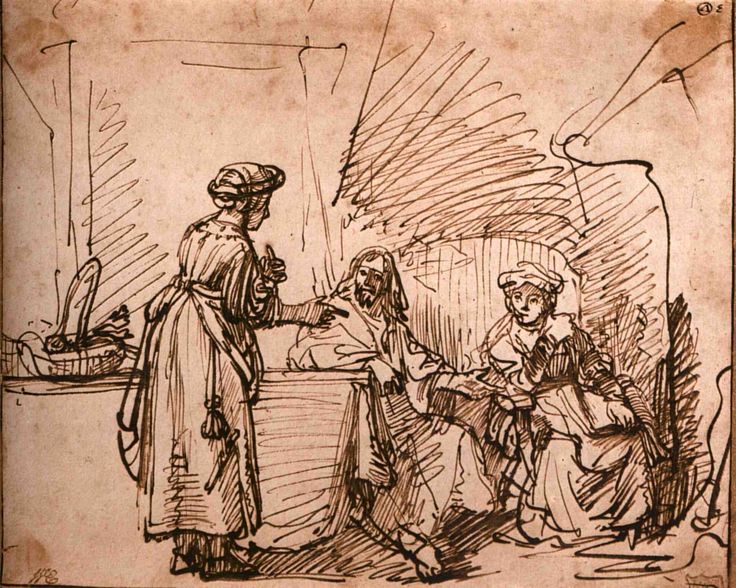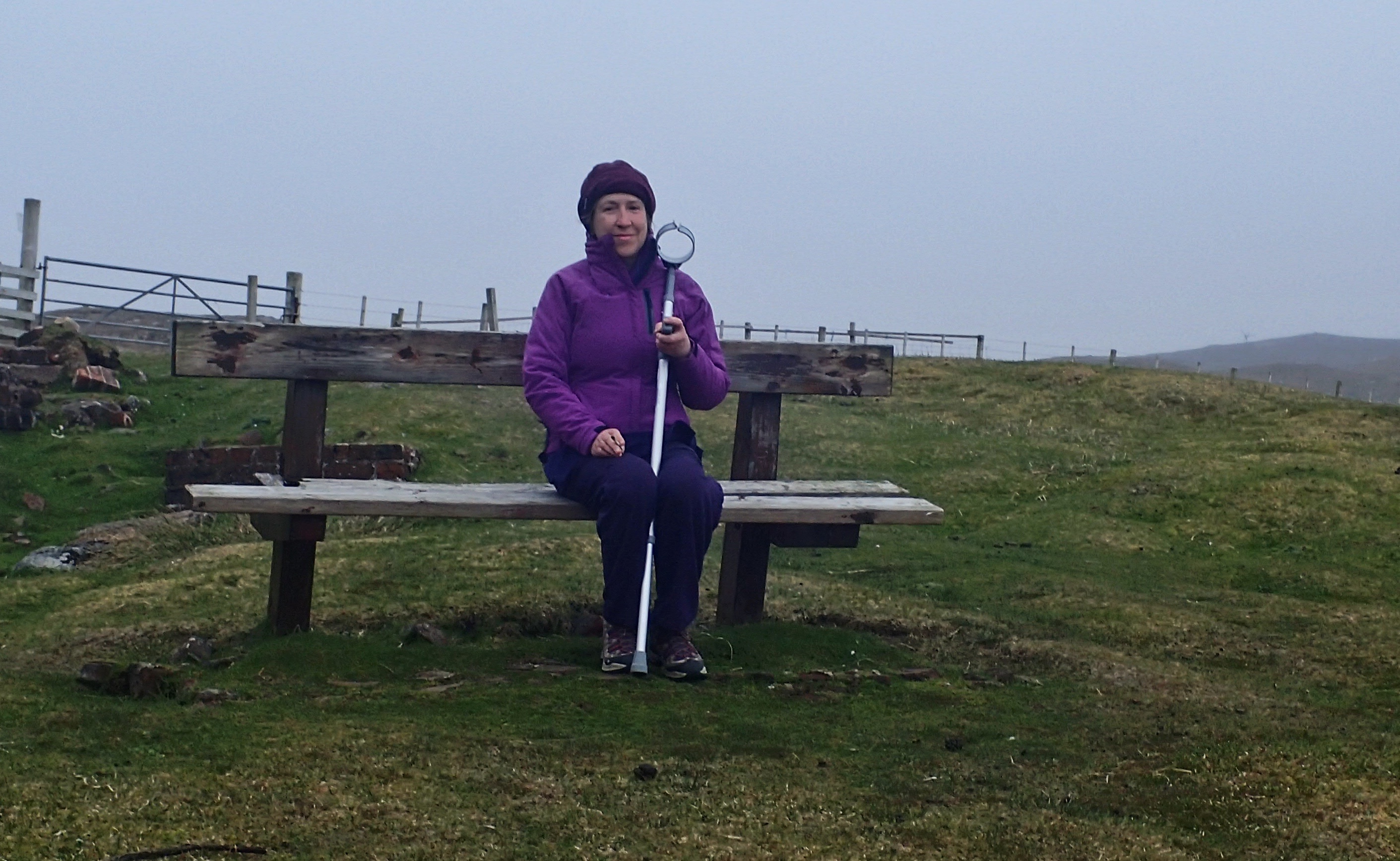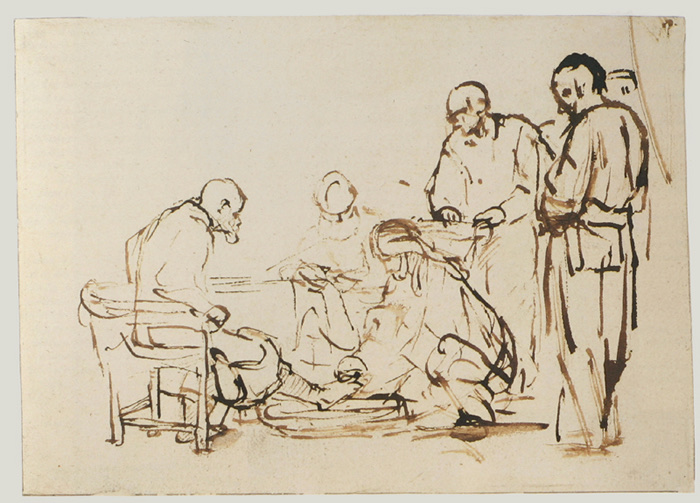
Our daughter Eleanor died on 21st April of this year. She left me the soft toys she used as puppets in her stories for children.
E: I saw you using my animals yesterday for your zoom worship…
M: It’s true I felt close to you….I don’t like doing that stuff alone, it was more fun with the two of us… what did you think of it, by the way?
E. It was a disgraceful surrender of the serious task of teaching children about their eternal salvation, while substituting a piece of knockabout comedy. And all the better for that!
M: It really is you! You haven’t lost your sense of humour. It’s been a while, my dear, I don’t quite know why….
E: You’ve been sad, sadder than you were right after my death, why’s that?
M: Because, as time goes by, days, and weeks, I’ve realised you’re not coming back. You won’t suddenly be here again, for the next part of our story…
E: But soon enough, you’ll be here for it. You’re an old fart, remember
M: Are you allowed to swear in… in…?
E: We’d agreed to call it heaven and the answer is yes, as long as it’s done with affection. Or did you have a sudden thought I might be in what you people call the other place?
M: No. But I do remember the story of the believer who goes to heaven, and asks for cigarettes and is told, sorry they belong in the other place. And he gets the same answer when he looks for booze, and night clubs and the bookie’s: sorry they belong in the other place. Exasperated he questions St Peter, what’s going on, pal, all the good things of life are missing here, but available in the other place!
E: I’ll do it: Sorry, says St. Peter, it’s just the way it is, everything’s gone to hell since the Tory Government got in! Ach, there’s nothing like the old ones. Fortunately, heaven is not much like the stories…
M: No golden crowns, no sea of glass, no harps?
E: No space, no time..
M: So when we say you’re in heaven, what are you in?
E: Love. We’re in love.
M: Ach child. Are you happy?
E: All the barriers to learning how to be happy have been removed; so, I’m learning. In life I didn’t learn it. But you haven’t learned it either, have you?
M: What d’ye mean?
E: You haven’t learned how to be happy.
M: You didn’t help much!
E: I hope that’s not bothering you too much. I’ve forgiven myself for my mistakes.
M: I thought God does the forgiving…
E: Yes, but if you really believe that, you then have to forgive yourself. Have you done that, for your mistakes?
M: No, that’s why they haunt me. And yes, I made … mistakes.. with you. Have you forgiven me?
E: Certainly not! In fact I’ve a long list of them with appropriate penalties for each. Yes, of course I’ve forgiven the mistakes and given thanks for all the things you got right.
M: That’s a relief..
E: Everyone thinks living in love would be easy. It’s not. For a start you have to unlearn all the protections you built against hate. And failure.
M: Can you still fail in heaven?
E: If you can learn, you can fail.
M: That’s good. I believe in love and forgiveness but I don’t want everything done for me. I want to achieve something.
E: You want God to mark your jotter and say, well done, don’t you?
M: I guess so….
E: Well I can’t tell you things you don’t know, but I can tell you, it’s better than that.
M: Why can’t you tell me things I don’t know?
E: Because I can only work to the limits of your imagination. That’s how we meet.
M: So maybe I’m just making all this up to comfort myself?
E: Is that what you think, that I’m figment of your imagination?
M: No, I don’t think so, I hope not.
E: Hold on to that hope. Try to learn some more happiness. Love to mum. I’ll always be here.

One of a series which explores the artist’s images of Jesus.

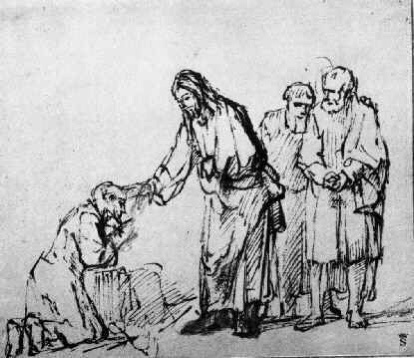
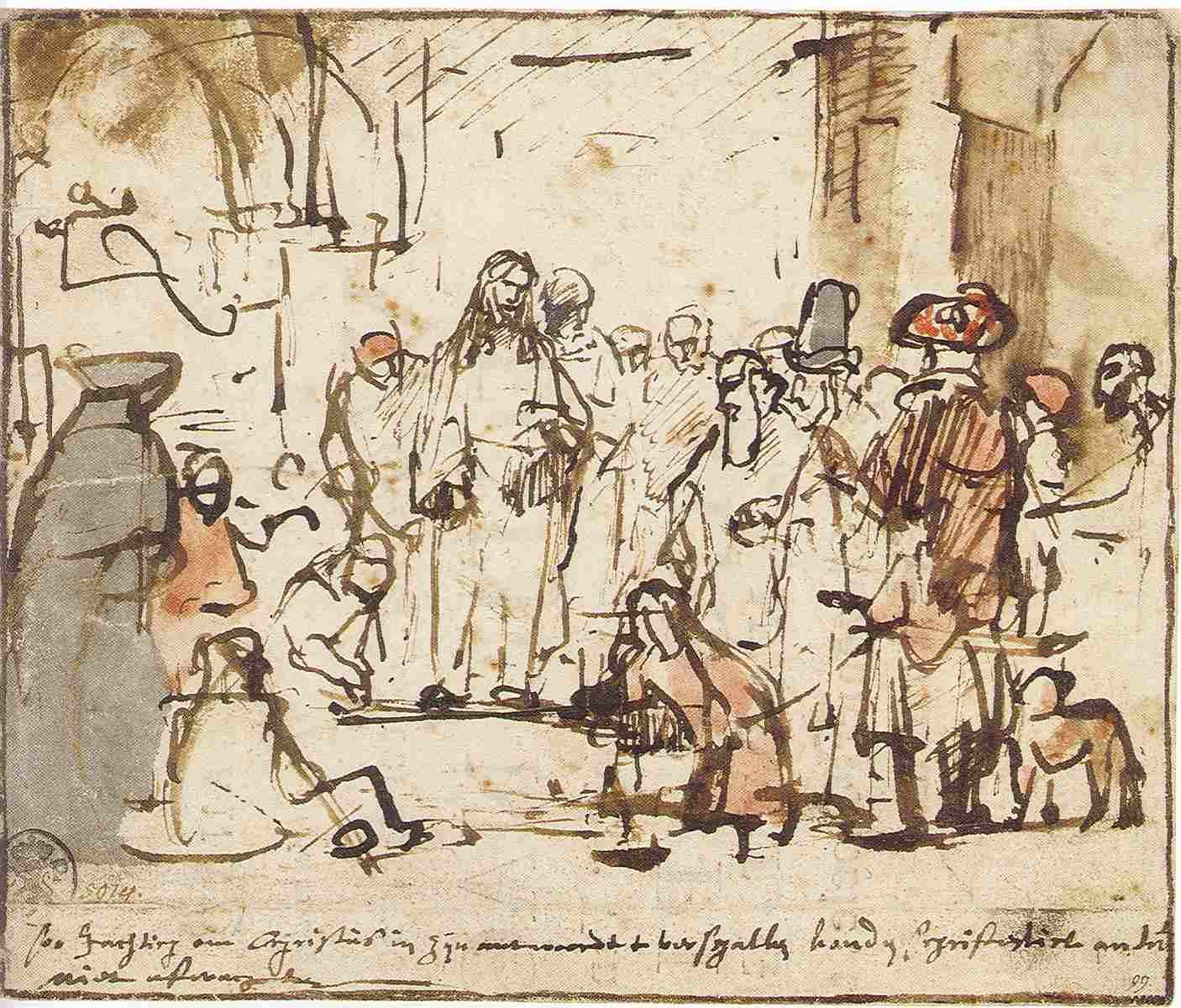
I apologise for the size of this image, but perhaps even in this reduction, readers will be able to see its power. This is one of the few where Jesus is not main figure. He is shown turning back towards the Canaanite woman who has plead with him for her sick child. He has responded like a good Jew, saying the food for God’s children should not be given to the wee dogs. This insult hangs in the air until the woman, with all the wit of her desperation throws herself on to all fours and reminds him that the wee dogs under the table can usually get the crumbs. Startled her wit and persistence, Jesus is in the act of admitting his fault and applauding her act of faith. He heals the child.

Now there are scholars who say that Jesus was testing the woman. Does anyone think that a football fan in court for making monkey noises at a black player, would get off with the excuse that he was testing his victim’s mental strength? No, you can’t call anyone’s daughter a wee dog without prejudice. This makes this story itself a test for honest commentary, and of course, honest representation in art.

Rembrandt passes the test surely. He shows Jesus off -centre identified with the standing figures of his disciples, who are either ignoring or looking askance at the woman, whom they are bypassing. The upright group are about to refuse the woman’s request: she is not one of them. But she has thrown all this into confusion by adopting the posture of a dog, and claiming that even wee dogs have rights. Seeing their prejudice acted out before them, stops them in their tracks. Jesus learns from her action what he already knows, that he cannot hold his hallowed prejudice if he remembers whose ‘food’ he is distributing. The woman by her doggy act reminds Jesus that she and her daughter are also children of the father. She has appealed to his heart and mind over the barrier of his words.

Rembrandt knew that Jesus urged people to turn to God and to their neighbours. Here he shows him obeying his own teaching by turning towards this woman. His perfection is not that he never did anything wrong, but that he was always open to learn and to do God’s goodness. (The doctrine of his sinlessness is part of an elaborate theory of how he brought salvation to the world. We can put it in the bin along with notions of Mary’s perpetual virginity and the like.)

People who acted out the I Can’t Breathe of George Floyd will understand the meaning of a Rembrandt’s woman pretending to be a dog in front of a bunch of men, and its power. The physical arrangement of the figures and their postures tells the story.

A series of blogs on Rembrandt’s drawings, etchings and paintings of Jesus.

Jesus heals Peter’s wife’s mother

Rembrandt’s images show that he read his bible with an active intelligence, applying what he had learned from the teaching of his church, while allowing his hand to discover more of the humanity of biblical characters, including Jesus. Inevitably as he imagined the body of Jesus, its weight and poise, the movement of arms and legs, he found an understanding of him that is very different from that held by those who work with words. Like me. Faced with Rembrandt’s vision of Jesus, I recognise immediately the poverty of words.

This drawing is of the incident in chapter 1 of Mark’s gospel, which tells of a Sabbath day in Jesus’ ministry. After synagogue, in which Jesus has cast out an evil spirit, he is invited to Peter’s house where his wife’s mother is said to be suffering from a fever. We can guess that she lives there because she is widowed and has come to be with her daughter. She is the older woman, but she is not in charge of the house. As the house would only have one large room, with curtained spaces for sleeping, she would have been within earshot of the houseguests, who were expected to ignore her. But Jesus, breaking all social taboos, enters her area, a man to a woman, and worse, takes her “by the hand”. He is not prepared to let her languish out of sight.

Notice how Rembrandt has Jesus use both hands, with his bare feet firmly poised on the floor, so that he can bend towards her, ready to lift her with strength of his trunk, from her bedding to her feet. Only the action is paused at the first moment of lifting, so that the calm pressure of Jesus’ ‘rescue’ is evident. But also evident is the cooperative reaction of the woman who braces herself to be raised. This is how Jesus deals with the social displacement of this woman: he helps her to her feet and she takes over the role of host. It is also a powerful image of Jesus “rescue” of a sick humanity: he bends towards it in compassion, he lifts it up, the human being responds.

Rembrandt understood of every story in Mark’s gospel was an image of the whole salvation that Jesus worked for humanity. Not just every woman but every man also can put themselves in the posture of the mother-in-law, to feel the inexorable kindness of Jesus prompting them to stand on their feet.

We realise that learning how his muscles worked is knowing something new about Jesus.

We all know, thank goodness, that racism is a crime and the mother of crimes, and many of us are prepared to demonstrate against it. The horrific murder of George Floyd has aroused anger amongst black people in the USA but also amongst people of all skin colours and in many parts of the world. A history of oppression is being held up so that it can be seen, judged and challenged. I wrote recently on this site about the systematic dishonouring of black women men and children by the institutions of most nations in the world, including, for example the UK and and China, as well as the USA. Steady, costly opposition will be needed to remove this blight and to liberate its victims, but the effort to do so is noble.

We all know, or should know, that poverty is a crime and the mother of crimes, affecting far more people than racism, ever since societies have existed, yet protest against it is at best weak and often altogether absent. The evident division across the centuries since the invention of cities is between the majority of people whose labour creates a surplus of material resources and the minority whose monopoly of violence allows them to live off that surplus. There are developments of this division over time – Karl Marx thought that the 19th century European development gave an opportunity for revolution- but it remains the most evident feature of most societies throughout the world today.

Poverty in Rio

In some times and places the income of the labouring classes is sufficient for a human life – the UK of the 1950’s, Norway today, but in no place has the division been totally abolished: even so-called communist or socialist regimes have perpetuated it, as for example between party and citizens, governors and governed. The advance of technology has increasingly created another a subdivision of people whose labour is not required for the creation of a surplus, and who are therefore dependent on state benefits, charity, slavery and crime.

Obviously, these extreme manifestations of poverty are seen mainly in poorer nations, but even here in reasonable wealthy Scotland, some of them exist unseen by most citizens, although an increasing number of charity workers, child protection staff and others, are becoming uncomfortably aware that the horrifying individual cases that they deal with, are part of a systemic social problem, the existence of poverty. Every day in our world the knee of poverty chokes the life out of many more people than racist thugs can kill. Poverty is one of punishments for having a skin colour that racist societies dislike.

Poverty in Scotland

Poverty, that is, the regular uncertainty of having the means of life, is still the condition of the majority of people in the world, and is increasing amongst the citizens of advanced capitalist states such as the USA and the UK, as witness the huge increase in the use of food banks in them. All over the world there are men who scavenge in waste dumps, women who prostitute themselves to earn food for their families, children who live and die in slums overflowing with sewage, whole communities whose expectation of life is a half of what wealthier communities expect. Even those whose labour provides them with an adequate income live with the constant anxiety of a disaster – illness, unemployment, violence, which will deprive them of income. For them there is no credit available except from those who want to harm them.

If we are being rightly asked to recognise racist people and institutions in our societies, why are we not being asked to waken up to the underlying division between rich and poor? And why is it, that even good people who have protested against racism, may become defensive and angry if asked to think about poverty? Racism it would appear is an evil human attitude, whereas poverty is a basic condition of humanity, possibly invented by God. The poor are not expected to protest, nor to have any right to protest, for they are thought to be at least partly responsible for their own deprivation. And anyway, poverty is just a fact of life.

At present we are beginning to realise why so many black people are angry. My wonder is that most poor people are not angry. They have been the object of violence, they have seen their lives and the lives of their children blighted by poor housing, inadequate diet, decreasing or non – existent public services, along with the suspicion and scorn of wealthier people. They are more frequently and completely dishonoured than those subjected to racism, and in fact often suffer from it as well.

I hope the day of their anger arrives. Meanwhile we who are not poor should refuse with all the passion we can muster, to live in acceptance of this division which degrades the lives of a majority of our brothers and sisters. We should in the UK be determined to sweep away the idle privileged trash who presently rule us, replacing them with a government that is determined to eradicate poverty. But if we are to do so by democratic means, we must create a new consensus that our whole society and every citizen of it, are so dishonoured by poverty that we will vote for its abolition regardless of any small disadvantage to ourselves.

As for those of us who belong to churches, our responsibility was marked out long ago by the Hebrew prophets:

The word of the Lord

When you stretch out your hands,
I will hide my eyes from you;
even though you make many prayers,
I will not listen;
your hands are full of blood.

Wash yourselves; make yourselves clean;
remove the evil of your doings
from before my eyes;
cease to do evil,
learn to do good;
seek justice,
rescue the oppressed,
defend the orphan,
plead for the widow.

Pope prays with Grand Mufti in Mosque

We all know that we ought to respect other people’s religious beliefs.

The principle of modern inter-faith movements is that all religions, whether worldwide or local, should be respected by those who profess other religions or none. This is considered essential for societal and international peace, as well as being a good discipline in itself.

Of course there are advantages in people of different religious beliefs sharing a sense of mutual trust which in turn helps build up multicultural communities. It is also good to have a peaceful basis for learning about other religions from those who actually practice them. Hans Kung, a noted Roman Catholic theologian, put his calling at risk to study other faiths from the standpoint of his own, and reached the conclusion that “there will be no peace amongst nations until there is peace amongst religions.”

There are critics who argue that the goal of multicultural community is both unrealistic and self-defeating in that most people have limited tolerance for the unfamiliar; and anyway what’s good about religions, if anything, is their distinctiveness. Often these critics are defending prejudice or advocating so-called Christian privilege, as for example in Orban’s Hungary.

Just occasionally, however, I find myself utterly opposed to the beliefs and/or practice of a particular faith-group, and am unwilling to stifle my opposition. Often this has been with regard to other Christian groups. For example the arse-licking policies of the Orthodox Church is Russia towards President Putin, as of many Hungarian churches towards Victor Orban, as of fundamentalist churches in the USA towards Donald Trump, are offensive to me, and in my opinion, unchristian. The calm assurance of many Moslem friends that we’d all be better under an Islamic Caliphate also gets up my nose, especially if it comes from those whose liberal behaviours would have led to them missing a number of bodily parts, under any Moslem regime. I assume that people who do not share my beliefs have similar complaints about me.

So what am I saying here? That mutual respect across boundaries of faith is impossible or maybe not even desirable? Not at all, but I consider that our duty of respect is towards religious people rather than their religions. We ought to be able to cherish each other and live in peace, while holding each other’s faith or practice in frank disrespect, if that is our conviction. So, Boris’s remark about Moslem women looking like postboxes was guilty of contempt of persons, whereas (some) protestant criticism of the Pope is directed to an office in a religious hierarchy rather than to Francis as a person.

Given that most religions put forward their faith as a set of profound truths it seems unreasonable to demand respect for what others see as nonsense. The Christian doctrine of the Trinity seems to Moslems pernicious nonsense because it insults Allah who is one. On the other hand, out of respect for me, their brother, they may choose not to mention this to my face. When St.Francis preached to the Moslem Sheikh and began to express his celibate disgust of the bodies of women, the Sheikh interrupted him and warned that if he continued to insult his wives and daughters he would be obliged with regret to cut off his head. Respect is for persons rather than doctrines and when religious doctrines show disrespect for people, we should be able to say so.

The respect we ought to have for our brothers and sisters of other faiths includes a requirement that at least with regard to the faiths of our neighbours, we spend time knowing their beliefs and customs, including such study in the curriculum of our schools. We may find within the stories of other faiths signs of respect which match stories in our own. Jesus was faced up by a Canaanite woman whom he had disrespected, and he immediately praised her faith. The prophet Mohammed, seeing a funeral in the street, stood up in respect. The bystanders looked at him in surprise, saying, “It’s only a Jew.” The Prophet, peace be upon him, answered, “Is it not a soul?”

Respect of persons should not preclude respect for the truth. Even if we practice a wise scepticism towards our possession of the truth, and especially towards the words in which our faith has expressed it, we should not lose our commitment to it. If we say that the truth possesses us rather than vice versa, we are still obliged to witness to it, as best we may. When we do so, we must expect those of other faiths to do so as well. I think this kind of robust friendship between people of differing belief will help the growth of communities which are colourful, rich, disputatious and humorous. It is my experience that those who were happiest with their own faith, were full of broad humour about it, and ready to offer me, if not my faith, their respect.

We all know that honour is an outdated idea.

Reputation now, bolstered by all the modern means of publicity, yes, that’s something real, but honour sounds as if it’s 50% family inheritance and 50% heroism when the former is out of date and the latter is a combination of courage and insanity.

There’s nothing new in being sceptical about honour. In Shakespeare’s Henry IV prince Hal tells Falstaff before a battle that “he owes God a death” to which Falstaff replies with a sceptical examination of “honour”:

Tis not due yet. I would be loath to pay Him before His day. What need I be so forward with Him that calls not on me? Well, ’tis no matter. Honour pricks me on. Yea, but how if honor prick me off when I come on? How then? Can honor set to a leg? no. Or an arm? no. Or take away the grief of a wound? No. Honor hath no skill in surgery, then? No. What is honor? A word. What is in that word “honor”? What is that “honor”? Air. A trim reckoning. Who hath it? He that died o’ Wednesday. Doth he feel it? No. Doth he hear it? No. ‘Tis insensible, then? Yea, to the dead. But will it not live with the living? No. Why? Detraction will not suffer it. Therefore, I’ll none of it. Honor is a mere ‘.scutcheon. And so ends my catechism.

He concludes that honour is a mere coat of arms, a claim to nobility. Shakespeare of course doesn’t leave the matter there but shows certain characters gaining honour in battle because a man’s gotta do what a man’s gotta do. But in spite of that, most people remember Falstaff’s speech long after the rest have been forgotten. We all know that honour is a concept born in past culture which has no currency now.

And yet, what exactly were we offering to the NHS staff whom we applauded at our doors? Thanks? Yes, but not just that. Celebrity? No, something more serious. Solidarity? Possibly, but for how long? So, could it be that we were dealing with Honour, and if so, were we conferring it or recognising it? I think we were recognising that by their duty, courage and skills, these women and men had gained honour in the eyes of our society which we had to reflect back to them so that they would know it.

If that is so, here, in the 21st century, is an admission of the relevance of an ancient concept, which suddenly seems real because we are faced with an obvious public danger. Our normal rejection of it may be due to the normal absence, in our society, of that sort of danger. Certainly in war there are special honours for outstanding acts of courage, but honour is also given to all who have done their duty. The honour we have given to the NHS staffs is of the latter kind: they found themselves in a situation where we would have been terrified, and they were also, but they did their duty, day by day.

I smuggled in the word “duty” because it too is considered a bit out of date, as representing a moral obligation: to do what we can to protect the lives and welfare of our fellow human beings. The pandemic has reminded us that we may have duties which go beyond our comfortable self- concern, and even if we don’t like them, push us to do the right thing in order to preserve our honour, even if only in our own eyes.

Jesus, as reported in the Gospels, offered to everyone, especially to those regarded by others as scum or outcast, an advance of honour, simply as human beings, capable of doing their duty. Something like this advance of honour is offered by citizens to their fellow citizens in any decent society. Of course some may prove unworthy of this honour, but the mutual regard which makes society work, cannot be maintained without it.

Trump dishonouring the Bible

To refuse this advance of trust is to dis-honour a fellow citizen; to refuse it to a particular class of citizen, is to dis-honour not only that class but the whole society which cannot survive peacefully without that trust. And if a whole class of society, let’s say, those with black skins, has been systematically dishonoured, what will happen when a particularly vile and dishonouring murder of one of that class is shown on every kind of social media? Well, then we get the USA today, where that whole dishonoured class is demonstrating its conviction that the bonds of society are broken. In the face of riot, arson and looting people who sympathise with their black fellow citizens may plead for calm, pointing out that this violence does their cause no good. They forget that black citizens have been deliberately dishonoured, treated as scum, by the Police, whose actions have been supported by some in society and permitted by others.

It turns out, not the first time, that Jesus was a good deal wiser and more realistic than those who imagine that you can take away a person’s honour and still expect her to be a loyal citizen; and certainly wiser than a President whose exercise of power involves dishonouring his opponents almost every day. Some Christian believers may dissent from my interpretation of what Jesus offered to the dishonoured of his society. They may want to call it, healing, compassion, salvation. These are good words, but without the restoration of honour they would have been meaningless.

The New Testament word for the restoration of honour is “redemption” which means “buying back” and was particularly used of the liberation of a slave. The dishonouring condition was removed and the former slave set free to be a citizen. Those who wrote about Jesus thought that this word characterised his practical application of his message. His advance of honour freed people to do their duty as human beings.

I certainly don’t have a ready-made policy for the USA, but I want to insist, in the wisdom of Jesus, that it must include a) an end to the dishonouring habits of the Police towards black people and b) a start to restoring the honour of those who have been deprived of it again and again.

Our common knowledge that honour is an outdated idea turns out to be wrong.

We all know that nothing lasts.

From the motor car that we hoped would see us through another year to the old friend we’d meaning to see once again, we can find our expectations dashed by the ability of things to wear out or to be smashed by accident. We know this, yet we are shocked and grieved when it involves something or someone dear to us; and in spite of the ravages of time on the face and alcohol on the liver, we refuse to accept that it happens to us: no, no, amidst the ruins we, our fundamental selves, are the same. Aye right! The bright certainties of my youth, that I was wonderful and the world my oyster, where have they gone? They and the person that believed them have not lasted.

I went walking in the hills yesterday, continuing a project that I began with my late daughter, to climb all the hills between 2000 and 3000 feet in the county of Angus, in which I live. It was conceived partly out of a recognition that she might no longer be fit for the higher hills, but could rebuild her health on these smaller ones. It was not to be. On the hill, however, enchanted again by beauty and solitude, I felt comfortably close to her, remembering particularly her knowledge of landscape forms and their history. She would have understood how these hills were once of alpine height at least, thrust into the air by the force of clashing tectonic plates, only to be ground down by wind and rain until they were sculpted anew by the glaciers that munched through them in the ice ages. She would have been able to tell me where the local ice cap was located and the direction of the glacier flow.

At the top we would have shared together some bars of caramel shortbread, which we had long considered the ideal mountain snack, ever since we discovered a garage where the youthful attendant sold his granny’s version of it under the counter. Now both the granny and the garage are gone. Then we would have argued furiously about whether that was Lochnagar – non-Scottish readers need told that this is a mountain- rising in the middle distance. As I stood alone on the summit of the Hill of Sauchs, I imagined that it was lower by some tiny but measurable amount as a result of erosion, than when I visited this glen as a teenager more than sixty years ago.

Doubtless these thoughts of mutability were due to my daughter’s recent death. I remembered some lines by one of my favourite poets, “The hills are shadows and they flow/ from form to form and nothing stands.” Today I looked up the passage, from In Memoriam, section 23/24,, recollecting that Alfred Tennyson wrote the poem following the death of his dear friend, Arthur Hallam:

There rolls the deep where grew the tree.
O earth, what changes hast thou seen!
There where the long street roars, hath been
The stillness of the central sea.

The hills are shadows, and they flow
From form to form, and nothing stands;
They melt like mist, the solid lands,
Like clouds they shape themselves and go.

But in my spirit will I dwell,
And dream my dream, and hold it true;
For tho’ my lips may breathe adieu,
I cannot think the thing farewell.

(The “thing” is of course his friend)

His friend, at least in his human form, has not lasted, but his friendship endures, across the gap of death. This fact leads him to think directly of human faith in something or someone that might transcend the realm of life-and-death

CXXIV.
That which we dare invoke to bless;
Our dearest faith; our ghastliest doubt;
He, They, One, All; within, without;
The Power in darkness whom we guess;

I found Him not in world or sun,
Or eagle’s wing, or insect’s eye;
Nor thro’ the questions men may try,
The petty cobwebs we have spun:

If e’er when faith had fall’n asleep,
I heard a voice ‘believe no more’
And heard an ever-breaking shore
That tumbled in the Godless deep;

A warmth within the breast would melt
The freezing reason’s colder part,
And like a man in wrath the heart
Stood up and answer’d ‘I have felt.’

No, like a child in doubt and fear:
But that blind clamour made me wise;
Then was I as a child that cries,
But, crying, knows his father near;

And what I am beheld again
What is, and no man understands;
And out of darkness came the hands
That reach thro’ nature, moulding men.

This is an astonishing section. The first stanza makes clear that the “God” he imagines is not the well-defined God of Christian theology. His list of the arguments which have not led to his enlightenment includes cosmological arguments and arguments from design, which then as now focused on the eye as an organ which ‘must have been’ designed as a whole. None of them cuts the mustard for him. His discovery comes from the most painful experience of doubt, without which he would have remained in reasoning alone. We should note that the great stanza which ends “I have felt” does not mean “I have felt there is a God, and that outweighs the experience of doubt” but rather “I am a creature that feels and has felt, especially the love I have felt for my friend.” This love is his identity which, he asserts, is just as real as the changing earth. He does not deny the facts of change and death, but makes them part of what he feels, which prompts his cry to the one who is near to the crying child.

All logic and common sense tells us that Tennyson should have called this presence “mother” as of course it’s the mother who is near to the crying child while the father is in the library writing poetry

“ And what I am beheld again/ what is” He asserts his true identity as a being that feels, because only as such can he feel the “hands that come out of darkness” the darkness of change, death and sorrow, moulding him in and through these natural experiences.

These sections are the turning point of the poem, and are also helpful to me. They tell me that I must not deny the truth that nothing in this world lasts, but that there is a greater wisdom in my sorrow than in my reasoning, because the facts of human love and rage at its interruption, may be the only things that point to something that outlasts the hills.

The great Buddhist teacher, Dogen, in his collection of meditations called Shobogenzo, sums up a reflection with the words:

“You, who are learning to be Buddhas, who are practicing the Way in this age, open your minds to the mountains that flow and the rivers that do not.”

Or, as Isaiah put it:

“For the mountains shall depart and the hills be removed; but my lovingkindness shall not depart from you, says the Lord that has mercy upon you.”

We all know that that living things are unique, because even individuals that are not unique by birth, become so by virtue of their interaction with their environment. We know this, but because all lives are classified by what they share with each other, such as DNA; and because most species are numerous enough for us to experience their common behaviours; we become less accustomed to recognising the unique behaviour of unique individuals. I do not expect a bird to bark, but one of our resident starlings, living as it does in an area which abounds in small, yappy dogs, has learned to include a bark or two in its vocal repetoire.

This is also true of our experience of human beings: we expect their behaviours to accommodate to a norm, even if that norm changes, for example when a community becomes multi- cultural, but we do not expect any human beings to groom each other for parasites, like certain apes. We are happiest with people whose character and behaviour is familiar, although we are pleased if they can still surprise us by word or action. Most human behaviours can be understood by some sort of quantification, by numbers, percentages, statistical estimates, equations, algorithms and the like.

I’ve just finished reading the final volume of a trilogy by novelist J M Coetzee entitled The Childhood of Jesus, The Schooldays of Jesus, and The Death of Jesus. The protagonist is a boy called David, whose adoptive parents Simón and Inés struggle to understand his uniqueness as doubtless Mary and Joseph did with Jesus. These books are difficult, not because they use strange vocabulary or means of expression, but because they chart the life of a unique individual amid the kinds of ordinary human routines with which we are familiar. Parents have expectations of what a child is going to be- oh I don’t mean only about their child’s ability or future work – but about the norms of child development and behaviour. Children who depart from these norms are called geniuses or ‘suffering from learning difficulties’, and these classifications in turn also have norms.

The last novel in the series shows how hard it is for a child who knows his own uniqueness to find any satisfactory role in a world that wants to script every role in advance. A sign of this is David’s love of individual numbers and his refusal to use them in arithmetic or any system that prescribes their interaction. He sees himself also as alone and unique, imagining himself through the one book he has read, as Don Quixote, the man who sees a different world from everyone else. When he becomes ill he asks, “Why do I have to be this child?”

Even his loving adoptive parents do not understand him, wanting him to be even a little like other children, but are able after his death, to process him as a special kind of prodigy. Set free however from the terrible demands of parenting, they ready themselves without great teluctance for a return to ordinary living.

The books are a protest against the speed with which we put people in boxes and the tardiness with which we grapple with their uniqueness. How desperately I wanted my late daughter to be more like other people’s daughters, successfully independent, happily partnered, fruitful in work, surrounded by friends. How slow I was to see and value her unique character and to appreciate her unusual gifts. Yet all sorts of needy people were able to see her clearly and wrote movingly of her after her death.

We are also aware that the more a person insists on their uniqueness, the more they will suffer, because they will be unacceptable to those who have hidden themselves in socially approved roles. This kind of suffering is seen in the story of Jesus, his family and his community. His family thinks he’s off his head and his community sees him as a jumped up charlatan, all of which contributes to his suffering. For the gospel writers as for Coetzee, character is the destiny of their unwise protagonists, who refuse to hide what they are.

Our science tells us that each person is unique; even identical twins are not identical for long, and clones would speedily differ from their model. This is a mystery which cannot be described in general concepts, but only obliquely referenced in riddling phrases, as when Coetzee’s hero says, “I am what I am.” Maybe this is why Coetzee gives his story the name of Jesus. He looks with admiration on the one who is able to assert this identity and with compassion on those who love such a person without comprehending their mystery.

There is a hymn for children that says this truth:

God made me as I am,

Part of creation’s plan.

No one else will ever be

The part of God’s plan that’s me.

We all know that killing people is wrong.

In the wake of a anniversary of VE day, it may be as well to get one argument out if the way first of all. People may try to kill me of my family and friends, by way of crime, vendetta, terrorism or war. In these cases I have a duty of defence which if need be, overrides my duty not to kill. Even in such circumstances I have a duty not to kill more than is necessary. Radical pacifists and others may argue that all killing is wrong in all circumstances, and that violent defence leads to the perpetuation of violence. We may applaud their witness to non-violence, while noting that it departs from the common view, that reasonable self-defence against violent attack is permitted in national and international law, and accepted as morally right by most decent people – which is what I mean by “we all know.”

The exception I have introduced above does not lead me to approve all killings by, for example, British armed forces. If Britain enters a violent dispute in promotion of its own trade advantage or retention of its remaining empire, its armed forces are not fighting in defence of its people, and are therefore engaged in illegal killing. It’s easy for governments to excuse this sort of killing because they say it is in the national interest, but improper use of violence turns its trained defenders into hired killers.

The conviction that killing is wrong means that even in cases of for example terrorism, minimum effective violence should be used, so that perpetrators may be taken alive and tried by law. We want to maintain our respect for human life even if a particular human may be a killer. There is some evidence that armed police squads are being used more often than before against potentially violent criminals, a habit which unfortunately means that on occasion unarmed suspects are also killed. While almost all citizens support the police, there is justifiable worry that policing by consent may be substituted with policing by force.

A divinely appointed killer

It should be noted that the argument which supports defensive violence by individuals or nations, has also been used to justify the kind of armed struggle against injustice seen in South Africa, or more controversially, in Northern Ireland. Sections of populations who see themselves as oppressed, having exhausted all peaceful means of change, claim the right to kill in defence of their rights. Some such movements have restricted their violence to members of the security forces, others such as the IRA have killed ordinary citizens. The IRA claimed that its war on the UK was similar to Mandela’s struggle against Apartheid. I think that most people reject this as spurious, and would limit their approval of deadly violence to occasions where oppressive forces are actually threatening lives.

We all know that killing is wrong and would extend the meaning of the term to cover situations where the death of a person is the result of criminal carelessness, neglect, torture, beatings, or enforced exposure to life-threatening conditions.

But how so we know this moral truth? It’s clear that we know it through civil and/or religious tradition. In Scotland we know it through the legal tradition of the European civilisation mediated through the civil society of lowland Scotland. No amount of pro-Celtic argument can disguise the fact that Scottish clans viewed killing the members of other clans for the sake of honour as acceptable into the 18th century. We also came to know it through the Christian tradition, in particular the Ten Commandments and the teaching of Jesus, the latter indeed forbidding any violence of word or deed.

I am saying that we do not know this essential moral truth by some kind of universal intuition, or innate instinct: we have to learn it.

Why then do we not teach it?

In places of education we teach all manner of things for the benefit of individuals and society, but nowhere, as far as I know, do we teach moral truth about killing. Surely this is an astonishing carelessness. Perhaps the reasonably recent dominance of the Christian tradition in British society allowed educators to assume that most people would be exposed to its teaching on killing, but it is clear that this assumption is out of date. The absence of any serious teaching of this morality may turn out to be dangerous, especially in a world where climatic interruptions of settled patterns of life will be more frequent. Would we like to live in a society where we don’t all know, or perhaps very few of us know, that killing people is wrong?

Meantime, Christian Churches might consider it more important to teach children, teenagers and adults that it’s wrong to kill, rather than dubious narratives from its Bible that suggest the opposite.

We all know that human beings invented God. As this is precisely the opposite of what my religion teaches, it’s necessary to repeat it in case some kindly reader thinks it’s just a careless mistake: we all know that human beings invented God, well in the first instance Gods, and later the single God.

Gods first appear in the ceremonies, stories, artefacts and writings of human beings. Of course it’s also true that trees first appear in the same way, but whereas there is general agreement that, although trees appear to us through our human processes of perception, they are real existences separate from us, there is no such agreement about Gods or God, which cannot be perceived by the senses or examined by science.

Now I imagine that some scholars will want to object that lots of Gods, of the sort Christianity calls idols, can be seen, touched and even tasted. Yes, true, but the thing that distinguishes an idol from a lump of wood, is precisely the human imagination of its power. Others may want to note that much of what is important in science cannot be perceived by our senses, and is also the product of human imagination. Yes, true, Einstein’s terrible equation E = MC squared, which we might call a universal law, is the invention of a human being, the product of a very profound imagination. It has however been found to be in accordance with physical reality, most terribly in the atomic explosions in Hiroshima and Nagasaki. But if in some future circumstance the equation was found to be faulty, it would be revised or abandoned by scientists.

If I want to argue that belief in God is like this equation, a product of human imagination which is in accordance with reality, I have first of all to admit that there is no revelation that gives me privileged access to truth, and that my God must be as subject to correction by experience as Einstein’s equation. We all already know that we have invented our God or Gods. We give the game away when we attribute his (Hindu) Gods, or her (Islamic) deity to mere imagination, but ours to divine revelation. The Christian Bible, if we read it rationally, is quite clear that God is invented, sometimes well, but always partially, by patriarchs, lawgivers, prophets, and indeed by Jesus, Paul and the rest, all of whom add their precious adjustment to the image of God.

But if we admit this, as I do, we must immediately take responsibility for the appalling violence unleashed by religions over the centuries in the name of Gods who are absolute truth and cannot accept competition. As soon as we are more modest in our claims, recognising that our Gods are are own inventions, and that we may be able to learn from the imagination of others, violence will at any rate, seem less justifiable. We have allowed our traditions to persuade us that our knowledge of God is certain, but it may be that our violent response to others is a sneaky sign that we are not completely persuaded, and cannot cope with the dreadful thought that it may all be a load of baloney.

So it’s healthy, sane and I believe blessed, to know that our God is a product of an imagination which is dealing with human questions: how can I be safe, when should I plant my crops, what am I looking at in the sky, should I kill animals, how should I treat my neighbour, where do I come from, where am I going, whom should I obey? And more. And while there will always be answers which are in the form of facts or theories, there are also answers which are stories. This is especially the case with the Gods, most of whom are stories: Zeus turning himself into a bull, Krishna into a blue-skinned seducer, Jehovah into Jesus. This form of knowledge can be seen as feeble compared with science, but who will seriously argue that Homer, Shakespeare and Tolstoy give us more feeble knowledge than Einstein? In fact it’s quite possible a new story of any God to take Einstein into account.

My Christian faith then is a product of the imaginative stories told in the Bible – eh, hang on a minute, surely Jesus is a fact? Yes, Jesus is a fact deduced from a story. As I was saying, my Christian faith is a product of the imaginative stories about God in the Bible, worked over in the imagination of the church over centuries and re-interpreted by the living imaginations of my own church and myself. I think that these images of God point to what Dante called, “the love that moves the sun and the other stars.” They do not define, fix, pin down the mystery of God, but point reliably in God’s direction. The rest is for living rather than arguing.

An example. The gospel writers, Mark and Matthew show Jesus starting out with a clear, radical trust in God his Abba as one who desires to turn human beings towards his justice and love, through Jesus his dear child. Their stories show him living out this image of God in conversations, acts of healing, and prophetic announcements. But then he is betrayed by his own people, tortured and killed by an imperial power. He ends by asking, My God, why have you abandoned me? As well he might. This event forces his followers to imagine God (and Jesus) in a new way.

Another example. The first Christians saw their God as Israel’s God, their faith as a continuation of Israel’s faith. St. Paul however recognised that if Jesus had been rejected by Israel, faith in Jesus meant rejecting the God of only-Israel in favour of the God of all people.

A final example. People have said about my daughter’s death, that my faith will strengthen me. In fact that event is changing my faith, my imagination of God, for now she/he has my daughter with him/her. Or not. We all know that human beings invent God; our actions and our sufferings reveal how well we have done so. Decent religious people know this; they have to get used to chasing off leaders and teachers who say, We have the true God; the rest are human inventions.