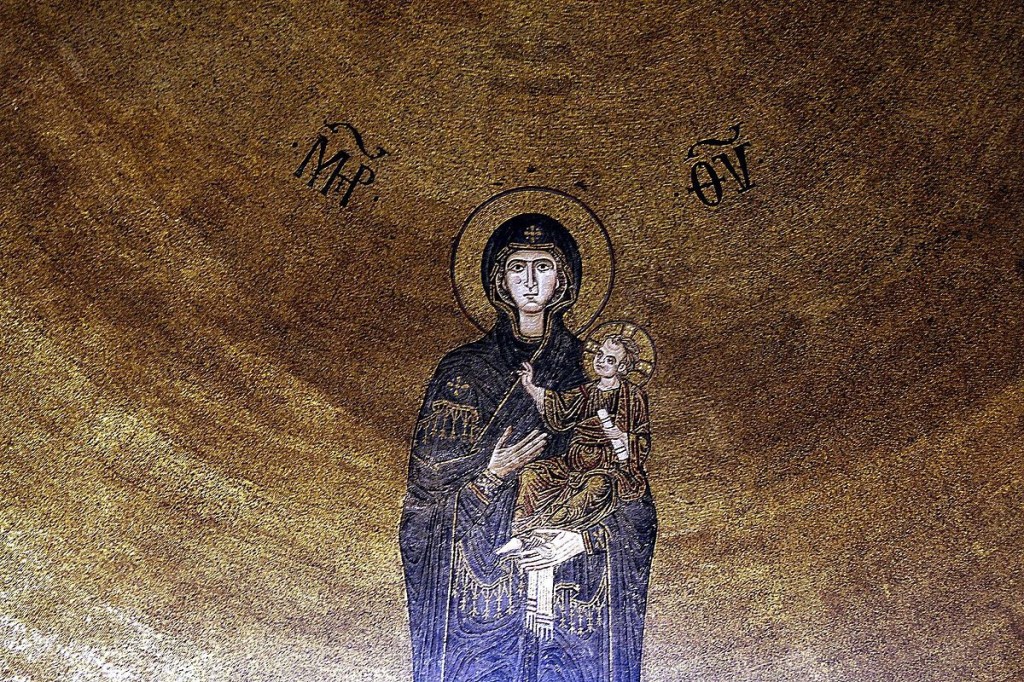
The Greek for Lord, kurios, can also mean as little as Sir, but has special significance as applied to Jesus:

1. In relation to the disciples of a Rabbi it means Master, that is, a teacher with complete authority, as over slaves.

2. Because it was used in the Greek translation of the Hebrew Bible to translate Adonai, which was the pious substitute for the unspeakable name of God, it carried theological implications about Jesus, uniting him with God.

In relation to 1, I have asked if the master/ slave relation is appropriate to Jesus and his followers, then and now. Jesus seems to have had no problems with that relationship, using it as a metaphor for the obedience owed to God. Slaves abound in the parables of Jesus, being diligent, lazy, trustworthy or otherwise, and their duty to their master is never questioned. Of course you can argue that he was talking about God, and that his attitude to the societal institution may have been different. My guess is that he saw it as fact, limited by biblical law, which in his estimation may have included the Jubilee legislation of Leviticus 25 providing for the freeing of slaves every 50th year. Radical as that was, it still left a lot of room for slavery. Jesus’ disciples however were free men and women, who nevertheless passed on the very teachings which demanded complete obedience and used the language of master and slave. Since that would normally have been unacceptable to them, I have to reckon that his relationship with them made it not only acceptable but necessary: they wanted to call him Master. The term carries the weight of something strange and primal from the experience of Jesus’ first disciples.

2. That experience was then interpreted by the use of kurios as signifying God. Although no formal identification of Jesus with God need have been intended at first, this language included Jesus in the sphere of God, as our Lord, and therefore as the referent of that language in Scripture. It was OK for Jesus to have bossed people around since he was standing in for God.

I can see how this title was creative in the early church’s thinking about Jesus, but do I accept it for myself, that Jesus demands my absolute obedience? In any other relationship I would reject such a demand, but in this, since the devotion of my heart has made him God for me, it can seem logical and right.

Then I remember that I do not believe in a God of absolute command, but in one who persuades. I also think that absolute power is the essence of evil, no matter who exercises it. But the master/slave material in the Gospels is so pervasive and deeply rooted in the traditions about Jesus, that it cannot be simply dismissed as spurious. I have not solved this dilemma, although I consider that a solution may lie in seeing this metaphor as part of the Jewish wisdom tradition to which Jesus belonged. Perhaps the apparently absolute commands should be interpreted as being preceded by “The wise person will…..” “The wise person will love her enemies; the wise person will bless those who curse her.” That would allow me to see the commands as a form of persuasion and the master/slave language as a metaphor for the urgency of Jesus’ persuasion.

This is not an unimportant issue. Everything I detest about religion hangs on the issue of absolute authority demanding complete obedience: suicidal jihadism, hatred of homosexuals, superiority of males, child abuse by clergy, denial of scientific fact, obedience as opposed to virtue- all these are the fruit of absolute authority. So serious is this issue that I must question my own desire to offer Jesus unconditional obedience as a sick piece of piety, relieving me of responsibility for my own actions, while allowing me a sneaky share in the omnipotence of Jesus.

Jesus is not my Lord; he is my teacher, my brother, my rescuer.

There is every evidence in Scripture for the Greek Ho Christos (The anointed one) as a standard accompaniment of Jesus’ name as early as Paul’s letters, in which it might also be translated, The Messiah, referring to the ruler expected from God to restore Israel. In spite of Jesus’ rejection by Jewish leaders, most early Christians wanted to maintain the link with Jewish history, expectation and scripture.

For the bulk of Christian believers today however, Christ is only Jesus’ second name, so that translating the Greek as THE Christ might be helpful in guiding people towards a fuller understanding of it. That still leaves the question of whether I think of Jesus as the Jewish Messiah. Certainly I think of him as Jewish, and want some reference to his Jewishness in the Creed. Does it make any sense to call him Messiah when so many Jews in his time and now, reject him as such? This takes me into Jewish politics of both times, reminding me that Jesus was executed as a messianic claimant by the Romans, even while he was rejected as such by the leaders of his own people. To think if him, as Paul did, as “a crucified messiah” assists my understanding of faith and politics, as his story furnishes a critique of both empire and nationalism, of oppressive government and violent revolution.

I am happy to affirm Jesus as the Christ, less so to call him God’s “only son.” The Lord’s Prayer” in Matthew’s version calls God, “our father” as does Paul, who is explicit in the claim that believers are children of God. How then can Jesus be the only son? Of course theologians may argue that we are only God’s children IN the only son Jesus. That simply pushes the issue on to another stage: OK in Jesus are we or are we not genuine sons and daughters of God? If yes, then we have to find a better term to use of Jesus. I think it would be better to use the biblical term “beloved”, marking the specific relationship between Jesus and God, into which believers are subsequently called.

Does this change not reduce Jesus to simply one of us? Of course I want to insist that he was one of us, but also that his greatness was in what he did and suffered as a human being. His being “God” is not some additional quality or nature in Jesus, but in his being the one who commands the “devotion of my heart” (Luther) along with the father and the spirit, as the one God. The naming is done by me and all believers.

CREATOR OF HEAVEN AND EARTH

Yes, yes, I believe in God the creator of elephants, hyenas, viruses, bacteria, supernova, whirlpools, mushrooms, birch trees, Joseph Stalin, Jesus, Mount Everest, cyanide, bread, sex, lesbians, Mars, cancer, Boris Johnson, blue-green algae, hippopotamuses, icebergs, methane……..

I do not believe that God has finished the job, but is rather continuing until, as Paul puts it, “creation itself is set free from its slavery to decay”

I believe, as did Alfred North Whitehead, that in the process of creation God is intensely involved with every event, and is therefore changed by each and every one of them. No creator, no painter, sculptor, or composer is left unchanged by her creation; no more is God. The Creed is wisely agnostic on this matter, although much Greek thought was unable to imagine any change in God. It was for this reason that Aristotle named him the unmoved mover.

The biblical God in both testaments, however, is moved and must therefore be subject to change. I think that for many believers this conclusion, that God changes, will be very disturbing. How can you have faith in someone who is changing? But in fact we put faith all the time in some of our fellow human beings, who are of course, changing. We trust that their affection for us will not change although other aspects of themselves may change. If we can do it with changing people, why not with a changing God? As we change, we invite God to change in relation to us.

In this process of mutual change God persuades us to help in the perfecting of creation. Indeed, all the elements of the universe are involved in this same process by which everything is continually changed. The fact that we could destroy our species and even our planet is a measure of the freedom God has given us and of the commitment of God to persuasion rather than force. We may be the only creatures in the universe who can refuse the creator’s persuasion.

Where is God? Everywhere. The creation is in God, and God in it. In God we live and move and have our being; but God may also lodge in us, if we let him. God asks our permission before entering our lives: we shall attend to this when considering belief in the Spirit. Does that mean that God simply takes up residence in other living creatures? No, God in her courtesy always asks permission, but it may be that in the case of the other creatures she always gets it. And God is also present in every event right down to the smallest particles and their activity. Nothing is untouched or unaffected by God’s love.

In respect of creation, God is the alpha and the omega, the “author and finisher” as the writer to Hebrews says. This means that in addition to God’s abiding presence with the universe, she has blessed it with initial purpose and with the lure of an achieved perfection. It has often been said that the event of Jesus is God’s new creation, but I cannot see that God has ever stopped creating; the story of Jesus is an episode in God’s continuing creation.

To live in this faith is exhilarating.

THE FATHER ALMIGHTY

I recognise and agree with much that women believers have written about the patriarchal culture from which the notion of the male God arises, both about its insistence on male authority and its denigration of female ability. I am not denying that criticism when I point out that at least in the New Testament God is primarily understood as the father of JESUS. That is for example as the father of the one who had women disciples, defended women from easy divorce, welcomed the trust of prostitutes, resisted the law of stoning, and allowed himself to be rebuked by a gentile woman whose children he had insulted as dogs. Clearly the One Jesus called Abba was no purveyor of patriarchy. When Jesus refers to himself as a mother hen, he attributes motherliness also to his father.

I want to hold on to the image of God as the Abba of Jesus, while also welcoming womanly, as well as non-binary and asexual images, as long as they are compatible with God’s identity as the Abba of Jesus. There needs to be some criterion of appropriate imagery. The Bible ends with a womanly image of God as a mother who wipes away the tears from the eyes of her human children. God is said to have the strength of hills, and on the other hand to pant like a woman in labour. Human experience of God will generate many creative images which enrich the primary image of God as the Abba of Jesus.

There would be of course a problem in referring to God as the mother of Jesus, because the human Mary has this dignity, but that should not stop me praying to God as my (heavenly) mother and the mother of all living creatures. It is probably impossible to remove all taint of patriarchy from the Apostle’s Creed. If we did we would lose contact with the historical Christian communities of women and men who devised it.

“Almighty” is a problem of a different kind. It is a translation of Greek: pantokrator, Latin: omnipotent. These terms are drawn from the cult of ancient rulers, who were thought to have Godlike powers over their people, and in many cases over huge empires. The official propaganda of such rulers admitted no limit, natural or human, on their power of life and death over their subjects. It is not clear whether God language was first transferred to such rulers or vice versa, but it is clear that with significant modifications it was used by biblical writers of YAHWE, the God of Israel, and of the Abba of Jesus. Although the Old Testament uses power language of Yahwe, its stories often undermine those phrases. The book of Genesis for example plays sophisticated games with readers’ expectations, showing the creator as powerless in the face of the human creature’s evil, and having to befriend just one human family in order to persuade them of his wisdom. And most scandalously Yahwe does not intervene to save his chosen family from conquering empires. This God is no more almighty than the Abba of Jesus who does not prevent the execution of his son.

The Almighty God is of course also supreme in the heavens, “above all Gods” which relegates the Gods of other religions to a lower division. This is probably not a good start to interfaith discussion or multi- cultural community building.

I am strait -forwardly opposed to calling God “almighty”. Alfred North Whitehead, the 20th century philosopher, said that the discovery of God as persuasive rather than coercive, made in theory by Plato and in practice by Jesus, is the most important in the history of thought. I am aware that departing from “almighty” is just as problematic as departing from “father” would be, and just as divergent from those who created the Creed, but in this case I accept the problems and the divergence, because I simply do not believe in “the Almighty”

Book of Common Prayer, 1662[

I believe in God the Father Almighty,
Maker of heaven and earth:

And in Jesus Christ his only Son our Lord,
Who was conceived by the Holy Spirit
Born of the Virgin Mary,
Suffered under Pontius Pilate,
Was crucified, dead, and buried:
He descended into hell;
The third day he rose again from the dead;
He ascended into heaven,
And sits on the right hand of God the Father Almighty;
From thence he shall come to judge the quick and the dead.

I believe in the Holy Spirit;
The holy Catholick Church;
The Communion of Saints;
The Forgiveness of sins;
The Resurrection of the body,
And the Life everlasting.
Amen.

This is the 1662 translation of the Apostles’ Creed, the first written version of which comes from the 7th century, but was probably developed in 5th century Gaul. It is a revision of the Old Roman Creed, which may have arisen as far back as the 2nd century. It has nothing to do with the 12 Apostles of Jesus, except that the church held that it expressed their teaching. It is not a proclamation of the Gospel, but rather a summary of the church’s faith in God. It neither declares salvation nor expresses individual faith.

Still it does assume that truths about God can be stated; and that these are affirmed by all believers. I once affirmed them as the truths underlying my trust in God. How much of this stuff do I still believe?

I BELIEVE IN GOD

I notice that the creed assumes I know what is meant by “God”. Certainly it comes from a time when atheists were thin on the ground. I have to accept that a definition of God can only come from the whole creed, but it’s reasonable to think that here the word refers to one who is not human, but immortal, invisible, the only wise one. When I was a child and teenager, growing up in a Presbyterian church and household, I accepted that sort of concept of God without much difficulty. God was external to the universe, but powerful within it, guiding its existence providentially.

During my lifetime, within my culture, this concept of God has been challenged by all the sciences, including some theology, so that only about a third of people in Scotland any longer affirm such a belief. Young people especially think of it as an outdated fairy tale. My own experience of life, moreover, including the early death of my daughter, has encouraged me to look critically at any faith that presupposes God as a simple datum. This personal questioning is only a small reflection of the much more profound question asked by the generation before mine: how can there be faith in God after Auschwitz? Surely any God worth the name would have stopped it? This really leads to the next phrase of the creed, but I should admit here that a) I do not think that God is a simple given; and b) I do not believe in God’s supernatural providence in the universe.

But on the other hand, there is Luther’s demystifying statement, “It is the care and trust of the heart that make both God and idol.” At one stroke this makes God into a human construct which either equates to reality or not. This is similar to Bob Dylan’s great song, “ You gonna have to serve somebody:

You may be an ambassador to England or France
You may like to gamble, you might like to dance
You may be the heavyweight champion of the world
You may be a socialite with a long string of pearlsBut you’re gonna have to serve somebody, yes
Indeed you’re gonna have to serve somebody
Well, it may be the devil or it may be the Lord
But you’re gonna have to serve somebody

Dylan makes this universal, a fundamental condition and choice: what God do we make and serve?

This understanding gives me back God as one created truthfully or deceitfully by human beings. I’ll continue to explore this insight.

Here’s a great Scottish ballad which came into my head today.

For the benefit of readers: corbies are crows; tane means one of them; fail is turf; wot means know; swate is sweet; hause-bane is neck bone; theek means thatch;

As I was walking all alane,
I heard twa corbies makin a mane;
The tane unto the ither say,
“Whar sall we gang and dine the day?


In ahint yon auld fail dyke
I wot there lies a new slain knight;
And nane do ken that he lies there,
But his hawk, his hound an his lady fair.”


His hound is tae the huntin gane,
His hawk tae fetch the wild-fowl hame,
His lady’s tain anither mate,
So we may mak oor dinner swate.”

Ye’ll sit on his white hause-bane,
And I’ll pike oot his bonny blue een;
Wi ae lock o his gowden hair
We’ll theek oor nest whan it grows bare.”

Mony a one for him makes mane,
But nane sall ken whar he is gane;
Oer his white banes, whan they are bare,
The wind sall blaw for evermair.”

For sheer unmitigated focus on one aspect of the human condition, this takes some beating. The corpse has been a knight, that is, a person of status in late medieval society. He has been a nobleman not a peasant; he has possessed a house and a household with the ordinary marks of wealth- a hawk and hound for hunting and fair lady for a wife or paramour. His feudal superior, Lord or King has called for his service in battle. He would have considered himself a person of substance, and most people would have shared his opinion.

Now he has been killed, his corpse is concealed and fresh. The stanza about him being forgotten by his animals and wife is not realistic. They have not already moved on, but they will. Their neglect has been brought forward to make it the more shocking. The corpse can therefore be despoiled by the crows – and other creatures -until it becomes a skeleton that whistles in the wind.

Has there been any significance in the life of this creature? Only that it has eventually been useful to a couple of crows. Of course, you can say he meant something to his parents, his friends, his wife, but the ballad tells us, not all that much. As Hamlet asks, “What to me is this quintessence of dust?”

We want to protest against this verdict: what about Buddha, Confucius, Jesus and Muhammad? Think of the golden hair in the crows’ nest.

What about Alexander, Caesar,Genghis Khan, Napoleon. Think of the bonny blue een.

What about Shakespeare, Tolstoy, Beethoven and Einstein? Think of the white banes.

Sir Walter Raleigh, yes him of the cloak placed on the puddle, wrote on this topic:

O ELOQUENT, just, and mighty Death! whom none could advise, thou hast persuaded; what none hath dared, thou hast done; and whom all the world hath flattered, thou only hast cast out of the world and despised; thou hast drawn together all the far-stretched greatness, all the pride, cruelty, and ambition of man, and covered it all over with these two narrow words, Hic jacet! (Here lies..)

I don’t have some profound conclusion, I just say, in the face of this fact, let’s stay humble. We’re not that important, except maybe to God.

Living on the northern edge of the Tay estuary gives me the delight of hearing and seeing huge numbers of migrating pink-footed geese arriving from Iceland or Svalbard making for Loch Leven or the Montrose Basin, both of which house thousands of wintering birds. Many skeins may journey at the same time, filling the sky with wings and the ear with honking. As a demonstration of the power and wisdom of animals it is unequalled in my experience.

The birds are large, elegant and in my experience, not very frightened by human beings. They can be closely observed in the stubble fields near the water, where they feed. They do not attack human beings, but if they did, they would be formidable. To be below them or amongst them is to be part of a living wildness which is strange but not completely foreign, arousing deeply buried knowledge of journeying.

Investigation has shown that these birds are formidably well-equipped for detecting the earth’s magnetic field: paired particles of pigment in their brain are activated by magnetic fields so that the birds may almost see them. Their beaks are sensitive to smells which allow them to recognise particular locations. Images of the night sky may be imprinted on it soon after birth. All these tools are used in the annual migration of several thousand miles.

In addition, no goose has ever made its first migration on its own but only in company with its parents as part of a flock to which they all belong. Doubtless information about the journey is memorised by each bird when young and developed by subsequent experience. Possibly the earth below the flight may be like a movie which can be stopped and restarted, but which always has the same ending.

They remind me that I too am equipped to orient myself on the earth, and to journey. I have abilities developed by evolution to understand the landscape through which I move. Moreover I have learned from my parents and other adults how to navigate well-known landscapes, by using established paths, roads and motorways, with the help of maps which preserve the knowledge of my forebears and contemporaries. All this perhaps explains my delight in walking, running, climbing and map-reading.

And yes, of course, I am on a journey from birth to death, on which the true way has been mapped out for me by the great pilgrims of the past, the masters of the way, whose wisdom does not diminish but rather enhances my own ability to walk the way, making my own discoveries. I’ve been travelling for almost eighty years, but this autumn still, hearing and seeing these winged travellers, I feel again something of our purpose, adventure and mystery.

The above phrase was the motto of an editor of the then Manchester Guardian, which has at least attempted to honour it throughout its history until now. But is it entirely clear that facts can be separated from opinion or interpretation?

An astronomer is looking at images from a powerful telescope of a pair of linked stars in the Milky Way galaxy. One star appears to be drawing material from the other, creating a special form of light, where the stars are joined. The astronomer notices that an area of this light vanishes from view, only to re-appear more than an hour later. The astronomer explains this as the occlusion of the light by a body moving in front of it, in fact by a large planet, possibly the size of Jupiter. After many more observations of this phenomenon, and examinations of the data by others the event is reported as the discovery of a new exoplanet, which is probably not earth-like.

Now where are the facts in this process? The astronomer is looking at images on a screen. Are they facts? Yes, but they are facts about a screen. Ah, but they are caused by light waves which have travelled light years through space. So we have facts about light waves. Ah but we know that they come from a source, which can be located in space-time. But we only “know” that because we accept an interpretation of the data we receive from space-time, an interpretation which has developed over two thousand years, and may continue to develop in ways that alter how we the think of the data we are dealing with now. It may therefore be important, while not denying the fact of this exoplanet, to keep the primary data, the images on the screen, so that a future astronomer may re-interpret them in the light of greater knowledge, to establish a different fact.

The above is enough I think to show that fact and interpretation are not simple to disentangle. Facts are not only primary data but may be constructed from such data by interpretation. Because any data at all must be received by the human mind, we know of no facts which are untouched by humanity. We are immersed in a constantly changing field of events, by which we ourselves are changed. Noticing and interpreting these changes is our special ability as a species.

We honour facts when we do not force the basic events of our experience into some predetermined story, either scientific, social or political, but resist prejudice, testing our construction of facts always against the grain of reality and the experience of others. This not easy, and requires discipline. For example, we should learn not to privilege certain sorts of events more than others. We should establish a democracy of basic events, so that events involving say, animals, are just as important as those involving human beings or planets. Jesus knew this: “not a sparrow falls to earth without your father in heaven.” He suggests that God is not prejudiced, relates to all creatures and loves all.

For Christian believers a disciplined attention to data, and a careful construction of facts is part of our imitation of God.

The philosopher Wittgenstein asserted that “the world is everything that is the case. It is constituted by facts, by all the facts.” One of the difficulties in understanding the COP 26 process, is distinguishing between facts and interpretations of facts: global warming is a fact; while global warming due to human activities is as yet an interpretation of facts. It is by far the most convincing interpretation of the facts, and therefore a reasonable basis on which to make decisions, but in the face of ideologically motivated denials of global warming it is important to insist that the increase in global temperatures is factual and cannot be denied by anyone except an idiot, whereas the view that this increase is caused by human activity is only an overwhelmingly probable interpretation which could be sensibly denied by someone with a more probable interpretation.

The facts are of primary importance and we protect them by not confusing them with interpretations no matter how probable these may seem.

“Richer nations will give £xbillion to help poorer nations manage the effects of climate change.” This is not a fact but a persuasive interpretation of a decision taken by richer nations. In fact much of this transfer of funds will be in the form of loans.

“This conference is not about climate change: it is about business as usual and blah, blah, blah.” That also is not a fact, but an interpretation persuasive to some, of what COP 26 is doing. There is no reason why Greta Thunberg should limit herself to facts, except that in opposing the ideologies of powerful people, a scrupulous use of facts may be her most effective weapon. For example, it is a fact that younger people will bear more of the consequences of global warming than older people. Her repeated announcement of this fact has rightly gained her the support of many young people.

This may seem an odd way to think about COP26, but as with the Covid pandemic, facts as discovered by sciences, should be carefully distinguished from all responses to the facts, even if some of these responses are made by scientists. This purist understanding of facts is helpful not just in refuting the wild assertions of malevolent or crazed ideologues, but also in using the precious facts for the welfare of human survival on this planet. We have got into this mess by giving too much credence to powerfully communicated opinions, such as those of the petrochemical industry, and too little to the disturbing facts of climate change.

In a world of largely uncontrolled mass media, facts are ever more vital, as being the only evidence that we are dealing with reality, rather than our own or someone else’s fantasy. There are at least two issues about facts that ought to be acknowledged:

1. Wittgenstein spoke of ALL the facts. Some scientists have imagined that only their disciplines deal with facts, while others like, say, art or religion deal solely with meanings and interpretations. This arrogance should not be accepted. All rigorous forms of human study may discover and use facts. The facts of beauty or prayer are as relevant to human survival as those of physics.

2. Facts require interpretation, without which they remain isolated atoms of knowledge. If we are severe about what counts as fact, we should be indulgent about what counts as interpretation of them. A scientific prediction on the one hand and a dystopian novel on the other may be equally valuable interpretations of climate change fact.

In a culture that respects facts, there will be a continuing role for faith communities, but only IF they are honest about the facts of their own faith. All faith communities have asserted as fact things that are beliefs. Indeed, people have been expelled or even killed as heretics for challenging some of these. This has to stop. No holy book was ever dictated or even verbally inspired by God. To claim that it was, is to mistake belief for fact. I may say that the Bible is authoritative for all Christian believers because God speaks through it. But if I invent a story about God dictating the Pentateuch to Moses, I have turned my faith into a pseudo- fact. Christianity has become better at this, but Islam, for example, will not permit any historical investigation of its origins.

I have been assuming so far that we are able to tell what constitutes a fact in any discipline. This is not an easy matter. Even chemists, physicist and biologists will admit that their disciplines have made new discoveries which reveal that what was taken as fact was not. How can the facts change? My next blog will deal with this issue in some detail.

Confucius uses a word junzi to designate the great, or noble, or superior person as opposed to the small, ignoble and inferior person. I prefer to translate this as the “large-minded person” as opposed to the small-minded.

Here are some of his sayings:

The large-minded person knows what is right; the small-minded knows what is profitable.

This is sharp enough even today to distinguish amongst delegations at the COP26 conference. Yes, there are some who know what is right, but there are many who look to what is profitable, and hope to make a profit out of either the failure of climate control or its success, but have no interest in what is right. Confucius is unsparing in his criticism of such people.

Jesus told unforgettable stories about lovers of profit, like the rich farmer whose expansion plans are summarily cut short by his death; or the rich man who imagines that even in hell the poor man can be used as a slave to bring him water. Such people are called foolish in traditional Jewish language, whereas the large-minded are called wise. “There was a wise man who built his house upon rock..” This is a person who puts Jesus’ teaching into practice rather than just thinking about it.

Confucius has a similar distinction: “in the case of the large-minded person, her words follow her actions.” Had that principle been followed at COP26 there wouldn’t have been much said. He added that the large-minded person is “slow to speak but quick to act.” His ideal is not a person who never speaks but one whose thoughts, words and actions are integrated.

Jesus also touched on the same distinction: “Not those who say,’Lord, Lord, but those who do the will of my father in heaven.” Modern biblical scholars have noted that Jesus stands in the Jewish Wisdom Tradition, which includes Psalms, Proverbs, Ecclesiastes, Job, Song of Songs, and is a major element in Judaism. Wisdom has a divine origin but reflects the nitty- gritty of human living. The large-mindedness praised by Confucius is similarly practical and profound. Appreciation of disturbing facts is part of wisdom and large-mindedness, such as those provided by the earth scientists for the benefit of politicians.

A deeper understanding of the large-minded person is contained in the saying: “The large-minded person is not a vessel.” Confucius means not a man or woman to be filled with facts, opinions, ideologies, or even by wise teachings, but a true and creative identity who says and does new things. Confucius is himself like this. Although he is comprehensively aware of the traditions of his people, he is his own man, his own mind, soul and spirit, offering his characteristic insights for the benefit of his people.

Jesus too was expert in the Law , the Prophets and the Writings of his people, but he is described as “having authority and not as the scribes,” and most beautifully compares himself to a “spring of living water bubbling up into everlasting life.” He is the spring, not the vessel.

We should make sure that the authority and freshness of our large-minded spiritual teachers can be brought to bear upon the issues of global warming.