
I am just coming to the end of a part-time ministry in two linked congregations in the Angus countryside near Dundee. Over the five or six years of this association I have learned a great deal about rural life and its institutions, and about farms and farmers. Having spent all of my previous working life in cities, I had a great ignorance and considerable prejudices about the countryside, both of which have been reduced by my recent experience. When I add that the countryside in question is the lovely green strath on the southern side of the Sidlaw hills, readers will understand when I state that I feel blessed to have been given this opportunity, in my relatively advanced years.
The true blessing has been the new friendships made and sustained. Because rural living often puts people at a greater distance from each other than urban living does, many rural dwellers put a great value on the friendships which prevent loneliness and build up community. Hospitality which fosters friendship is still recognised as a virtue in such communities. Readiness to share food, conversation, concerns and individual experience enables friendship, and although in many cases for me these friendships remained tentative rather than fully established, they involved a genuine sharing of goodwill. To know that another person with a different experience of life, likes you and values your liking of them, enhances your life and your ability to live well. Some of the pleasures of friendship – the times of mutual discovery, the fact of mutual trust, for example – are similar to those of being in love, but without the dynamics of sexual passion. There is an easiness about friendship which we do not find in sexual love. Many couples say however that in a long relationship, friendship between them has developed alongside sexual love and become as important.
Some of the friendships I have made will survive the end of my ministry, but many will not, which is why it can seem like an event of mulitiple bereavement, with losses which seriously diminish the wealth of my daily experience. I do not find this topic much addressed in the literature about retirement or changing jobs. Perhaps most people assume that friendships established through work will survive outside it. If so I consider they will be wrong as least as often as they are right. Nor is friendship itself a great topic of discussion in say, the popular press, unlike sex, while the endlessly discussed so-called friendships on Facebook are nothing of the sort.

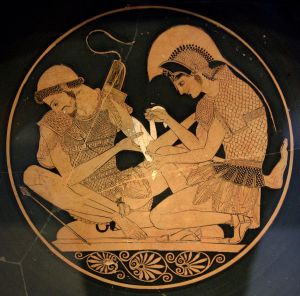
Are there great works of art about friendship? Ancient literature abounds with friendships between warriors, Achilles and Patroclus, David and Jonathan, Roland and Oliver. Shakespeare of course recognised it in Hamlet and Horatio, Brutus and Cassius, although these are not the main matter of the plays in which they appear. Boswell’s biography of Dr. Johnson is at one level a celebration of his hero’s friendships. Mark Twain beautifully delineates friendship between Huck and Jim. Sherlock and Watson are friends. Friendships abound in great modern masterpieces by Proust and Joyce, but in none are they the ruling subject. Perhaps the only great work of art in which a friendship is the true subject is Tennyson’s In Memoriam, where the friend has died. The poem eventually establishes the experience of friendship as constitutive of the poet’s intellectual, emotional and spiritual identity. Faced with his friend’s death and the absence of any coherent comfort, the poet says, “The heart stood up and answered, ‘I have felt.'” The experience of friendship allows Tennyson to hold to the worth of human existence even when everything else seems to reduce it to insignificance.
Perhaps in theology this sustaining human relationship has been underused as a model for understanding God. Set against the absolute use of the word love, friendship may look more ordinary. In Paul’s classic summary of the experience of God, “the GRACE of the Lord Jesus Christ, the LOVE of God and the FELLOWSHIP of the Holy Spirit” maybe we should look again at the last component, in Greek KOINONIA, often used of commercial collaboration, meaning shared enterprise,
shared life. We might define it as friendship within a common project, which for Paul means the down-to-earth shared friendship amongst members of the believing communities enabled by the shared friendship of God, extended to the newcomer and the stranger, and even to the persecutor. In this way we could give friendship its true place in the story of God: acknowledging the creative and sustaining parental love, marvelling at the passionate longing of the divine lover, we can enjoy the companionship of the divine friend, who shares our journey, and gives us other dear companions on the way. Maybe after all, the Bible is the great work of art about friendship.
 Yesterday in every university of the earth, some scholars found happiness in handling the material of their discipline, rather than worrying about research ratings.





 My alien pal Marty is normally a stand -out, what with his green skin, lizard-like hands and chinless head, but suitably dressed he merges seamlessly into any gathering of the European aristocracy, of which there were many representatives at the Passchendaele remembrance ceremony earlier this week. I had urged him not to go, but he was anxious to understand one of the great tragedies of earthling history, which he had come here to study.
 Tell me things I don’t know, baby,” he said in that irritating Martian drawl. “All you’re saying is that they belonged to a stupid society. A society too stupid to have a press that thinks and writes independently; too cowed to oppose the crime of conscription; too conventional to have churches that might stand up for the views of Jesus. No, it’s true the young men were failed by their culture and their religion, but still, they knew what they were being asked to do: to go and kill other young men who were in the same position as themselves. By the time of Passchendaele, many of them had heard some facts from older men about the nature of the conflict, yet still they went like lambs to the slaughter, because they hadn’t learned to think for themselves or to organise together against the establishment. I am not saying these men were thick and unable to think, but that they were stupid because they did not use the brains they had. Those who have youth and strength and vitality and courage will always be used by older people who lack these qualities but possess cunning, unless they have a humane ethos and learn to question any departure from it.”
 xtremejesus